What is the procedure for turning?
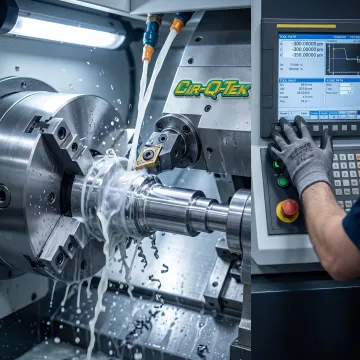
Turning begins by securing a workpiece in a lathe or CNC turning center and rotating it at a controlled speed. A cutting tool then moves along or across the spinning material to remove stock and create the required diameter, profile, face, groove, thread, or taper. CNC programming controls each movement for repeatable dimensions, while inspection verifies critical features before shipment.
What is the difference between turning and lathe?
Turning is the machining process in which a rotating workpiece is cut to form cylindrical or rotational features. A lathe is the machine used to perform that process. Modern CNC lathes or turning centers automate tool movement, spindle speed, and part positioning. Many also include live tooling and multiple spindles, allowing turning and selected milling operations in one setup.
What operations can be done on a lathe?
A lathe can perform facing, straight turning, taper turning, profiling, boring, drilling, reaming, grooving, parting, knurling, and threading. CNC turning centers can add more capability through live tooling, including cross-drilling, slotting, and milling flats. The practical operation set depends on the machine configuration, workholding, material, part geometry, tooling access, and required tolerances.
What materials can Cir-Q-Tek CNC turn?
Cir-Q-Tek can machine almost any material used in custom-part manufacturing, including standard metals, high-strength and high-temperature alloys, engineered plastics, ceramics, composites, and other non-metals. The team also has finish-machining expertise for aluminum, zinc, magnesium, iron, and stainless steel castings. Material selection should be confirmed against the part’s functional, environmental, and tolerance requirements.
How accurate are your CNC turning services?
Cir-Q-Tek’s precision CNC machining capabilities can maintain tolerances as close as ±0.0005 inch, depending on material, geometry, feature accessibility, size, and inspection requirements. High-performance equipment, CAD/CAM programming, and high-end metrology support accurate, repeatable production. During quoting, the team reviews your drawing and critical dimensions to determine an achievable, cost-effective machining plan.
What do you need to quote custom turned parts?
For non-PCB and non-PCBA items, Cir-Q-Tek requests CAD and 3D data and/or fabrication drawings. Include material specifications, quantities, tolerances, surface finish requirements, thread or feature details, inspection needs, and requested delivery timing when available. Complete technical information helps the team evaluate machining methods, identify potential design considerations, and prepare an accurate quote for prototypes or production.
Can you support both prototypes and production runs?
Yes. Cir-Q-Tek supports custom CNC machining across prototype, low-volume, and production requirements. CAD design and CAM programming expertise help establish a repeatable process as a program progresses. For ongoing production, the company can stock approved parts and ship them through just-in-time delivery arrangements, helping customers reduce inventory burden while maintaining supply continuity.
How do you ensure turned parts meet quality requirements?
Parts are machined in facilities certified to ISO 9001, ISO 13485, and IATF 16949 standards, supporting quality requirements for general, medical, and automotive applications. Inspection is performed using high-end metrology equipment under strict supervision. Your drawing, tolerance callouts, material specifications, and any required inspection documentation guide the verification plan for each custom component.