Is CNC machining in high demand?
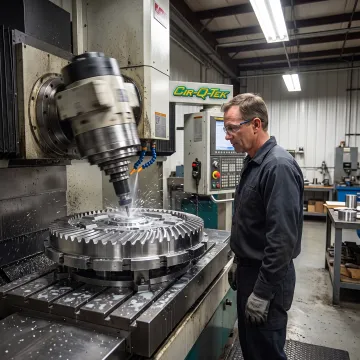
Yes. CNC machining remains in strong demand because manufacturers need accurate, repeatable components for industries such as medical devices, automotive, telecommunications, industrial controls, and electronics. It supports both rapid prototypes and scalable production without requiring dedicated tooling for every design change. Multi-axis capabilities are especially valuable when a part has complex geometry, tight tolerances, or multiple features that must align precisely.
What is 7 axis machining?
Seven-axis machining describes a CNC configuration that combines multiple machine movements to reach and machine complex features from more angles. The exact axis arrangement varies by machine builder and may combine milling, turning, spindle movement, and workholding motion. Its purpose is to reduce setups, improve access to intricate geometries, and produce more features in one operation. Capability should always be matched to the part design.
What tolerances can Cir-Q-Tek achieve?
Cir-Q-Tek can maintain machining tolerances as close as ±0.0005 inches, depending on the part geometry, material, dimensions, feature type, and inspection requirements. Tolerance feasibility should be reviewed during quoting because thin walls, deep features, surface finish needs, and material stability can affect results. CAD data, 3D models, and fabrication drawings help the engineering team evaluate the most suitable machining approach.
What materials can be CNC machined?
Cir-Q-Tek machines a broad range of materials, including standard metals, high-strength and high-temperature metals and alloys, engineered plastics, ceramics, composites, and other non-metals. The team also has finish-machining expertise for aluminum, zinc, magnesium, iron, and stainless steel castings. Material selection should consider the component’s strength, thermal, wear, weight, corrosion-resistance, and dimensional-stability requirements.
Can you support prototypes and production quantities?
Yes. Cir-Q-Tek supports parts in virtually any quantity, from early prototype requirements through ongoing production programs. Prototype work helps validate design intent, manufacturability, fit, and performance before a larger release. For production programs, the team can apply repeatable CAD/CAM processes, inspection controls, and parts-stocking or just-in-time shipping options to help support planned manufacturing schedules.
What information is needed for a machining quote?
For non-PCB and non-PCBA items, a complete machining quote requires CAD and 3D data and/or fabrication drawings. Useful details include material, required quantity, tolerances, surface finish, critical dimensions, threading or secondary operations, inspection needs, and requested delivery timing. Providing complete technical documentation enables a more accurate review of manufacturability, setup requirements, material sourcing, and production planning.
How does quality inspection work for machined parts?
Machined components are produced in ISO 9001, ISO 13485, and IATF 16949 certified facilities and inspected using high-end metrology equipment under strict supervision. Inspection requirements can be tailored to the program’s drawings and critical features. This quality-focused approach helps verify dimensional conformance, repeatability, and documentation expectations for commercial, medical, automotive, and other demanding applications.
Can Cir-Q-Tek provide just-in-time delivery for machined parts?
Yes. Cir-Q-Tek can stock parts and ship them on a just-in-time basis to help customers align deliveries with their production schedules. This option can reduce the need to hold all inventory at one location while supporting more predictable replenishment. Stocking and release plans are established around part demand, production quantities, packaging requirements, and the customer’s requested delivery cadence.