Standard CNC machining, the kind that handles brackets, housings, and structural parts just fine, starts to buckle under these demands. Many manufacturers struggle to find shops that can reliably hit micron-level accuracy without scrapping half the run.
This guide breaks down what micro CNC machining actually is, how the process works, which techniques and materials apply, and how to vet a manufacturing partner capable of this level of precision.
Key Takeaways
- Micro CNC machining targets features measured in microns, far tighter than conventional CNC tolerances
- Micro milling, micro turning, and micro EDM each solve different geometry and material challenges
- Medical, aerospace, electronics, and automotive parts often fail or pass on a single micron of precision
- Choose partners with certified quality systems and proven, repeatable tight-tolerance results
What Is Micro CNC Machining?
Micro CNC machining is a specialized subtractive process that produces parts or features measured in micrometers rather than millimeters. It requires purpose-built machinery, ultra-fine tooling, and process controls that a general-purpose machine shop simply doesn't stock.
A human hair runs roughly 70 to 100 microns thick, according to Machine Design's 2026 precision manufacturing comparison. Micro CNC machining routinely works with features that fall well below that thickness.
Standard CNC vs. Micro CNC Machining
Size is only the start. Equipment, tooling, and process controls all change:
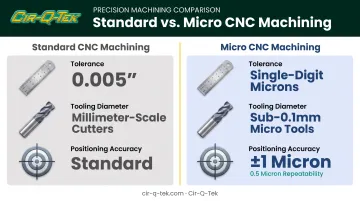
- Standard CNC machining: tolerances often hover around 0.005 inches (over 120 microns), per Machine Design's 2024 overview of CNC micromachining
- Micro CNC machining: pushes into single-digit-micron territory on finished parts, with some machine platforms holding positioning accuracy of ±1 micron and repeatability of 0.5 microns
- Tooling: standard shops use cutters measured in millimeters; micro shops run tools that can be smaller than 0.1mm in diameter
Machine Design frames the general engineering range for micromachining as 1 to 500 microns. That's a wide spectrum, which is exactly why buyers need to ask suppliers for specifics rather than assuming "micro machining" means one fixed tolerance.
Why does a single micron matter this much? At this scale, one miscut separates a working part from scrap:
- A watch gear that fails to mesh with its neighbors
- A medical stent that tears tissue instead of expanding cleanly
- An aerospace cooling channel where restricted airflow causes overheating
How Does Micro CNC Machining Work?
The workflow starts the same way conventional CNC does: CAM software translates a CAD design into G-code. From there, everything changes.
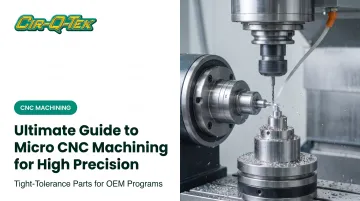
Micro CNC machines run cutting tools often under 0.1mm in diameter. G-code paths must account for tool deflection and heat buildup at a scale where even the machine's own thermal expansion can throw off a cut.
Workholding at Micro Scale
Clamping a part that weighs almost nothing without crushing or distorting it is genuinely difficult. Shops solve this with:
- Vacuum chucks that hold delicate workpieces without mechanical clamping pressure
- Precision vises engineered for micro-scale repeatability
- Custom fixtures designed around the specific geometry of fragile parts
Spindle Speed and Coolant Delivery
Micro tools require far higher rotational speeds than standard end mills to maintain proper cutting conditions. According to SME reporting on micro cutting tools, most applications run in the 30,000 to 60,000 RPM range. Some specialized tooling reaches 150,000 RPM, with diameters as small as 0.013mm.
At these speeds, flood coolant can actually damage delicate tools or wash fragile parts out of position. Through-tool and high-pressure coolant delivery systems are commonly used instead, clearing chips precisely at the cutting edge without disturbing the workpiece.
Key Micro Machining Techniques
Three core techniques cover most micro CNC applications, and each fits a different part geometry.
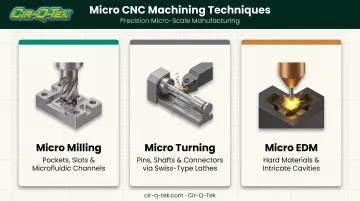
Micro Milling Uses tiny multi-point cutters to carve pockets, slots, and complex 3D contours. It's the go-to method for microfluidic channels and intricate housings where multiple features need to exist in a compact footprint.
Micro Turning Applies a single-point tool to rotating stock, producing precise cylindrical parts like pins, shafts, and connectors. Swiss-type lathes are frequently used here, some capable of turning, milling, and drilling a complete micro part from barstock in a single setup.
Micro EDM Uses controlled electrical discharges instead of mechanical cutting. That makes it ideal for hard materials and intricate cavities conventional cutting tools can't reach. Variants include sinker, wire, and fine-hole EDM for complex ceramics and small electronics work.
Materials and Industries Suited to Micro CNC Machining
Not every material behaves the same way at micron scale. Choosing the right one depends on the application's mechanical, chemical, and biological demands.
Materials Commonly Used
- Stainless steel, titanium, and aluminum: valued for strength, biocompatibility, or lightweight performance
- Copper and bronze alloys: chosen for electrical conductivity in connectors and sensor components
- Engineering plastics like PEEK: prized for chemical resistance and use as a metal alternative in medical and aerospace parts
- Ceramics and composites: suited to high-wear applications and specialty optical or semiconductor components
Cir-Q-Tek's precision CNC machining covers metals and engineered non-metals—including plastics, ceramics, and composites—with tolerances as close as ±0.0005".
Industries That Depend on Micro CNC Machining
| Industry | Typical Micro-Machined Components |
|---|---|
| Medical | Surgical instruments, implants, stents, diaphragms, pumps |
| Aerospace | Fuel nozzles, precision cooling channels |
| Electronics | Micro connectors, small electronics housings |
| Automotive | Fuel injector components, small-tolerance sensors |
| Telecom | Fiber optic connector bores |
| Watchmaking | Intricate watch movement gears and components |
Medical and automotive work carries particularly strict requirements. Both sectors expect suppliers to operate under ISO 13485 and IATF 16949, respectively, since a single out-of-spec part can mean a failed audit or a recalled product.
Benefits and Challenges of Micro CNC Machining
Micro CNC machining unlocks capability that standard machining simply cannot deliver, but it comes with real tradeoffs worth understanding before you commit to a supplier or a budget.
Key Benefits
- Precision that holds features and tolerances conventional tooling cannot reach
- Material versatility spans metals, engineered plastics, and composites without switching processes
- Repeatability at scale after process optimization, so production runs stay viable—not just one-off prototypes
Common Challenges
Micro tools are fragile by nature. A cutting condition that would just make a standard tool "growl" can snap a microtool outright. This means:
- Frequent tool replacement, plus adaptive strategies planned around expected wear
- Vibration sensitivity that turns micro-vibrations into dimensional error on millimeter-scale parts (low-runout tooling and heat-shrink clamping help)
- Higher cost than conventional CNC from specialized equipment, tooling, training, and sometimes cleanroom needs
That last point deserves a straight answer: yes, micro CNC machining generally costs more than standard machining. Machine Design's 2024 analysis notes that the specialized equipment and training required can make outsourcing to an experienced partner more economical than building in-house capability from scratch, particularly for shops that won't use the equipment at full capacity. OEMs that need those tolerances without owning the equipment often use contract manufacturers such as Cir-Q-Tek, which machines precision components to ±0.0005″ under ISO-certified processes.
Choosing the Right Micro CNC Machining Partner
Not every shop that advertises "precision CNC" can actually hold micron-level tolerances. Here's what to verify before committing a project.
Equipment and Process Controls
Ask specifically about high-speed spindles, ultra-fine tooling inventory, and vibration or thermal control systems built for micro-scale work. A shop running standard-duty equipment at reduced feed rates isn't the same as one purpose-built for this scale.
Tolerance Claims and Verification
Any supplier can claim tight tolerances. What matters is how they prove it. Ask what tolerances they can repeatably deliver, not just their single best result, and how they verify those numbers:
- CMM: measures complex geometries with high dimensional accuracy
- Optical comparators: project the part against a drawing to check lengths, angles, and radii
- Vision systems: use edge detection and autofocus for delicate features without contact
Material and Certification Experience
Machining behavior for titanium differs significantly from stainless steel or engineering plastic at micro scale. Confirm your supplier has hands-on experience with your specific material, not just a general capability list.
Certifications matter too, especially:
- ISO 9001 for baseline quality management
- ISO 13485 for medical device manufacturing
- IATF 16949 for automotive supply chain compliance
One example of a partner that meets these criteria is Cir-Q-Tek. It holds all three certifications: ISO 9001:2015 (through July 2027), ISO 13485, and IATF 16949.
Its precision CNC service uses multi-axis, multi-tasking machinery with live tooling and multiple spindles to hold tolerances as close as ±0.0005 inches. CAD/CAM programming supports accuracy and repeatability across production runs, not just prototypes.
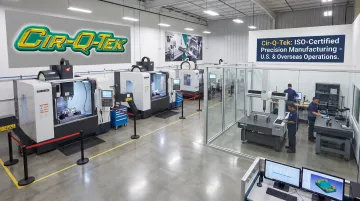
Cir-Q-Tek's Bristol, Pennsylvania headquarters coordinates with its Shenzhen, China office, where bilingual staff manage specs and quality standards between customer and factory. Parts are inspected with high-end metrology under ISO-certified supervision, then checked again in Pennsylvania before shipment—offshore pricing with domestic quality oversight.
If your project needs tight-tolerance CNC work alongside broader manufacturing support, request a quote with your CAD files and fabrication drawings to get a specification-matched consultation.
Frequently Asked Questions
What is CNC micro machining?
CNC micro machining is a specialized CNC process that produces parts and features measured in microns rather than millimeters. It uses ultra-fine tooling and high-speed spindles to hold tolerances far tighter than standard machining.
How does micro CNC machining differ from standard CNC machining?
Standard CNC tolerances typically hover around 0.005 inches, while micro CNC pushes into single-digit-micron territory on finished parts. Micro machining also uses tools smaller than 0.1mm and spindle speeds often between 30,000 and 60,000 RPM.
What tolerances can micro CNC machining achieve?
Tolerances vary by process, material, and equipment. Finished parts can reach single-digit microns, with machine positioning accuracy as tight as ±1 micron. Always confirm whether a quoted figure is machine capability or verified part output.
What materials are best suited for micro CNC machining?
Stainless steel, titanium, and aluminum cover strength and biocompatibility needs, while copper and bronze suit electrical applications. PEEK, ceramics, and composites handle chemical resistance and high-wear uses.
Which industries use micro CNC machining the most?
Medical, aerospace, electronics, and automotive lead adoption for implants, fuel nozzles, connectors, and precision sensors. In these parts, a few microns of deviation can cause functional failure.
Is micro CNC machining more expensive than conventional CNC machining?
Yes. Specialized tooling, equipment, and training cost more than standard CNC work. The premium is usually worth it when the part only works if precision and miniaturization hold.