Not every CNC shop delivers the same results, though. Many manufacturers struggle to find a partner whose tolerance capability, material range, and production volume actually match their project, and the gap between shops can be significant. One supplier might hold ±0.005 in. on a good day; another can consistently hit ±0.0005 in. on complex geometries.
This article covers what CNC machining is, the core capabilities separating capable shops from exceptional ones, the machine types involved, where CNC shows up across industries, its practical limitations, and how to choose a manufacturing partner that actually fits your specs.
Key Takeaways
- CNC machining removes material with computer-guided tools, preserving the base material's full mechanical strength
- Plan around ISO 2768 general tolerances; specialized shops can hold down to ±0.0005 in.
- Milling, turning, and 5-axis systems cover nearly any geometry, from brackets to cylindrical shafts
- Medical, automotive, aerospace, and electronics work relies on CNC when parts must meet regulated, precision-critical specs
- Partner selection should weigh certifications and material range as heavily as price
What Is CNC Machining and How Does It Work?
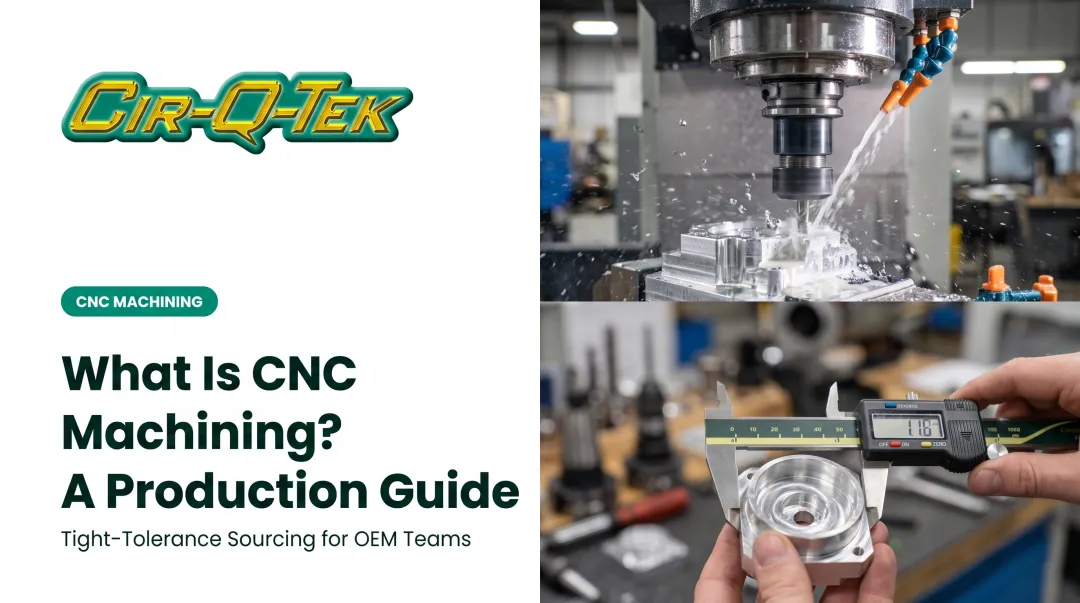
CNC stands for computer numerical control. A machine follows a programmed set of instructions, known as G-code, to guide cutting tools with precision no human hand could match consistently.
The workflow starts with a CAD model of the part. That design gets converted through CAM software into toolpaths and G-code, which tells the machine exactly where to move, how fast to feed, and which tool to use at each step. Once the workpiece is secured, the machine executes the program, cutting away material until the final geometry emerges.
There are two primary methods:
- Milling: A rotating cutting tool moves against a stationary workpiece, removing material to create flat surfaces, pockets, holes, and contours.
- Turning: The workpiece spins on a lathe while a stationary tool shapes it, ideal for round, cylindrical features.
The key distinction from 3D printing is what CNC doesn't do: add material. CNC starts with a solid block or bar stock and cuts away the excess, so the finished part keeps the same grain structure and mechanical properties throughout.
CNC parts are typically isotropic—equally strong in every direction. Additively manufactured parts often aren't, because layer-by-layer printing can create weaker bonds along certain planes. For load-bearing or structural components, that difference matters.
Key Capabilities of CNC Machining
Precision and Tight Tolerances
Tolerance is where CNC earns its reputation. Industry practice generally follows ISO 2768, which sets tolerance bands by part dimension and class rather than one flat number. Per Hubs' manufacturing standards guide, a 3mm feature might carry ±0.05mm while a 500mm dimension allows ±0.3mm.
For most commercial parts, that translates to roughly ±0.005 in., depending on size and class. Demanding applications such as medical implant components or aerospace fasteners need far tighter control.
Cir-Q-Tek's precision CNC machining can hold tolerances as close as ±0.0005 in. on complex geometries. Multi-axis, multi-tasking machines with live tooling and multiple spindles finish parts in a single setup, which cuts the cumulative error that comes from repositioning a workpiece.
Multi-Axis Machining for Complex Geometries
A 3-axis machine cuts along X, Y, and Z. That works for straightforward parts, but angled features or undercuts need multiple setups. 5-axis machines add two rotary axes, either indexing the part in 3+2 machining or interpolating all five axes at once to reach nearly any surface without repositioning.
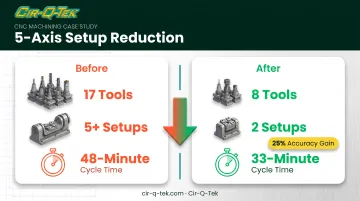
DMG MORI's 2024 case data shows the payoff. One part went from 17 tools and five-plus setups down to 8 tools and two setups, cutting cycle time from 48 to 33 minutes with a reported 25% gain in process accuracy. The company notes results vary by part and procedure. Fewer setups also tighten positional relationships between features, which matters for assemblies with mating parts.
Material Versatility
CNC machining handles nearly any material that can be cut:
- Aluminum, stainless steel, titanium, and brass for structural or wear-resistant parts
- Engineering plastics like ABS, nylon, PEEK, and Delrin for lightweight or chemical-resistant applications
- Ceramics and composites for specialized thermal or electrical requirements
Cir-Q-Tek brings particular depth in finish machining castings made from aluminum, zinc, magnesium, iron, and stainless steel, refining cast parts to their final precise dimensions after the initial casting process.
Repeatability and Speed at Scale
Once a toolpath is programmed, it doesn't drift. The same G-code runs identically on part one and part ten thousand, which is why finished parts on a production run typically hold repeatability within a few thousandths of an inch. That's what lets an automotive Tier 1 supplier order 50,000 identical brackets without re-verifying every batch.
Speed varies more. Xometry's marketplace benchmark lists expedited CNC lead times around 3-4 business days, though the company notes complexity, quantity, and material availability can push that out. Full production runs take longer: more parts mean more machine time, even with efficient setups.
Design-for-Manufacturability Support
The best CNC outcomes start before the machine ever runs. Experienced providers review a part's geometry, wall thickness, and tolerance callouts against what's actually achievable, catching problems on the drawing instead of in the scrap bin.
Cir-Q-Tek pairs its machining capability with CAD design and CAM programming expertise, working from customer-submitted CAD files, 3D data, and fabrication drawings to develop the toolpath strategy before production starts. That upfront engineering helps the company hit tight tolerance callouts consistently across production volumes, not only on one-off parts.
Types of CNC Machines and Processes
CNC Milling
Milling uses a rotating, spindle-mounted cutting tool that moves across a stationary or lightly repositioned workpiece. It's the go-to process for parts with flat faces, pockets, slots, and drilled features.
Typical milled parts include:
- Brackets and enclosures
- Gearbox housings
- Custom gears cut from solid stock
Modern machining centers add automatic tool changers, so one setup can run drilling, tapping, and contouring back to back.
CNC Turning (Lathes)
Turning flips the setup: the workpiece spins on a lathe while a stationary cutting tool shapes it. That makes it faster and cleaner than milling for round geometry.
Common turned parts include:
- Shafts, bushings, and spindles
- Threaded rods and other cylindrical features
Live tooling on modern turning centers can add milled features—flats or cross-holes—without a second machine, so concentricity stays tight between turned and milled surfaces.
Specialized Processes
Milling and turning cover most jobs, but some features need extra help:
- EDM (electrical discharge machining): Erodes hardened metals that are tough to cut conventionally—sharp internal corners and fine details in tool steel
- Precision grinding: Refines surface finish and flatness beyond what cutting tools alone achieve
- Drilling: Standalone or in a milling cycle, from simple clearance holes to deep, tightly toleranced bores
Applications of CNC Machining Across Industries
CNC machining shows up anywhere a part needs to be strong, precise, and repeatable. Here's where it does the heaviest lifting:
- Medical and healthcare devices: Surgical instruments and orthopedic implants need biocompatible materials like titanium and stainless steel, held to tight tolerances. ISO 13485-certified manufacturing is typically required for regulated device parts.
- Automotive: Engine components, transmission housings, and performance parts use CNC for prototyping and volume production. IATF 16949 certification signals automotive-grade quality systems built for defect prevention.
- Aerospace and defense: Structural frames and engine parts need strict dimensional accuracy in titanium and aluminum alloys. Five-axis milling of one-piece bladed disks (blisks) shows how far CNC geometry can go in a single setup.
- Electronics and telecommunications: Housings, connectors, and heat sinks need precise tolerances to seat correctly and dissipate heat as designed. A poorly toleranced heat sink is a functional failure, not a cosmetic one.
- Industrial process control and commercial equipment: Gears, brackets, and custom fixtures keep machinery and automation running, often in high-wear conditions that demand durable metals.
- Prototyping and product development: A functional metal or plastic prototype lets teams validate fit, function, and durability before committing to tooling—and shortens time-to-market.
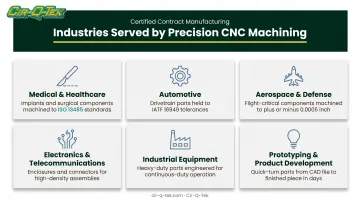
Cir-Q-Tek serves customers across most of these sectors. ISO 13485 and IATF 16949 certifications cover the same machining facilities that produce medical and automotive parts, so one supplier relationship can support multiple product lines.
Advantages and Limitations of CNC Machining
CNC machining's core advantage is straightforward: it produces strong, accurate parts, repeatedly, with the material properties the finished design requires. Because parts are cut from solid stock rather than built layer by layer, they retain isotropic strength, which matters for anything load-bearing or safety-critical.
That said, CNC isn't the right fit for every job. Common constraints include:
- Higher per-part cost at low volume, since programming and setup spread across fewer pieces
- Internal corners keep a tool-radius round-over unless a secondary process is added
- Thin walls can deflect under cutting force and drift dimensionally without adequate support
- Simple, low-complexity parts often print faster than they can be machined and set up
Most of these constraints shrink with early design-for-manufacturability review. An experienced shop will flag a tight internal corner or thin wall before it becomes scrap, then adjust the design or process to meet the same functional goal.
Choosing the Right CNC Machining Partner
Picking a CNC supplier is less about finding the cheapest quote and more about finding one whose actual capabilities match your part.
What to check before committing:
- Quality certifications for your industry – ISO 9001 (general), ISO 13485 (medical), IATF 16949 (automotive). Matching certs aren't optional if you ship into a regulated market.
- Demonstrated tolerance capability – Ask for real data on comparable parts, not a marketing claim. ±0.0005 in. on complex geometries is a different tier than ±0.005 in. as a best case.
- Material range – Confirm the shop actually machines the metals or plastics your part calls for, rather than offering a generic "we can do anything" answer.
A one-stop manufacturing partner cuts that overhead further. If a CNC-machined bracket needs to pair with a custom PCB assembly, separate vendors mean two relationships, two shipping schedules, and two quality systems. One supplier covering CNC machining, PCB fabrication, and PCBA assembly consolidates all three into a single point of contact.
This is where Cir-Q-Tek fits. It runs ISO 9001, ISO 13485, and IATF 16949-certified CNC machining with tolerances as close as ±0.0005 in. on complex parts. Multi-axis, multi-tasking machines with live tooling and multiple spindles finish parts in a single setup.
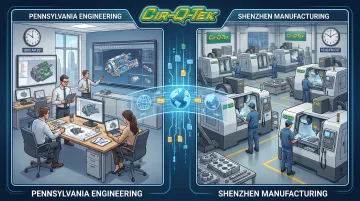
A Pennsylvania headquarters and Shenzhen office with bilingual engineers support a domestic-service, offshore-pricing model—U.S.-based communication, a secondary Pennsylvania inspection checkpoint, and offshore manufacturing costs. Every project starts with CAD/CAM programming support so tolerance and material decisions are set before the first cut.
Ready to see how it fits your part? Request a quote with your CAD files and fabrication drawings to get started.
Frequently Asked Questions
What are the capabilities of CNC machining?
CNC machining delivers tight tolerances, multi-axis handling of complex geometries, and broad material compatibility across metals and plastics. It also supports single prototypes through large production runs with consistent repeatability part to part.
What are the limitations of CNC machining?
Very low-volume orders can carry higher relative costs due to setup time, and certain geometries, like sharp internal corners or thin walls, are harder to machine cleanly. Lead times also tend to run longer than 3D printing for simple parts.
What materials can be CNC machined?
Common metals include aluminum, stainless steel, titanium, and brass, while typical plastics include ABS, nylon, PEEK, and Delrin. Many shops, including Cir-Q-Tek, also machine ceramics and composites for specialized applications.
How accurate is CNC machining?
Standard tolerances generally follow ISO 2768, often translating to roughly ±0.005 in. depending on part size and dimensional class. Specialized providers like Cir-Q-Tek can hold tolerances as tight as ±0.0005 in. on complex parts.
Which industries use CNC machining the most?
Medical device, automotive, aerospace, electronics, and industrial equipment manufacturers rely heavily on CNC machining for precision, regulated components. Prototyping and product development teams across nearly every sector use it too.
How long does CNC machining typically take?
Lead times depend heavily on part complexity, tolerance requirements, and order volume, ranging from a few days for quick-turn prototypes to several weeks for full production runs. Material availability and setup requirements also factor into the timeline.