What does "precision machine" mean?
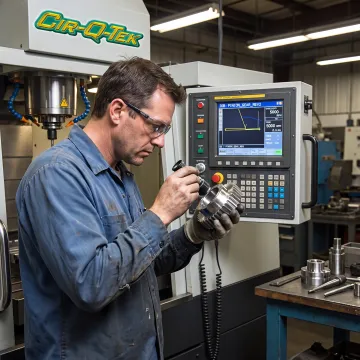
A precision machine is equipment designed to make, measure, or control parts with very tight dimensional accuracy and repeatability. In machining, this usually refers to CNC mills, lathes, and multi-axis systems that follow programmed toolpaths. Precision work also relies on stable setups, capable cutting tools, calibrated inspection equipment, and documented quality processes to verify that critical features meet drawing requirements.
What are precision machine tools?
Precision machine tools are manufacturing machines built to remove, shape, drill, turn, or finish material to closely controlled dimensions. Common examples include CNC machining centers, CNC lathes, multi-axis mills, grinders, and equipment with live tooling. Their accuracy depends on machine rigidity, spindle performance, control systems, fixturing, programming, tooling, and verification through metrology equipment.
What tolerances can Cir-Q-Tek achieve for CNC machining?
Cir-Q-Tek’s precision CNC machining capabilities can maintain tolerances as close as ±0.0005 inches. Achievable tolerances for an individual part depend on its material, geometry, feature size, wall thickness, inspection requirements, and the machining process selected. Providing complete CAD models and fabrication drawings allows the team to review critical dimensions, identify manufacturability considerations, and prepare an accurate quote.
Which materials can be precision machined?
Cir-Q-Tek can machine almost any material, including standard metals, high-strength and high-temperature metals and alloys, engineered plastics, ceramics, composites, and other non-metals. The team also has finish-machining expertise for aluminum, zinc, magnesium, iron, and stainless steel castings. Material selection should account for functional performance, dimensional stability, finish needs, production volume, and budget.
Can you handle prototypes and production quantities?
Yes. Cir-Q-Tek supports precision-machined parts in a range of quantities, from prototype needs through production manufacturing. This flexibility helps teams validate designs before scaling while maintaining a path toward repeatable production. The appropriate machining approach, setup strategy, inspection plan, and delivery schedule are determined from the part design, material, quantity, and required tolerances.
What information is needed for a machining quote?
For non-PCB and non-PCBA machining requests, Cir-Q-Tek requires CAD and 3D data and/or fabrication drawings to prepare a quote. Include the required material, quantity, dimensions, tolerances, surface finish, critical features, and any inspection or packaging requirements. Complete documentation helps the team assess manufacturability, select an efficient process, and provide accurate pricing and lead-time guidance.
How is machined-part quality inspected?
Machining is performed in ISO 9001, ISO 13485, and IATF 16949 certified facilities, with high-end metrology equipment used under strict supervision. Inspection requirements are evaluated against the drawing and critical part features. This approach supports dimensional verification, repeatability, and documented quality expectations, particularly for programs serving medical, automotive, industrial, and other demanding applications.
Can Cir-Q-Tek stock and ship machined parts as needed?
Yes. Cir-Q-Tek can stock parts and ship them for just-in-time delivery, helping customers align supply with their production schedules. This option can reduce internal inventory pressure and simplify replenishment for repeat components. Stocking arrangements, release schedules, quantities, packaging, and shipping requirements should be defined during project planning so fulfillment supports your operational needs.