What CNC machining services does Cir-Q-Tek provide?
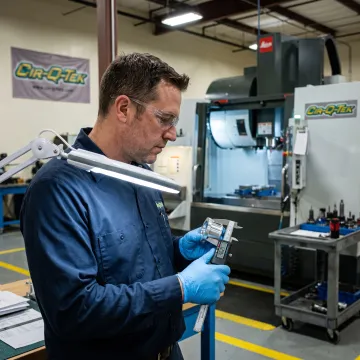
Cir-Q-Tek provides precision CNC milling and turning supported by multi-axis, multi-tasking machinery, live tooling, and multiple spindles. These capabilities can produce complex geometries and finished parts from efficient setups. The company also provides CAD design and CAM programming support, finish machining for selected castings, inspection, parts stocking, and just-in-time delivery for qualified production programs.
How tight are your CNC machining tolerances?
Cir-Q-Tek can maintain machining tolerances as close as ±0.0005 inches, depending on the part geometry, material, dimensions, and inspection requirements. Tight-tolerance work is supported by high-performance equipment, controlled manufacturing processes, CAD/CAM programming, and high-end metrology equipment. A review of the drawing package helps determine which tolerances are practical and how they should be verified.
What materials can a CNC machine shop work with?
Cir-Q-Tek machines a broad range of materials, including standard metals, high-strength and high-temperature metals and alloys, engineered plastics, ceramics, composites, and other non-metals. The team also has finish-machining expertise for aluminum, zinc, magnesium, iron, and stainless-steel castings. Material selection should account for the component’s function, environment, tolerances, finish, and production volume.
Can you handle both prototypes and production CNC parts?
Yes. Cir-Q-Tek supports components in a range of quantities, from prototype parts used for design validation through repeat production runs. Its manufacturing model is designed to provide flexibility as requirements evolve. For ongoing programs, parts can be stocked and shipped on a just-in-time basis, helping manufacturers align inventory with assembly schedules and reduce unnecessary carrying costs.
What files are needed for a CNC machining quote?
For non-PCB and non-PCBA CNC machining quotes, Cir-Q-Tek requests CAD and 3D data and/or fabrication drawings. Complete documentation should identify material, dimensions, tolerances, finishes, critical features, required quantities, and any inspection requirements. Providing this information early allows the manufacturing team to review machinability, select an appropriate process, and prepare an accurate quote for the requested component.
How do you inspect precision-machined components?
Precision machining takes place in ISO 9001, ISO 13485, and IATF 16949 certified facilities with high-end metrology equipment and strict supervision. Inspection planning can be aligned with the drawing’s critical dimensions and customer requirements. This quality-focused approach helps verify dimensional conformance and consistency before parts move into customer production, regulated applications, or final assembly.
Which industries use your precision CNC machining capabilities?
Cir-Q-Tek supports customers in medical and healthcare devices, automotive, telecommunications, industrial process control, gaming, product dispensing, audio and video, computers and electronics, and commercial industries. Its certified manufacturing facilities and ability to work with diverse materials make the service suitable for components requiring complex features, controlled tolerances, traceable quality processes, or reliable repeat production.
Can Cir-Q-Tek support ongoing inventory and scheduled deliveries?
Yes. Cir-Q-Tek can stock parts and ship them to support just-in-time delivery programs. This option is useful for manufacturers that need dependable access to repeat components while avoiding excess on-site inventory. Delivery planning is coordinated around the customer’s production schedule, part demand, and approved manufacturing requirements, helping simplify procurement and maintain continuity across recurring orders.