Introduction
Building a single electronic product often means juggling four or five vendors: a PCB fabricator, a component distributor, an assembly house, and sometimes a separate enclosure or harness supplier.
Each handoff adds a delay. Each vendor speaks a different language of specs, lead times, and quality standards.
Many hardware teams struggle with exactly this — coordinating multiple suppliers just to get one working board. Miscommunication between vendors drives project delays and cost overruns.
Turnkey PCB assembly solves this by putting the entire build under one accountable manufacturing partner. This guide covers what turnkey PCB assembly actually means, the benefits it delivers, the step-by-step process, what drives cost, and how to pick a partner you can trust with your next build.
Key Takeaways
- One provider handles design review, sourcing, fabrication, assembly, testing, and delivery end to end.
- Full turnkey shifts nearly all sourcing risk to the manufacturer; partial turnkey shares it with you.
- Cost depends on board complexity, component availability, testing needs, and volume — not a flat rate.
- The right partner offers relevant certifications, quick-turn capability, and services beyond bare boards.
What Is Turnkey PCB Assembly?
Turnkey PCB assembly is a manufacturing model where a single supplier manages the entire production process: from reviewing your Gerber files and bill of materials through fabrication, component sourcing, assembly, testing, and final delivery. You send design files; you receive a working board.
The term itself has nothing to do with electronics originally. Merriam-Webster defines "turnkey" as something "built, supplied, or installed complete and ready to operate," with the adjective's first known use dating back to 1860. The idea translates directly to PCB manufacturing: the product arrives ready to "turn the key" and use, without you needing to manage separate vendors along the way.
A true turnkey service typically bundles:
- Component procurement from authorized distributors
- BOM management, including flagging obsolete or long-lead parts
- PCB fabrication to your specified layer count and finish
- SMT and through-hole assembly
- AOI, X-ray inspection, and functional testing
- Packaging and shipment, sometimes including drop-ship fulfillment
Full Turnkey vs. Partial vs. Consigned Assembly
Not every "turnkey" order is the same. The differences come down to who sources the parts.
| Model | Who sources components | Best for |
|---|---|---|
| Full turnkey | Manufacturer sources 100% of components | Startups and OEMs who want a hands-off build |
| Partial turnkey | Customer supplies some parts; manufacturer sources the rest | Companies with existing inventory or preferred suppliers for specific parts |
| Consigned assembly | Customer supplies all materials | Companies with established vendor relationships or unique/proprietary components |
Full turnkey generally means fewer vendor handoffs and less coordination on your end, since the manufacturer owns the entire supply chain. Consigned assembly gives you more control over sourcing, but split shipments and incomplete kits can quietly delay production if parts arrive labeled incorrectly or in short quantities.
Partial turnkey lands in between. It fits when you already hold most of the parts but want the manufacturer to fill the gaps.
Benefits of Turnkey PCB Assembly
The appeal of turnkey isn't just convenience. It changes the economics and the risk profile of your build.
Lower total cost. Consolidated procurement means volume discounts on components and fewer shipping legs between vendors. You're not paying to move partially built boards from one facility to another.
Faster time-to-market. Sourcing and fabrication run in parallel instead of sequentially. Some suppliers can move fast — Sierra Circuits, for example, advertises fully assembled PCBAs in as fast as five days for straightforward builds, though actual timing always depends on design readiness and part availability.
Higher quality confidence. Early DFM/DFA review catches design issues before they become expensive rework. Multi-stage inspection catches what's left. Automated optical inspection systems check for the defects you can see:
- Missing or wrong parts
- Polarity errors
- Skewed or misaligned components
- Tombstoning
- Insufficient or excess solder
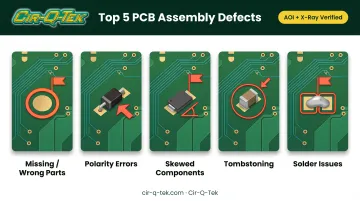
Koh Young notes that AOI systems are built to catch exactly these placement and solder defects, but hidden-joint issues under packages like BGAs need X-ray to find.
Providers that run inline AOI and X-ray on every SMT line—Cir-Q-Tek included—catch solder voids and hidden misalignment under fine-pitch components before a board ships.
Single-point accountability. One provider, one point of contact, no finger-pointing between a fabricator and an assembler when something goes wrong.
Scalability. The same DFM setup that qualifies a 10-unit prototype run can carry through to a 10,000-unit production order without re-qualifying a new vendor.
The Turnkey PCB Assembly Process: Step-by-Step
A turnkey build moves through six stages. Skipping or rushing any one of them is usually where problems start.
- Design and documentation review. The manufacturer checks your Gerber or ODB++ files, BOM, and CPL (centroid) file, running DFM and DFA analysis to catch footprint, polarity, and spacing issues before anything gets fabricated.
- Component sourcing and procurement. The manufacturer buys parts from authorized distributors against your BOM. It flags out-of-stock or long-lead items and proposes substitutions so the project does not stall.
- PCB fabrication. The fabricator builds bare boards to your specified layer count, copper weight, and surface finish, from a single-sided board to a 40-layer multilayer stack depending on the design.
- SMT and through-hole assembly. Pick-and-place equipment mounts SMT parts, then reflow or wave soldering secures them. Through-hole components follow on the same line when the design needs mixed technology.
- Testing and quality assurance. Boards go through AOI, X-ray for BGAs and hidden joints, and in-circuit or functional testing as your project requires.
- Final inspection, packaging, and delivery. The team packs finished boards in ESD-safe materials and ships them. Some providers also drop-ship or handle fulfillment straight to your customer.
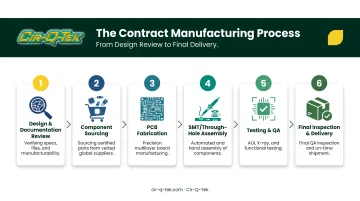
For a quick-turn prototype, this whole sequence can compress into days. A production run with complex sourcing may take several weeks, driven mostly by component lead times rather than the manufacturer's own throughput.
How Much Does Turnkey PCB Assembly Cost?
There's no flat rate for turnkey PCB assembly, and any quote that doesn't ask about your board first should raise questions. Cost is driven by a handful of specific factors:
Board complexity — layer count and fine-pitch components like BGAs or QFNs cost more to place and inspect accurately
Component availability — parts with long lead times or scarcity in the market drive up sourcing cost and timeline risk
Testing requirements — in-circuit and functional testing add fixture and labor cost, especially for complex boards
Order quantity — unit cost typically drops as volume increases, though the relationship isn't linear
Surface finish — HASL is usually the least expensive; ENIG costs more but gives the flatness fine-pitch parts, chip-scale packages, QFNs, and BGAs need
If your design leans heavily on fine-pitch components, that finish choice alone can shift per-unit cost more than you might expect.
Here's what surprises a lot of first-time buyers: turnkey often looks pricier on a line-item basis than consigned assembly, but it's usually cheaper overall. Consigned assembly hides its true cost in vendor coordination time, split shipments, mismatched part counts, and rework when a customer-supplied part doesn't meet spec. Once you factor those hidden costs in, one accountable turnkey quote frequently wins.
The only way to get a real number is a line-itemized quote after the manufacturer reviews your actual Gerber/ODB++ files and BOM. Generic price ranges published online rarely hold up against a specific design.
How to Choose the Right Turnkey PCB Assembly Partner
Not all turnkey providers are equal, and picking the wrong partner costs more than a bad quote: it costs you a failed program. Here's what actually matters.
Check certifications against your industry. ISO 9001 covers general quality management and should be table stakes. If you're building for medical devices, ISO 13485 isn't optional. If you're supplying automotive, IATF 16949 is the standard that matters. Verify the certificate actually covers the manufacturing site doing your work, not just the company's letterhead.
Assess quick-turn capability and communication. If your partner operates offshore facilities, ask how design questions get resolved and how fast. Time zone gaps and language barriers turn small clarifications into multi-day delays.
Look for one-stop capabilities beyond the bare board. Some manufacturers only touch the PCB, leaving you to source harnesses, machined parts, or enclosures elsewhere. That puts you right back to juggling multiple vendors.
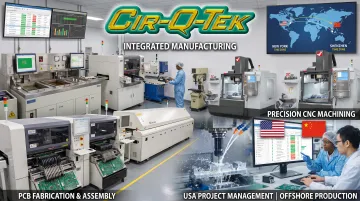
Cir-Q-Tek addresses that gap with a Pennsylvania-based project management team paired with bilingual Shenzhen operations. Design questions get answered in plain English on a U.S. business schedule, while manufacturing runs at offshore pricing. With precision CNC machining alongside PCB fabrication and PCBA, one partner can take a design further toward a finished product without new vendors mid-project.
Ask about defect handling and traceability before you sign. A manufacturer should be able to explain, in plain terms, what happens if a build doesn't meet spec:
- Is non-compliant product replaced at no cost, or do you pay for their mistake?
- What documentation ties a finished board back to the components used and the inspection results?
- Is there a secondary quality check beyond the factory floor, or does the product ship the moment it clears the line?
Getting clear answers here upfront saves a painful conversation later.
Frequently Asked Questions
What is turnkey PCB assembly?
Turnkey PCB assembly is a single-supplier service covering component sourcing, PCB fabrication, assembly, testing, and delivery. You send design files and receive a ready-to-use board, without managing separate vendors.
How much does it cost to assemble a PCB?
Cost varies by board complexity, component count and type, testing needs, and order volume. Manufacturers typically provide a line-itemized quote only after reviewing your BOM and Gerber files.
What's the difference between full and partial turnkey PCB assembly?
Full turnkey means the manufacturer sources all components for your build. Partial turnkey means you supply some parts yourself while the manufacturer sources the rest.
How long does turnkey PCB assembly take?
Quick-turn prototypes can ship in days once design files are approved. Production runs depend heavily on component lead times and order complexity, often ranging from about ten days to several weeks.
What files do I need to submit for a turnkey PCB assembly quote?
You'll typically need Gerber or ODB++ files, a bill of materials (BOM), a centroid or CPL file, and any specific assembly or test notes. Some manufacturers request only Gerber/ODB++ and BOM at the quoting stage.
Is turnkey PCB assembly suitable for low-volume prototypes?
Yes. Most turnkey providers handle small prototype runs using the same DFM setup they'd use for full production, making it easy to scale up once your design is validated.