
Common pain points include:
- Choosing a metal that's overbuilt (and overpriced) for the application
- Unclear communication about what tolerance a supplier can really deliver
- Overseas vendors with inconsistent quality control and long lead-time surprises
This guide walks through metal selection, precision standards, cost drivers, and how to vet a manufacturing partner you can actually rely on.
Key Takeaways
- Match aluminum, steel, stainless, brass, copper, or titanium to your strength, weight, and conductivity needs
- Plan for standard CNC tolerances of ±0.005" to ±0.002"; specialized setups reach ±0.0005"
- Material, part complexity, tolerances, and volume drive most of your machining quote
- ISO-certified, one-stop manufacturers lower risk on medical and automotive programs
What Is CNC Metal Machining?
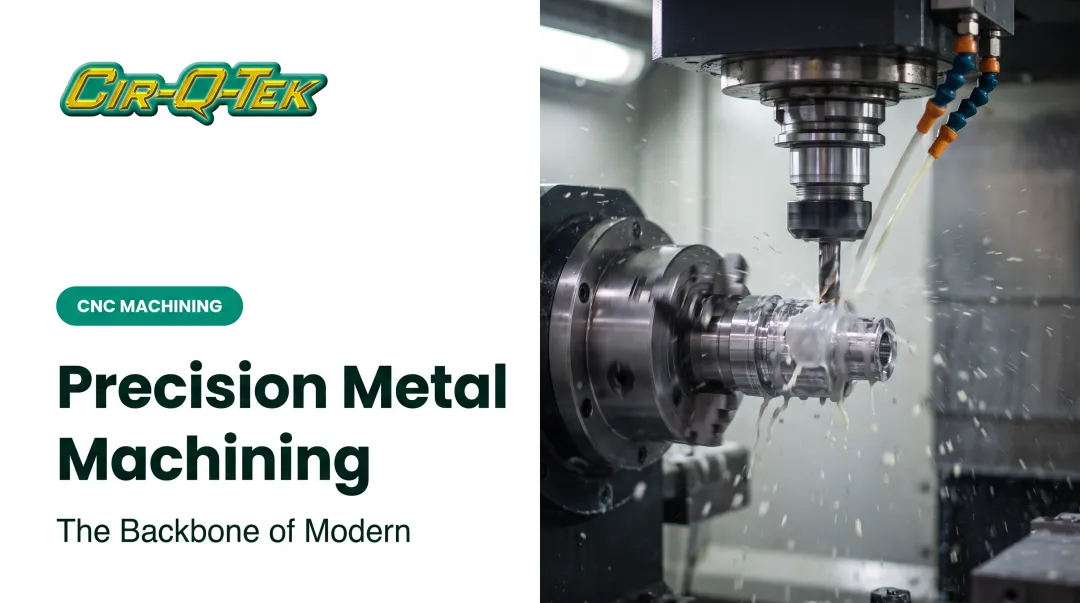
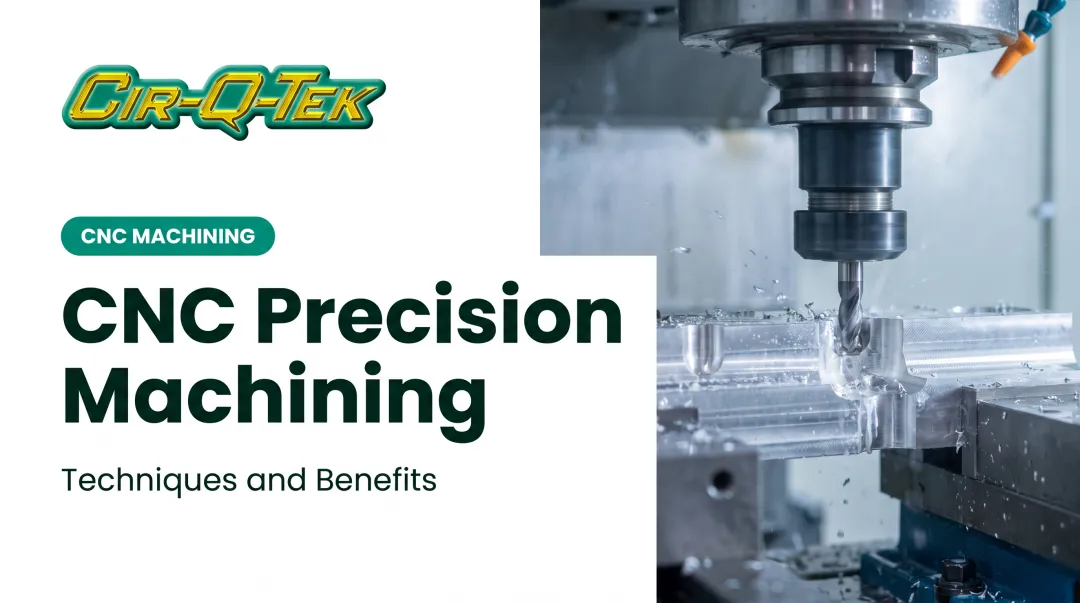
CNC (Computer Numerical Control) is a subtractive manufacturing process that removes material from metal stock with programmed cutting tools, according to ThomasNet's overview of CNC machining. Common operations include milling, turning, and drilling.
The typical workflow looks like this:
- CAD design: the part is modeled in 2D or 3D
- CAM programming: software converts the CAD file into machine toolpaths
- Machine setup: the workpiece is fixtured, tooling is installed, and zero points are located
- Cutting: the CNC program drives tool movement to remove material
- Inspection: the finished part is verified against the drawing

At Cir-Q-Tek, this workflow includes an engineering review up front. Our team flags machining challenges before programming starts, so issues get caught early instead of on the production floor.
Choosing the Right Metal for Your Application
Material choice sets the ceiling for strength, weight, corrosion resistance, and machining cost. Here's how the most common options stack up.
Aluminum
Lightweight and corrosion-resistant, aluminum is the default choice for automotive and consumer parts.
6061 offers 310 MPa tensile strength with excellent corrosion resistance and weldability, making it the general-purpose workhorse. 7075 reaches 572 MPa tensile strength but trades away some corrosion resistance. It suits aerospace and high-load work where weight matters more than environmental exposure.
Steel and Stainless Steel
- Mild and alloy steel — cost-effective strength for structural and industrial components
- 304 stainless — an all-purpose, corrosion-resistant grade with good formability
- 316L stainless — better suited for aggressive chemical or medical environments due to superior corrosion resistance
- 17-4 PH stainless — a precipitation-hardened grade capable of exceeding 1,310 MPa tensile strength in the H900 condition, holding strength up to roughly 600°F
Brass and Copper
- Brass (C36000) — machines easily with a machinability rating of 100; a go-to for fittings and connectors
- Copper (C11000) — harder to machine (rating of 20) but delivers minimum 100% IACS conductivity for electrical applications
Titanium
Titanium (Ti-6Al-4V) delivers high strength at low weight and is biocompatible, which explains its dominance in aerospace structures and medical implants. It is also genuinely difficult to machine. Modern Machine Shop attributes this to high-temperature strength, work hardening, and poor thermal conductivity, which mean slower speeds, heavier feeds, and more tooling wear.
| Metal | Machinability | Strength | Relative Cost | Typical Applications |
|---|---|---|---|---|
| Aluminum 6061 | Excellent | Moderate | Low | Automotive, consumer parts |
| Aluminum 7075 | Good | High | Moderate | Aerospace, high-load parts |
| Stainless 304/316L | Fair | Moderate-High | Moderate | Medical, chemical equipment |
| 17-4 PH | Fair | Very High | Moderate-High | High-strength industrial parts |
| Brass | Excellent | Low-Moderate | Moderate | Fittings, connectors |
| Copper | Fair | Low | Moderate | Electrical components |
| Titanium | Difficult | Very High | High | Aerospace, medical implants |

Nearly every commercially available metal can be CNC machined. Aluminum, mild and alloy steel, stainless, brass, copper, and titanium remain the most common choices for industrial, medical, and automotive parts.
Precision and Tolerances: What to Expect
Tolerance capability isn't universal. It depends on the shop, the part geometry, and the material. According to a Protolabs design tip on CNC tolerances, standard tolerances often land around ±0.005", precision machining around ±0.002", and specified reamed holes as tight as ±0.0005". Those figures are supplier capability benchmarks, not a universal standard—confirm what a shop can actually hold on your part.
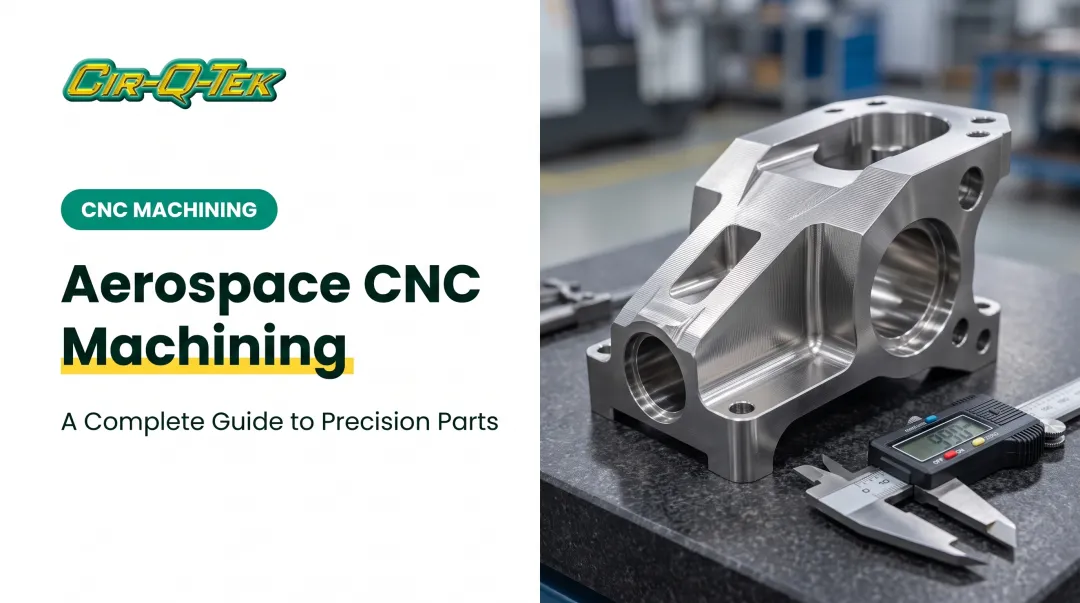
Cir-Q-Tek's precision CNC machining reaches tolerances as close as ±0.0005", using multi-axis, multi-tasking equipment with live tooling and multiple spindles that can finish complex parts in a single setup. That single-setup capability matters: fewer reclampings means fewer chances for stack-up error.
What Counts as "High Precision"?
There's no single industry-wide definition of high precision. ASME Y14.5 establishes the geometric dimensioning and tolerancing (GD&T) language used to specify tolerances, but it doesn't set a universal threshold. In practice, most shops treat anything at or below ±0.001" as high precision, with ±0.0005" reserved for critical features on medical or aerospace-grade parts.
Multi-Axis Machining and Inspection
Five-axis machines can reach complex geometries (inclined bores, contoured surfaces) without repositioning the part. One equipment manufacturer's case study reported 60% fewer setups and 30% shorter cycle times with this approach, though results vary by part.
Certifications matter for repeatability at scale:
- ISO 9001: cross-industry quality management baseline
- ISO 13485: adds regulatory rigor for medical device manufacturing
- IATF 16949: automotive-specific supply-chain quality requirements
Cir-Q-Tek machines parts in facilities that hold all three certifications. Finished parts are checked with precision metrology equipment, then go through a secondary inspection at its Pennsylvania facility before shipment.
What Drives the Cost of CNC Machined Parts?
Four factors control your quote, according to ThomasNet's cost-analysis of CNC milling:
- Material — expensive alloys (titanium, specialty stainless) cost more to buy and machine
- Tolerance — over-specifying tight tolerances on non-critical features inflates cost unnecessarily
- Complexity — more setups and harder-to-reach features mean more machine time
- Finish — elaborate surface treatments add processing steps
A simple aluminum bracket costs far less than a complex titanium housing with tight tolerances across multiple features.
Order volume shifts the math too. Quick-turn prototypes carry a per-unit premium because setup costs aren't spread out. High-volume production amortizes those costs across more parts.

Practical tip: Separate your critical tolerances from your general ones on the drawing. This lets your supplier quote accurately instead of pricing the whole part at the tightest spec.
Choosing a CNC Machining Partner You Can Trust
Not every shop can back up its tolerance claims with certified processes. Here's what to check before committing.
Certifications should match your end market:
- Medical devices need ISO 13485
- Automotive components need IATF 16949
- Everyone benefits from ISO 9001 as a baseline
A one-stop manufacturer reduces coordination headaches when a program needs more than machined parts. Cir-Q-Tek combines precision CNC machining with PCB fabrication and PCBA assembly inside ISO 9001, ISO 13485, and IATF 16949-certified facilities. That helps if you need machined enclosures alongside electronic assemblies without juggling separate vendors.
Cir-Q-Tek's dual U.S.-China office model gives customers a Pennsylvania-based point of contact while manufacturing runs through its Shenzhen operation, staffed by bilingual engineers. The model delivers offshore pricing without giving up domestic-level communication.
Confirm these practices with any supplier:
- Defect replacement at no extra cost (Cir-Q-Tek replaces non-compliant parts)
- Multi-stage inspection, including a secondary check at Cir-Q-Tek's Pennsylvania facility before shipment
- Volume flexibility from prototype quantities through full production without switching vendors
Frequently Asked Questions
How much does it cost to get a part CNC machined?
Costs vary based on material, complexity, tolerance, and volume. A simple aluminum bracket costs far less than a tight-tolerance titanium part. Request a quote from your CAD data for an accurate number.
What metals can be CNC machined?
Aluminum, mild and alloy steel, stainless steel, brass, copper, and titanium are the most commonly machined metals. Nearly any metal can be machined; the choice depends on your application's strength, weight, and cost requirements.
What does CNC stand for in parts?
CNC stands for Computer Numerical Control: an automated process that guides cutting tools with pre-programmed instructions to remove material from stock and create a finished part.
What is the most precise CNC machine?
Precision depends on the machine class, setup, and part geometry rather than one single "most precise" machine. High-end multi-axis equipment, like Cir-Q-Tek's, can achieve tolerances as tight as ±0.0005" on critical features.
How do I choose the right metal for my CNC machined part?
Base the decision on strength, weight, corrosion resistance, and budget. Aluminum suits lightweight industrial and electronics applications, while titanium and specialty stainless fit high-stress or biocompatible needs.