That reality creates a real headache for engineers and procurement teams. Finding a manufacturing partner who can hit micron-level precision, source certified materials, and produce full documentation packages — without blowing the budget or missing the delivery window — is harder than it sounds.
This guide breaks down what aerospace CNC machining actually involves: the materials, the processes, the tolerance and certification requirements, the components you'll see most often, the challenges machinists face, and how to vet a manufacturing partner before you commit production dollars.
Key Takeaways
- CNC machining produces flight-critical parts for aircraft, spacecraft, and defense systems
- Structural, engine, and fuel-system parts often need tolerances tighter than ±0.0005 in
- AS9100, NADCAP special processes, and First Article Inspection anchor aerospace quality systems
- Aluminum, titanium, nickel superalloys, and stainless steels lead for strength-to-weight and heat resistance
What Is Aerospace CNC Machining?
Aerospace CNC machining is computer-controlled subtractive manufacturing (milling, turning, and EDM) used to produce components for aircraft, spacecraft, satellites, and propulsion systems. The machines themselves aren't drastically different from those used in general manufacturing.
What separates aerospace work is everything around the cutting tool:
- Exotic, hard-to-machine materials like titanium and nickel superalloys
- Tolerances measured in ten-thousandths of an inch, not thousandths
- Mandatory quality certifications such as AS9100
- Full material traceability, from mill certificate to finished part
A shop can run flawless aluminum brackets for a consumer electronics client and still fail an aerospace audit because it lacks the documentation trail regulators require.
Why Precision Is Non-Negotiable in Aerospace
Out-of-tolerance aerospace parts don't just fail inspection. They create stress concentrations, fatigue cracking, and seal or hydraulic failures in systems with no margin for error.
The 2010 Qantas QF32 incident shows the stakes. The Australian Transport Safety Bureau found manufacturing defects left critically reduced wall thickness in a Trent 900 engine oil-feed stub-pipe counterbore on the No. 2 engine in the uncontained failure (ATSB investigation). One thin-walled feature missed at the machining stage contributed to a major in-flight event.
Precision also pays off in efficiency. CNC-machined thin-wall and topology-optimized structures cut aircraft weight without sacrificing strength, and every pound saved reduces fuel burn over the life of the fleet.
Airbus notes that even cutting potable water load can save up to 115 tonnes of fuel across an aircraft's operating life (Airbus fuel efficiency solutions). Lighter structural parts from precise machining feed the same weight equation.
Beyond safety and efficiency, precision underpins regulatory compliance. The FAA, EASA, and DoD all require parts to conform to approved drawings, and interchangeability across global maintenance fleets depends on every shop hitting the same dimensional targets, wherever the part was made.
Where It's Applied Across Aircraft and Spacecraft
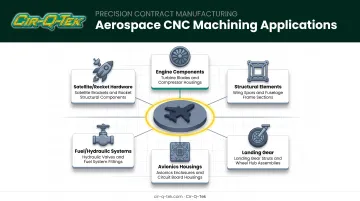
Aerospace CNC machining touches nearly every system on an aircraft or spacecraft:
- Engine and combustion components: fan discs, blisks, turbine discs, and combustion casings
- Structural elements: wing ribs, bulkheads, spars, and fuselage frames
- Landing gear: axles, pistons, and torque links, often finished in a single setup on large mill-turn platforms
- Avionics housings and brackets: enclosures that protect sensitive electronics from vibration and thermal stress
- Fuel and hydraulic systems: manifolds and valve bodies carrying pressurized fluid, air, or fuel
- Satellite and rocket hardware: combustion chambers and structural nodes machined from high-temperature superalloys
Materials Used in Aerospace CNC Machining
Material choice in aerospace comes down to strength, fatigue resistance, corrosion resistance, and temperature tolerance: cost and ease of machining are secondary, not primary.
Aluminum Alloys
Aluminum alloys (7075, 6061, 2024) remain the workhorse for structural parts. 7075-T6 delivers roughly 572 MPa ultimate tensile strength at a density of 2.80 g/cc, making it a strong pick for ribs, spars, and housings where weight matters as much as strength.
Titanium Alloys
Titanium alloys, particularly Ti-6Al-4V, offer an ultimate tensile strength around 1,035 MPa at just 4.42 g/cc density. That strength-to-weight profile, combined with high-temperature performance, makes titanium the go-to for engine components and landing gear parts.
Nickel Superalloys
Nickel superalloys like Inconel 718 and Haynes 625 hold their strength at temperatures that would soften most metals. Haynes 625 maintains long-term service capability up to 1,100°F and oxidation resistance to 1,800°F, which is why turbine blades and exhaust components rely on it despite the machining difficulty.
Stainless Steels
Stainless steels (15-5 PH and 17-4 PH) round out the list for landing gear, flanges, and metal-to-composite interfaces, offering high yield strength (17-4 PH Condition A reaches roughly 760 MPa yield) with corrosion resistance comparable to Type 304.
| Material Family | Strength Profile | Temperature Resistance | Typical Aerospace Use |
|---|---|---|---|
| Aluminum (7075, 6061, 2024) | High strength-to-weight, moderate density | Moderate | Ribs, spars, structural housings |
| Titanium (Ti-6Al-4V) | Very high strength-to-weight | High | Engine parts, landing gear |
| Nickel superalloys (Inconel, Haynes) | High strength retained at extreme heat | Very high (1,100°F+) | Turbine blades, exhaust systems |
| Stainless steel (15-5 PH, 17-4 PH) | High yield strength, good corrosion resistance | Moderate to high | Landing gear, flanges, fasteners |
CNC Machining Processes, Tolerances & Quality Standards
CNC Processes That Meet Aerospace Demands
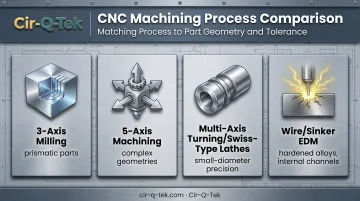
Different geometries call for different machine setups:
- 3-axis milling handles simpler prismatic parts: brackets, plates, and housings with features accessible from a limited number of angles
- 5-axis machining handles complex geometries like blisks, impellers, and contoured titanium structures in fewer setups, cutting accumulated error and improving dimensional accuracy
- Multi-axis turning and Swiss-type lathes produce cylindrical components: fasteners, pins, and avionics hardware where micro-precision on small-diameter parts is the priority
- Wire and sinker EDM cuts hardened alloys and internal fluid channels that are too complex or too hard for conventional cutting tools to reach
Tolerances, Certifications & Documentation
Aerospace tolerance requirements vary by drawing and application, but general ranges by component category typically look like this:
| Component Type | Typical Tolerance Range | Example Features |
|---|---|---|
| Structural (ribs, bulkheads, spars) | ±0.001 to ±0.0005 in | Mounting holes, fastener bores |
| Engine and turbine | ±0.0005 in or tighter | Blade roots, blisk profiles |
| Fuel and hydraulic systems | ±0.0002 to ±0.0005 in | Valve bores, manifold ports |
| Avionics housings | ±0.001 to ±0.002 in | Enclosure seats, connector cutouts |
Every feature still traces back to the specific engineering drawing, not a generic shop-wide claim.
Meeting those drawing requirements consistently takes more than good machines. Quality certification is what separates aerospace-capable shops from everyone else. AS9100D, maintained by the International Aerospace Quality Group, standardizes quality management system requirements specifically for aviation, space, and defense organizations (IAQG 9100 standard). It's the baseline credential, not an optional extra.
For specialized operations (heat treatment, non-destructive testing, welding), suppliers also need NADCAP accreditation covering that specific process. AS9100 covers the quality system; NADCAP covers the process itself. Neither substitutes for the other.
Documentation practices matter as much as the certs:
- First Article Inspection (FAI) per AS9102 documents every design characteristic on a drawing for the first production part, creating a measurable, auditable record
- Statistical Process Control (SPC) tracks process capability over time, catching drift before it produces a nonconforming part
Material traceability (mill certificates, heat-lot records) gets the same scrutiny as dimensional accuracy. If a part fails in service, that paper trail is what lets investigators trace the problem back to its source.
Common Aerospace Components & Key Manufacturing Challenges
Components Commonly Produced via CNC Machining
- Engine components: turbine blades, fuel nozzles, compressor discs
- Structural parts: bulkheads, wing ribs, spars
- Landing gear: axles, pistons, torque links
- Avionics hardware: housings, brackets, connector interfaces
Challenges Engineers and Machinists Must Overcome
Titanium and nickel superalloys are notoriously difficult to cut. Titanium's low thermal conductivity traps heat right at the cutting edge instead of dissipating into the chip, accelerating tool wear.
Recommended cutting speeds for titanium run around 130–260 sfm with carbide inserts, dropping material removal rates well below what shops see when machining aluminum (Sandvik Coromant machining guidance).
Nickel alloys present a similar problem: roughing speeds hover near 200 sfm (about 60 m/min), with heavy, clean coolant flow required to manage heat buildup and protect the tool.
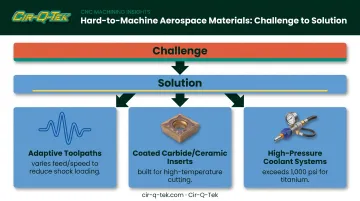
Shops mitigate these issues with:
- Adaptive toolpaths that vary feed and speed to reduce shock loading
- Coated carbide or ceramic inserts built for high-temperature cutting
- High-pressure coolant systems, sometimes exceeding 1,000 psi (70 bar) for titanium
Beyond material behavior, thin-wall features distort easily during cutting, and parts can shift dimensionally after heat treatment, sometimes enough to fail final inspection. Add certification lead times and raw material sourcing delays, and aerospace production schedules routinely stretch longer than commercial machining jobs.
Choosing the Right Aerospace CNC Machining Partner
Not every shop that claims aerospace capability can actually deliver it. Use this checklist before committing to full production:
- Verify certifications directly — confirm current AS9100 status (and NADCAP scope, if special processes are involved) rather than taking a website claim at face value
- Request sample parts and FAI reports — a shop should be able to produce a documented first article, not just a finished-looking part
- Audit the quality system — ask how nonconformances are tracked, how SPC data is captured, and how material traceability is maintained
- Run a small pilot order before committing to full-volume production
Many suppliers look capable on paper but struggle once exotic materials or genuinely tight tolerances enter the picture. Quoting with multiple suppliers and communicating clear design-for-manufacturability (DFM) requirements up front helps filter out the weak ones early.
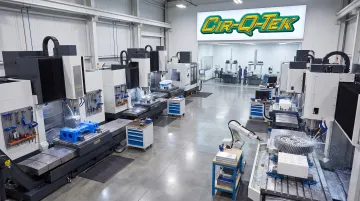
For programs where AS9100 certification isn't yet mandated (prototype hardware, ground support equipment, or precision components adjacent to aerospace programs), Cir-Q-Tek is worth a look. The company runs precision CNC machining with tolerances as tight as ±0.0005 in, using multi-axis, multi-spindle equipment across metals, engineered plastics, and ceramics.
Its facilities carry ISO 9001:2015, IATF 16949, and ISO 13485 certification, with U.S.-based project management out of Bristol, Pennsylvania, and production in Shenzhen, China. Parts get a secondary inspection at the Pennsylvania facility before they ship.
That structure suits teams that need precision-machined parts with domestic project management and offshore production capacity, scaling from a small pilot batch to full production under one partner.
For flight-critical, AS9100-mandated programs, confirm current certification status directly with any supplier. Cir-Q-Tek's current documentation covers ISO 9001, IATF 16949, and ISO 13485, not AS9100 or NADCAP.
Frequently Asked Questions
What is CNC machining used for in aerospace?
CNC machining produces high-precision, flight-critical parts such as engine components, structural elements, landing gear, and avionics housings that must meet strict tolerance and safety standards before they're approved for use.
What certifications are required for aerospace CNC machining suppliers?
AS9100D is the baseline requirement for aerospace quality management. Suppliers handling special processes like heat treatment or NDT also need NADCAP accreditation, and new parts typically require FAI per AS9102.
What is the difference between aerospace machining and standard CNC machining?
Aerospace machining involves tighter tolerances, exotic materials like titanium and nickel superalloys, mandatory quality certifications, and full material traceability, requirements that standard commercial machining generally doesn't carry.
How long does aerospace CNC machining typically take?
Lead times vary widely based on material availability, part complexity, and documentation requirements. Always request a part-specific schedule rather than relying on a generic industry estimate.
Which materials are most commonly used in aerospace CNC machining?
Aluminum, titanium, nickel superalloys, and select stainless steels dominate, chosen for their strength-to-weight ratios and temperature performance rather than machining ease.
Is aerospace CNC machining expensive compared to other manufacturing methods?
Costs run higher due to specialized materials, tight tolerances, certified quality systems, and lower production volumes. That investment is what keeps flight-critical parts airworthy and safe.