Yet many engineers and buyers hit the same wall early in a project: is 3-axis enough, or does this part actually need 4- or 5-axis capability? Guessing wrong affects cost, lead time, and whether the part is even manufacturable as drawn.
This guide breaks down what 3-axis CNC milling is, how it works, how it stacks up against 2.5-, 4-, and 5-axis machining, and when it's the right fit for your next project.
Key Takeaways
- 3-axis milling moves a cutting tool along X, Y, and Z linear axes to remove material from a fixed workpiece
- Most cost-effective, widely available option for panels, brackets, and 2.5D geometry
- Multi-sided or complex parts often need multiple setups—or a move to 4-/5-axis machining
- Pick 3-axis when geometry, tolerances, volume, and budget align with simpler setups
What Is 3-Axis CNC Milling?
3-axis CNC milling is a subtractive manufacturing process. A rotating cutting tool moves along three linear axes, X, Y, and Z, to carve a finished part out of a solid block of material based on programmed instructions.
The Three Axes Explained
Each axis controls a different direction of motion:
- X-axis: side-to-side movement across the worktable
- Y-axis: front-to-back movement across the worktable
- Z-axis: up-and-down movement that controls cutting depth
The spindle (which holds and spins the tool) and the worktable (which holds the part) work together to produce the cut. These axes can move independently or simultaneously, allowing a 3-axis machine to produce 2D and 2.5D geometry such as pockets, slots, and contoured surfaces.
Common 3-axis machine types include vertical machining centers (VMCs), CNC mills, and general-purpose machining centers. This configuration is the standard starting point in most machine shops, and it's the foundation from which 4-axis and 5-axis systems are built, typically by adding a rotary axis or a trunnion table.
3-Axis Milling vs. 3D Printing and Laser Cutting
Milling isn't the only digital fabrication method, but it remains the go-to for functional, load-bearing parts:
- 3D printing is additive, meaning it builds parts layer by layer rather than cutting from solid stock
- Flat-sheet laser cutting is largely limited to two-dimensional profiles cut from sheet material
- 3-axis milling removes material from solid billet or bar stock, producing parts with the mechanical properties of the base material
How 3-Axis CNC Milling Works: The Machining Process
Getting from a CAD file to a finished part follows a consistent sequence, whether the part is a one-off prototype or a production run of thousands.
The CAD-to-CNC Workflow
The process runs like this:
- Design the part in CAD software, either as a 2D drawing or 3D model
- Generate toolpaths in CAM software, which converts the design into cutting instructions
- Post-process into G-code, the language that drives the machine's actual movements
- Run the program on the CNC mill to cut the part
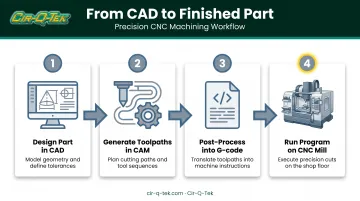
Cir-Q-Tek optimizes toolpaths and fixturing strategy in CAD/CAM before the first chip is cut, which reduces setup time and improves first-pass accuracy.
Workholding and Fixturing Limits
Because a 3-axis machine only moves the tool, not the part, the workpiece stays fixed in a single orientation for each setup. That means:
- Only one face of the part can be machined per setup
- Reaching other sides requires manually repositioning or refixturing the part
- Each repositioning adds setup time and introduces a chance for alignment error
This single-setup constraint is the defining trade-off of 3-axis work. It's simple and reliable, but multi-sided parts take more handling.
Operations and Tooling
3-axis mills handle a wide range of standard operations:
- Drilling, peck drilling, and boring
- Threading and thread milling
- Slotting and profiling
- Pocketing and contouring
- Face milling
Tool choice shapes what's achievable. Flat end mills cut clean pockets and sharp internal corners. Ball-nose cutters follow curved 3D contours, but they leave small scallops between passes that affect surface finish. Angular and dovetail cutters can produce chamfers and some undercut features without switching machine types.
3-Axis vs. 2.5-Axis, 4-Axis, and 5-Axis Milling: What's the Difference?
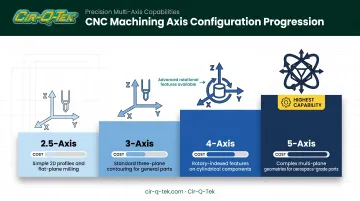
The core difference between these configurations comes down to one thing: how many axes the tool or workpiece can move along, and whether that movement includes rotation. That single variable drives part complexity, setup count, and cost.
Side-by-side:
| Configuration | Axis Motion | Best For | Relative Cost |
|---|---|---|---|
| 2.5-axis | X/Y move together, Z steps between passes | Flat or stepped profiles | Lowest |
| 3-axis | X, Y, Z move independently or together | Panels, enclosures, 2.5D geometry | Baseline |
| 4-axis | 3-axis plus one rotary (A) axis | Cylindrical or angled features, up to 4 sides in one setup | Higher |
| 5-axis | 3-axis plus two rotary axes | Complex curves, undercuts, compound angles | Highest |
A few practical distinctions:
- 2.5-axis machining is really a variation of 3-axis work, where the tool moves in X and Y at once but only steps down in Z between passes.
- 4-axis adds a rotational A-axis, letting the workpiece rotate so up to four sides can be reached without removing it from the fixture.
- 5-axis adds two rotational axes (or a linear-plus-rotary combination), supporting fixed 3+2 positioning or fully simultaneous cuts on curves and undercuts.
On cost, Thomasnet's manufacturing resource notes that 4-axis machines carry more complex setups and higher costs than 3-axis equipment, and 5-axis machines sit above both in price and programming complexity.
When a job outgrows 3-axis, that cost step-up is often unavoidable. Cir-Q-Tek runs multi-axis CNC with tolerances as tight as ±0.0005", so teams can move from 3-axis into 4- or 5-axis work under one manufacturing partner as geometry demands it.
Advantages and Limitations of 3-Axis CNC Milling
No single axis configuration wins every job. Here's an honest look at where 3-axis excels and where it hits a wall.
Advantages of 3-Axis Milling
- Lower cost: equipment, programming, and operating costs run below 4- or 5-axis systems, making it accessible for startups and small-to-medium production runs
- Simpler programming: requires less specialized training than multi-axis systems, so more shops and operators can run it confidently
- High accuracy on straightforward parts: repeatable results for geometries that don't require complex angles or undercuts
Limitations of 3-Axis Milling
- Multiple setups: machining multiple sides or angled features requires re-fixturing, which stretches cycle time and adds misalignment risk
- Complex geometry: deep cavities, undercuts, or compound-angle features can be difficult or impossible without specialized tooling
- Cross-face tolerances: each re-fixturing step can stack alignment error, so holding tight tolerances across multiple faces is harder than on machines that keep the part in one setup, as Okuma explains in its 3+2 vs. 5-axis comparison
Common Applications and Industries for 3-Axis CNC Milling
3-axis milling handles the bulk of parts that don't demand complex, multi-angle geometry. Typical parts include:
- Enclosures and panels
- Brackets and mounting plates
- Prototype components with flat or stepped features
Industries that rely heavily on 3-axis milling include:
- Electronics and computer hardware
- Automotive
- Medical devices
- Industrial process control
- Commercial products
Across these sectors, many shops—including Cir-Q-Tek—run 3-axis milling for rapid prototypes and full production. Customers can move from a single prototype to volume manufacturing without switching suppliers or requalifying a new process mid-program.
Choosing the Right Machining Approach and Partner
Deciding between 3-axis and a higher-axis process comes down to four factors:
- Part geometry: flat, stepped, and coplanar features suit 3-axis; angled or undercut features may need 4- or 5-axis
- Tolerance requirements: fewer setups generally make it easier to hold tight tolerances across faces
- Production volume: small runs and prototypes often favor 3-axis for cost reasons
- Budget: 3-axis equipment and programming cost less to buy and run than 4- or 5-axis alternatives
Bring a manufacturing partner in early—ideally during design—so you can confirm whether a part is cost-effective on 3-axis equipment or truly needs 4- or 5-axis capability before drawings are finalized.
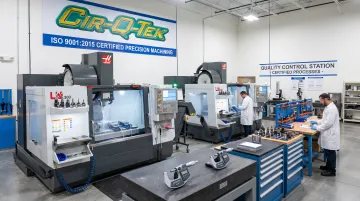
Cir-Q-Tek operates as a one-stop manufacturing sourcing partner, offering precision CNC machining alongside PCB fabrication and PCBA assembly. Work runs through ISO 9001, ISO 13485, and IATF 16949 certified facilities. That matters for regulated industries like medical devices and automotive, where documentation and process control aren't optional.
If you're weighing axis configurations for an upcoming part, request a quote to get engineering input before you lock the design.
Frequently Asked Questions
What is 3-axis machining?
3-axis machining moves a cutting tool along the X, Y, and Z linear axes to remove material from a workpiece. It's typically used to produce 2D and 2.5D parts like panels, brackets, and enclosures.
What is the difference between 3-axis, 2.5-axis, 4-axis, and 5-axis machining?
2.5-axis machines cut in X and Y while stepping down in Z between passes. 4- and 5-axis systems add rotation so the tool or workpiece can tilt, handling complex geometry in fewer setups—at higher machine and programming cost.
What materials can be machined using 3-axis CNC milling?
Aluminum, steel, stainless, engineered plastics, and composites all machine well on 3-axis equipment. Tooling and spindle speed must match the material.
Is 3-axis milling cheaper than 5-axis milling?
Generally, yes. 3-axis machines and programming cost less to buy and run than 5-axis systems. Multiple setups on complex parts can erase part of that savings in labor and cycle time.
Can a 3-axis machine cut angled or undercut features?
Some angled features are possible using specialized tooling like dovetail or angular cutters. Compound angles and true undercuts, though, typically require 4- or 5-axis machining for proper access.
What tolerances can be achieved with 3-axis CNC milling?
With the right equipment and process control, precision 3-axis machining holds tight tolerances. Cir-Q-Tek's CNC line holds ±0.0005" for demanding applications.