
But sourcing aluminum CNC parts isn't always simple. Many buyers struggle with inconsistent quality when they go overseas, or get hit with surprise costs and delays when a vendor doesn't communicate well. Machining time alone often outweighs material and finishing costs combined, so small design or process missteps get expensive fast.
This guide covers the processes, alloys, tooling, and design choices that determine whether your aluminum parts come out right the first time. Cir-Q-Tek approaches this by pairing U.S.-based project management with offshore CNC machining, offering tolerances as close as ±0.0005", without the usual guesswork that comes from working with a factory you never talk to directly.
Key Takeaways
- Aluminum’s machinability, strength-to-weight ratio, and corrosion resistance make it a top CNC material choice
- Choose 6061 for general-purpose parts; use 7075 for high-strength, aerospace-grade jobs
- Machining time, not material cost, usually drives your final price
- Use carbide end mills with 2–3 flutes and a high helix angle for the best finish and tool life
What Is Aluminum CNC Machining and Why Is It So Popular?
Aluminum CNC machining is a subtractive process. Computer-controlled mills and lathes cut away material from a solid block or bar of aluminum stock until only the finished part remains. No molds, no long lead-time tooling, just programmed toolpaths removing exactly what's needed.
Aluminum is popular because it combines several properties buyers rarely get in one metal:
- Lightweight — roughly a third the density of steel
- High strength-to-weight ratio — strong enough for structural parts without the mass
- Thermal and electrical conductivity — useful in enclosures and heat sinks
- Corrosion resistance — holds up in outdoor and marine environments without heavy coating
Aluminum vs. Steel: The Machining Difference
Speed is where aluminum really separates itself. Harvey Performance recommends cutting speeds of 800-1,500 SFM for wrought aluminum alloys, compared to just 100-350 SFM for stainless steel. That's a substantial gap, and it translates directly into shorter cycle times and lower labor cost per part.
| Factor | Aluminum | Steel |
|---|---|---|
| Machinability | Excellent, cuts easily | Harder, slower cutting |
| Tool wear | Lower with correct tooling | Higher, tools wear faster |
| Cutting speed | 800-1,500 SFM | 100-350 SFM |
| Relative cost | Lower machining time = lower cost | Higher machining time |

Those cycle-time gains only stick if quoting and quality keep up. Cir-Q-Tek's dual U.S./Shenzhen model pairs offshore aluminum machining rates with a domestic team on quotes, communication, and inspection—so machine speed isn't lost to slow vendor back-and-forth.
Core CNC Machining Processes Used on Aluminum
CNC Milling
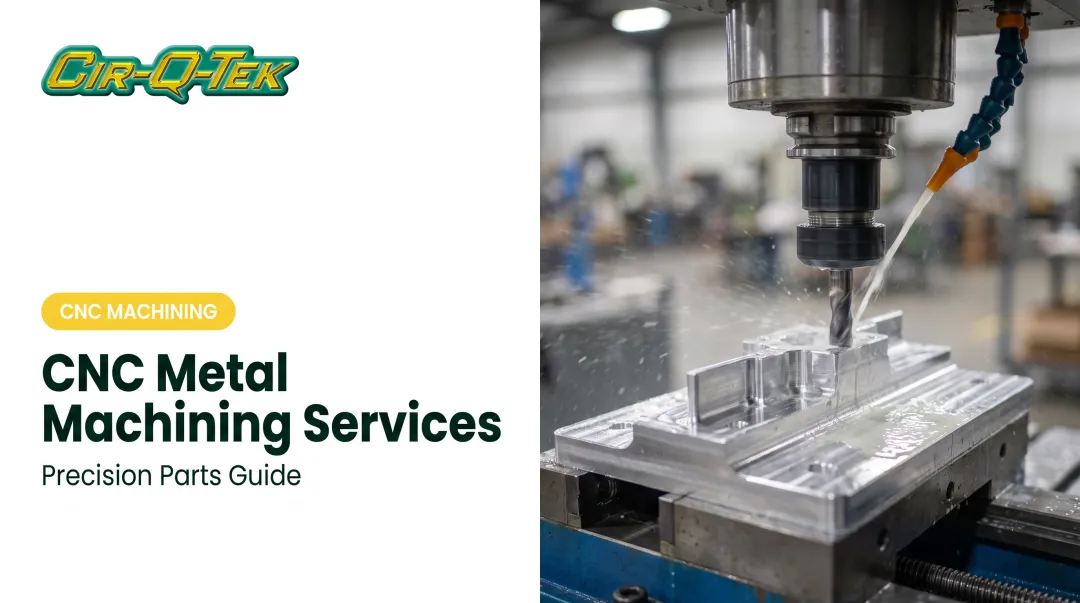
Milling uses rotating, multi-point cutting tools to remove material from a stationary (or fixtured) workpiece. It's the most versatile process for aluminum, handling flat faces, pockets, slots, and complex 3D contours in a single setup on multi-axis equipment.
CNC Turning
Turning spins the workpiece against a stationary cutting tool. It's the natural choice for round geometry: shafts, bushings, spacers, and threaded fittings all come off a lathe far more efficiently than a mill.
Drilling, Boring, and Tapping
These operations handle internal features:
- Drilling creates starter and through-holes
- Boring enlarges and refines them for tight tolerances
- Tapping cuts internal threads for fasteners
Aluminum's softness means tool sharpness and feed rate matter more than you'd think. Dull tools or feed rates that are too slow tend to tear the material instead of cutting it cleanly, leaving a rough or gummy finish.
Choosing the Right Process
Part geometry decides this one:
- Round, symmetrical parts (shafts, bushings, fittings) → turning
- Flat, boxy, or complex 3D parts (brackets, housings, enclosures) → milling
- Parts needing both (turned OD with milled flats or pockets) → combined mill-turn in one job

Popular Aluminum Alloys for CNC Machining
6061: The General-Purpose Standard
The Aluminum Association confirms 6061 is the most widely used alloy in the 6xxx series, and it's the default choice for most CNC projects. It balances good strength, low cost, and excellent machinability, making it the material of choice for brackets, enclosures, and fixtures.
7075: High-Strength Applications
When parts need to handle more stress, 7075 steps in. Kaiser Aluminum data shows 7075-T6 hits a tensile strength around 572 MPa (about 83 ksi), compared to 6061-T6's 310 MPa (about 45 ksi). That extra strength comes at a cost, though: 7075 is harder on cutting tools and pricier per pound.
5052 and 2024: Specialized Roles
- 5052 — non-heat-treatable, strong corrosion resistance, common in marine and outdoor housings; only fair machinability
- 2024 — good fatigue resistance, used in structural aircraft components; good machining characteristics but only fair corrosion resistance
| Alloy | Key Property | Typical Application |
|---|---|---|
| 6061-T6 | Balanced strength/machinability | Brackets, enclosures, fixtures |
| 7075-T6 | Highest strength | Aerospace, high-stress parts |
| 5052-H34 | Corrosion resistance | Marine, outdoor housings |
| 2024-T4 | Fatigue resistance | Aircraft structural parts |

Heat Treatment Tempers
T6 means solution heat treatment plus artificial aging. T651 adds a stretching step for stress relief, which reduces warp and distortion during machining — especially valuable on broad, flat parts where dimensional stability matters.
How Hard Is It to Machine Aluminum? Tools, Speeds, and Feeds
Aluminum is generally considered one of the easier metals to machine, but its softness still demands the right setup. The main headache is built-up edge, where material gums up on the cutting edge instead of clearing away as a chip.
Choosing End Mills
- 2-flute end mills — best chip clearance, ideal for aggressive roughing
- 3-flute end mills — good balance of finish quality and material removal
- High-helix geometries (35-40° for roughing, 45° for finishing) help chips evacuate cleanly instead of recutting
Tool Material and Coatings
Carbide is the industry standard over high-speed steel for aluminum work. Sandvik reports coated carbide inserts make up 80-90% of all cutting-tool inserts across metal cutting generally, and aluminum work leans heavily on that trend. Common coatings include ZrN and TiB2, though uncoated tools can perform well too.
Speeds and Feeds
Aluminum runs best at high surface speeds with carbide, often several hundred SFM and higher, paired with feed rates that form a real chip. Too slow or too light a cut causes rubbing, built-up edge, and a smeared finish.
Parameters also shift by grade. 6061 machines freely; harder alloys like 7075 need sharper edges and more conservative feeds. Increase feed before speed when dialing in an unfamiliar setup.
Cutting Fluid
Dry cutting isn't recommended for finishing operations. Fluid helps prevent chip smearing on the surface and keeps temperatures under control. Soluble-oil emulsions work well for most aluminum jobs.
Tooling, speeds, feeds, and fluid only pay off when they match the alloy on the table. Cir-Q-Tek's team sets those parameters by grade, so a 7075 part doesn't get run with 6061 values.
Cost, Thinness, and Design Considerations for Aluminum Parts
What Drives Cost
Four factors set your price:
- Alloy — 7075 and 2024 cost more than 6061
- Complexity — deep pockets, tight radii, and multi-axis features add machine time
- Tolerance — tighter specs mean slower cuts and more inspection
- Finishing — anodizing, bead blasting, or polishing add steps after machining
Machining time is usually the single biggest line item, often exceeding material cost outright.
How Thin Can Aluminum Be Machined?
Walls thinner than about 0.040" (1 mm) start to chatter, warp, or distort under cutting forces. Industry design guidance recommends staying above that threshold for reliable results. Stable fixturing and slower feeds can still push thinner sections when the part demands it.
Design Tips That Cut Cost and Risk
- Avoid sharp internal corners — keep internal corner radii at least one-third of the cavity depth (larger radii machine faster)
- Use uniform wall thickness — reduces warping risk during and after cutting
- Specify economic tolerances on non-critical features — tight tolerances everywhere just add cost without adding value

Cir-Q-Tek's CAD design and CAM programming support helps customers spot these issues before the first cut, which keeps both cost and lead time predictable.
Surface Finishing and Real-World Applications
Common Finishing Options
- Standard anodizing (Type II): adds corrosion resistance and color options
- Hard anodizing (Type III): provides a thicker, more wear-resistant coating for demanding applications
- Bead blasting and polishing: improve appearance and surface texture
Where Aluminum CNC Parts Show Up
Finish choice usually follows the end market. Aluminum CNC parts are common in:
- Medical devices: housings, brackets, and precision components
- Automotive: cylinder heads, transmission housings, EV components
- Telecom: enclosures and structural hardware
- Consumer electronics: panels, knobs, and casings
Medical and automotive programs usually require documented process control along with part quality. Cir-Q-Tek's ISO 13485 and IATF 16949 certifications support that need, so aluminum components for those sectors are produced under audited quality systems.
Frequently Asked Questions
How much does aluminum CNC machining cost?
Cost depends on alloy, tolerance requirements, part complexity, and finishing needs. These factors vary by project, so a quote is the most accurate way to get pricing.
Can CNC machines cut aluminum?
Yes. Aluminum is one of the most commonly CNC-machined metals, well-suited to milling, turning, drilling, and tapping across nearly every industry.
How hard is it to CNC aluminum?
It's relatively easy compared to steel or titanium. But you still need proper tooling and feed rates to avoid built-up edge and get a clean finish.
Can 6061 aluminum be machined?
Absolutely. 6061 is highly machinable and remains the go-to alloy for general-purpose CNC parts.
What is the most commonly machined aluminum alloy?
6061-T6 is the most common choice for its balance of strength, cost, and machinability.
How thin can aluminum be machined?
Most reliable designs keep walls above 0.040 in (1 mm). Thinner sections are possible with stable fixturing and slower feeds, but they add risk and cost.