What is precision manufacturing?
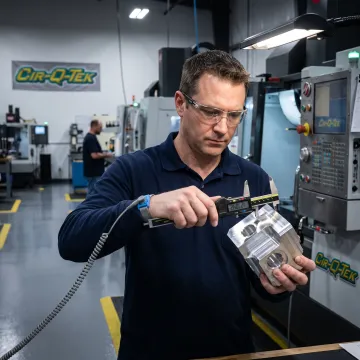
Precision manufacturing is the production of components and assemblies to tightly controlled dimensions, material requirements, and quality standards. It commonly uses CNC equipment, CAD/CAM programming, specialized inspection tools, and documented processes to achieve repeatable results. It is important when fit, function, reliability, or regulatory requirements are critical, such as in medical devices, automotive systems, industrial controls, and electronics.
What is a precision manufacturing company?
A precision manufacturing company produces parts or assemblies that must meet exact specifications rather than broad general-production tolerances. Its services may include CNC machining, PCB fabrication, electronics assembly, molding, or casting, supported by engineering and inspection resources. Cir-Q-Tek acts as an integrated sourcing partner, coordinating these capabilities through certified facilities for prototype and production requirements.
What does a precision engineer do?
A precision engineer helps translate product requirements into manufacturable, repeatable components or assemblies. Their work can include reviewing drawings and tolerances, selecting materials and processes, addressing design-for-manufacturing concerns, supporting CAD/CAM programming, and resolving production challenges. The goal is to balance performance, quality, manufacturability, cost, and delivery requirements before and during production.
What tolerances can Cir-Q-Tek achieve for CNC machining?
Cir-Q-Tek’s precision CNC machining capabilities can maintain tolerances as close as ±0.0005 inches, depending on the part geometry, material, feature requirements, and inspection plan. Multi-axis and multi-tasking equipment, live tooling, multiple spindles, CAD/CAM expertise, and high-end metrology support accurate, repeatable production. A drawing review helps confirm feasible tolerances before quoting.
Which materials can be used for precision-machined parts?
Cir-Q-Tek can machine standard metals, high-strength and high-temperature alloys, engineered plastics, ceramics, composites, and other non-metal materials. The team also has finish-machining expertise for aluminum, zinc, magnesium, iron, and stainless-steel castings. Material selection should account for mechanical performance, thermal conditions, corrosion resistance, finish requirements, part geometry, and the intended production quantity.
Can you support both prototypes and production orders?
Yes. Cir-Q-Tek supports small prototype orders as well as production manufacturing programs. For PCBs, pre-production samples generally take three days to build and two days to ship, while production orders are typically ready to ship in 10 days to four weeks. Lead times for machining and assembly depend on drawings, materials, complexity, quantities, and component availability.
What information is needed to request a manufacturing quote?
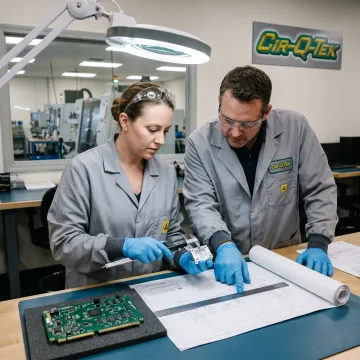
For machined parts, provide CAD and 3D data and/or fabrication drawings that identify materials, dimensions, tolerances, finishes, quantities, and any inspection requirements. PCB and PCBA quotes require a Gerber package or ODB file and a bill of materials. Complete documentation allows the manufacturing team to evaluate process needs, confirm feasibility, and prepare an accurate quote.
How does Cir-Q-Tek manage quality for regulated products?
Cir-Q-Tek uses manufacturing facilities certified to ISO 9001, ISO 13485 for medical-device manufacturing, and IATF 16949 for automotive requirements. Quality support includes controlled processes, multi-stage inspection, and advanced metrology for machined parts. PCB assembly lines use inline automated optical inspection and X-ray equipment to help verify complex electronic assemblies during production.