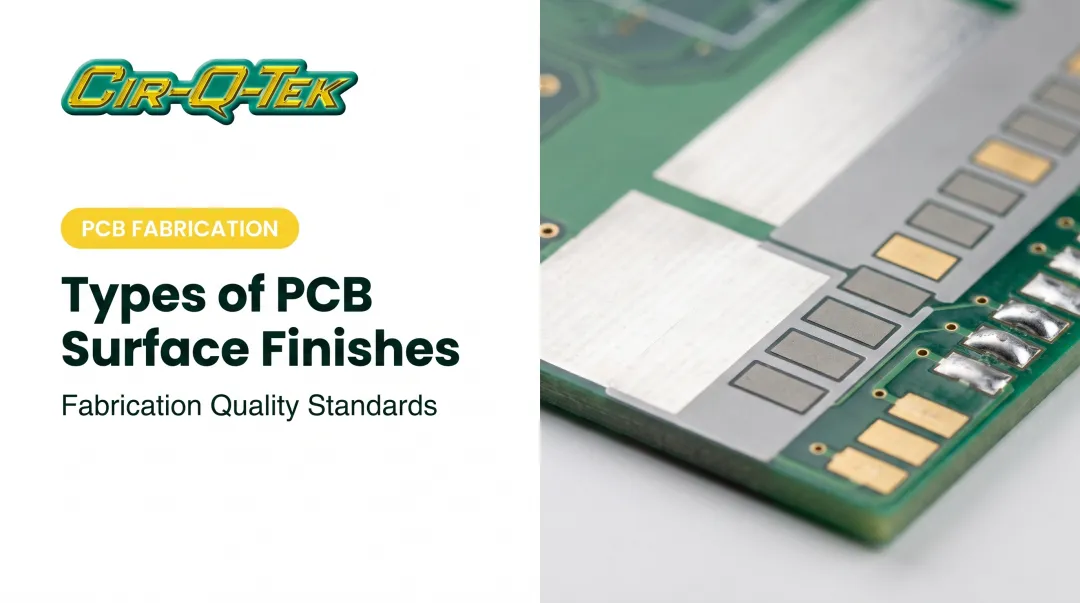

The finish you choose affects solderability, shelf life, and total program cost. For medical, automotive, and industrial builds, it can also determine whether a board survives years in the field or fails at the worst possible moment.
This guide compares OSP and ENIG across cost, durability, and real-world use cases, so engineers and buyers can make a confident call before Gerbers go out the door.
Key Takeaways
- OSP is the budget-friendly, RoHS-compliant choice for single-reflow consumer products with short shelf-life needs
- ENIG delivers stronger corrosion resistance, flatness, and multi-reflow durability for high-reliability builds
- Storage windows, reflow count, and exposed contact requirements often decide the finish, not price alone
- Cir-Q-Tek fabricates boards with both finishes, giving engineers flexibility across consumer and regulated programs
OSP vs ENIG: Quick Comparison
| Factor | OSP | ENIG |
|---|---|---|
| Cost | Lowest-cost option, no precious metals | Higher, due to gold and multi-stage electroless process |
| Composition | Thin organic azole coating (0.2-0.65 microns) on copper | Nickel-phosphorus barrier plus thin immersion gold topcoat |
| Shelf life | Product-dependent, often 3-12 months under controlled storage | Longer than OSP; exact duration varies by supplier |
| Reflow durability | Loses solderability margin after repeated reflow cycles | Handles multiple reflow and rework cycles more reliably |
| Electrical contact | Non-conductive, not suited for exposed contacts | Conductive gold surface, works for keypads and connectors |
According to Sierra Circuits' surface finish comparison, both finishes deliver excellent flatness and fine-pitch component support. The real differences show up in storage handling and how many thermal cycles the board needs to survive.

What Is OSP?
OSP (organic solderability preservative) is a water-based organic coating that chemically bonds to copper, blocking oxidation before soldering. It's specified under IPC-4555 for high-temperature, lead-free applications.
Why fabricators like it:
- Low cost — no gold, no multi-step electroless plating
- RoHS-compliant — no leaded finishes or heavy-metal plating baths
- Flat surface ideal for SMT paste printing
- Simple conveyorized process — self-limiting thickness keeps coating control low-maintenance
Cir-Q-Tek's fabrication line lists ENTEK 106 A-HT as its OSP offering, available on single-sided, double-sided, and multilayer boards.

Use Cases of OSP
OSP fits high-volume, cost-sensitive electronics where a single reflow pass and a moderate field life are acceptable:
- Toys and consumer peripherals
- IoT devices with short product life cycles
- Budget-driven programs where storage windows are tightly controlled
A Foxconn study on high-volume computing production called OSP "the most cost effective" lead-free finish alternative. It held up at scale when paste volume and reflow profiles were tuned to control voiding.
The paper did not publish a specific savings percentage. Treat OSP's cost edge as qualitative until your fabricator quotes your board.
What Is ENIG?
ENIG (electroless nickel immersion gold) is a two-layer metallic finish. The nickel layer acts as a diffusion barrier between copper and the thin gold topcoat, which protects against oxidation and provides a conductive surface.
Core benefits:
- Excellent flatness, well-suited to fine-pitch components
- Longer storage tolerance compared to OSP in most cases
- Multiple reflow tolerance, useful for complex double-sided assemblies
- Conductive surface, workable for keypads, edge connectors, and test points
A related variant, ENEPIG, adds a palladium layer between the nickel and gold. This is specified under IPC-4556 and used for demanding wire-bonding applications or boards needing mixed surface finishes on the same panel.

Use Cases of ENIG
ENIG shows up wherever field reliability outweighs upfront finish cost:
- Medical devices requiring long service life
- Automotive electronics facing thermal and vibration stress
- Aerospace and industrial controls
- Fine-pitch BGAs, CSPs, and wire-bonded packages
A 2022 accelerated reliability study found ENIG ranked above OSP overall in thermal cycling, with its strongest solder-alloy combination reaching a characteristic life of 4,440 cycles, according to research published in PMC.
The same study found OSP outperformed ENIG in certain SAC-Mn and SAC-In alloy pairings, so finish choice alone doesn't guarantee reliability. The full material stack matters.
OSP vs ENIG: Which Is Better?
Neither finish wins across the board. The right choice depends on:
- Project budget and how much cost pressure exists per unit
- Component density, especially fine-pitch BGAs or exposed contacts
- Storage and inventory timelines between fabrication and assembly
- Reflow complexity, including rework and double-sided processes
- End-use reliability requirements driven by industry or application
Choose OSP for cost-sensitive, quick-turn consumer projects with a single reflow pass and a short storage window before assembly.
Choose ENIG for medical, automotive, and industrial-grade boards that need long shelf life, multiple reflow cycles, or exposed electrical contacts like keypads and connectors.
Manufacturers that offer both finishes can help validate the decision before production starts.
Cir-Q-Tek runs ISO 9001, ISO 13485, and IATF 16949 certified PCB lines supporting both ENIG and OSP (ENTEK 106 A-HT). Coverage spans single-sided, double-sided, and up to 40-layer multilayer boards — useful when a program moves from prototype to regulated production without switching suppliers.
Real-World Example: Choosing the Right Finish for a Regulated Application
Picture a mid-size automotive electronics supplier building a sensor control board. The original design specified OSP to keep unit costs down during early production runs.
The problem showed up during assembly. Boards sat in inventory longer than expected, and a two-reflow process on a mixed-technology board produced inconsistent solder wetting on some lots.
A handful of field units later came back with corrosion-related connection issues traced to the finish's limited storage and reflow margin.

The engineering team re-specified the board with ENIG, prioritizing:
- Longer shelf-life tolerance for inventory buffering
- Reliable solderability across the second reflow pass
- Better corrosion resistance for under-hood thermal cycling
Lab cycling data backs this kind of switch. ENIG's strongest tested combinations held up for thousands of thermal cycles under the same stress profile where OSP typically falls short.
Match the finish to the application's risk profile up front, and you avoid rework and field returns that can escalate into recalls. For regulated programs, the finish decision belongs in the same conversation as material selection and process validation.
If you're weighing this decision for an upcoming build, Cir-Q-Tek's ISO-certified manufacturing team can help evaluate finish options against your storage timeline, reflow process, and reliability targets before you commit to a production run.
Conclusion
There's no universal winner between OSP and ENIG. OSP wins on cost and works well for single-reflow consumer products. ENIG wins on durability and shelf life for regulated, high-reliability applications.
Match the finish to real-world outcomes: cost control when the product life cycle is short, and long-term reliability when failure isn't an option. Get that alignment right and you cut field failures while improving ROI.
If you're weighing OSP vs ENIG for a medical, automotive, or industrial board, a manufacturing partner that handles PCB fabrication and PCBA can help validate the finish against your reflow profile, shelf-life needs, and volume targets before you lock the design.
Frequently Asked Questions
Is ENIG better than HASL?
ENIG offers superior flatness and fine-pitch compatibility compared to HASL's uneven surface. HASL remains cheaper and works well for through-hole assemblies where coplanarity matters less.
What is the difference between ENIG and ENEPIG?
ENEPIG adds a palladium layer between the nickel and gold, supporting wire-bonding reliability. It is less prone to black pad defects than standard ENIG, though not fully immune.
What is OSP finish for PCBs?
OSP is a thin, organic, water-based coating that protects copper from oxidation before soldering. It's popular for low cost and RoHS compliance.
How long does an OSP-coated PCB last in storage?
OSP boards typically remain solderable for roughly 3-12 months depending on the specific product and storage conditions. Longer storage generally requires vacuum-sealed, humidity-controlled packaging.
Can OSP be used for multiple reflow cycles?
OSP generally loses solderability margin after repeated reflow exposure, making it less ideal for complex, multi-step assembly processes compared to ENIG.
Which finish is better for fine-pitch BGA components?
Both OSP and ENIG offer flat surfaces suitable for BGAs. ENIG's added durability through multiple reflows makes it the stronger choice for complex, double-sided fine-pitch designs.