If you're a product designer, engineer, or part of a sourcing team evaluating manufacturing partners, the mechanics of production CNC machining directly affect three things you care about: cost, tolerance, and delivery. Get the process wrong and you'll see dimensional drift, rejected batches, and blown lead times — problems that compound fast in regulated industries like medical devices and automotive.
Despite being a widely used term, the production-specific mechanics of CNC machining — programming, tolerance stack-up, quality control — are often understood only within engineering teams. This guide breaks down how the process actually works, what drives cost and precision, and when CNC machining is, or isn't, the right call for your production run.
Key Takeaways
- CNC machining removes material via programmed tool paths for repeatable tight tolerances from prototype to production
- Workflow runs CAD design, CAM programming, machine setup, cutting, then inspection
- Material, axis count, tolerances, and part geometry drive cost and cycle time
- Simple high-volume parts or complex internal geometries often suit die casting, injection molding, or 3D printing better
What Is CNC Machining, and Why Is It Used in Production?
What Is CNC Machining?
CNC machining is a subtractive manufacturing process. Computer-controlled tools remove material from a solid block or billet, called stock, to create a part matching a digital design. The machine follows G-code, generated from CAD/CAM software, that tells cutting tools exactly where to move, how fast to spin, and how deep to cut.
The result is a finished part cut to exact dimensions—no operator turning dials or guiding the cutter by hand.
Two quick distinctions:
- 3D printing (additive) builds parts layer by layer; CNC machining removes material from a solid block instead
- Manual machining relies on a machinist controlling feeds and speeds by hand, which introduces more part-to-part variability than a CAD/CAM-driven program
Why CNC Machining Is Used in Production Manufacturing
Manufacturers turn to CNC machining in production for one core reason: repeatability. A program that cuts one part correctly will cut the next 10,000 the same way, provided tooling and calibration hold.
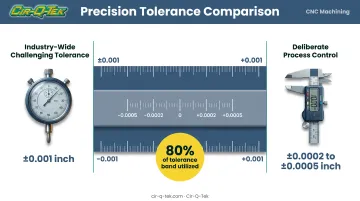
Modern Machine Shop reports that tolerances tighter than ±0.001 inch are considered challenging industry-wide, yet many shops regularly hold ±0.0002 to ±0.0005 inch with deliberate process controls—using only 80% of the tolerance band and minimizing thermal drift (Modern Machine Shop).
Cir-Q-Tek delivers CNC-machined parts within that range, holding as close as ±0.0005" across metals, engineered plastics, and ceramics.
Production environments demand:
- Batch-to-batch consistency — part 1 and part 5,000 must measure the same
- Regulatory compliance — medical (ISO 13485) and automotive (IATF 16949) customers require certified, documented processes, not just accurate parts
- Predictable lead times — scheduled batches need consistent cycle times to hit delivery windows
Skip these controls, and failures show up fast: dimensional drift as tools wear, parts rejected at incoming inspection, and assembly failures when mating components don't fit.
In regulated sectors, the bar is higher. Automotive suppliers are often required to hold third-party IATF 16949 certification, and medical device manufacturers rely on ISO 13485-certified processes to keep traceability intact through the supply chain.
How CNC Machining Works (Conceptual Flow)
CNC production machining converts a digital design into physical motion. A CAD file defines the geometry. Software translates that geometry into a program the machine can execute. The machine then drives cutting tools through raw material (aluminum bar stock, a titanium billet, whatever the print calls for), removing material until the final part emerges.
Three inputs feed the process:
- A CAD file describing the exact geometry
- Raw material in a chosen billet, block, or bar-stock format
- A CAM-generated program defining toolpaths, spindle speeds, and feed rates
NIST research on integrated CAM/CNC systems frames this as a digital thread. CAM software generates the toolpath, a postprocessor converts it into machine-specific G-code, and the CNC controller interprets and executes that code in real time (NIST). Every machine dialect is slightly different, so the postprocessor step matters more than most shops expect.
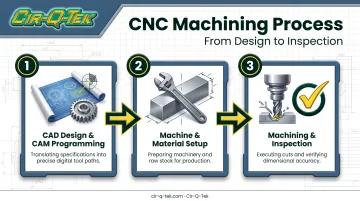
Step 1: CAD Design and CAM Programming
Engineers start with a 3D CAD model that defines every dimension and tolerance on the part. CAM software then translates that model into machine-readable instructions, calculating toolpaths, cutting sequences, and feed rates. At Cir-Q-Tek, this stage pairs CAD design support with in-house CAM programming expertise, so the toolpath , not just the part, is engineered for accuracy before a single cut is made.
Step 2: Machine and Material Setup
Before full production starts, the correct raw material is secured in the workholding, tooling is loaded and offset, and the program is proved out on the machine. A first-article inspection then confirms the part matches the print. Together, these checks catch programming errors or fixture issues before they multiply across a batch.
Step 3: Machining and Inspection
The CNC machine executes the program, cutting, drilling, or turning the part to its final geometry. Finished parts then go through dimensional inspection against the print, plus any secondary finishing like deburring, anodizing, or plating. Cir-Q-Tek adds a second inspection layer at its Pennsylvania facility before parts ship, giving customers a domestic quality checkpoint on top of factory-level inspection.
Where CNC Machining Is Applied in Production
Production CNC machining runs on a handful of machine types, each suited to different part geometries:
| Machine Type | Best Suited For |
|---|---|
| CNC mill (3-axis) | Flat, prismatic parts — panels, enclosures, brackets |
| CNC lathe/turning center | Round, rotating parts with varying diameters |
| Multi-axis machining center (3+2 or 5-axis) | Multi-sided parts needing fewer setups |
| Swiss-type lathe | Long, slender parts with tight length-to-diameter ratios |
Production CNC machining also shows up at multiple points in a part's life:
- Validating a prototype design before tooling investment
- Ramping up a new production line
- Running full-scale continuous batches
- Producing spare parts years after original tooling is retired
Because it needs no dedicated tooling, CNC machining bridges gaps other processes can't, especially between prototype and a fully tooled process like injection molding or die casting.
Industries most reliant on CNC production machining include:
- Medical devices: implantable components, surgical instrument parts, diagnostic equipment housings
- Automotive: sensor housings, brackets, engine and drivetrain components
- Industrial process control: valve bodies, precision fittings, instrumentation enclosures
Cir-Q-Tek supports these regulated industries with ISO 13485- and IATF 16949-certified CNC machining, holding tolerances as close as ±0.0005".
Paired with PCB fabrication and turnkey PCBA, that mix keeps machined components and electronics under one roof instead of split across separate suppliers.
Typical triggers for choosing CNC production machining include:
- Tight tolerances that casting or molding can't reliably hit
- Production-grade metals or engineered plastics
- A bridge solution while injection molds are still being built
Once running, it is scheduled and recurring work: batches or continuous runs, sometimes unattended in "lights-out" overnight shifts, not a one-off job.
Key Factors, Common Misconceptions, and When CNC Machining May Not Be Ideal
Key Factors That Affect CNC Machining in Production
Material selection has the biggest impact on machinability, tool wear, and cycle time:
- Aluminum — among the easiest metals to machine, supports high material removal rates, though chatter and fixturing limits still cap speed
- Stainless steel — needs slower speeds and tooling designed to resist edge chipping compared with aluminum
- Titanium — generates concentrated heat and wears tools chemically, lowering achievable cutting speeds
- Engineered plastics like PEEK — need grade-specific stress relief and controlled cooling to avoid warping or contamination
Beyond material, machine capability shapes what's achievable. A 3-axis mill handles flat, single-plane features; a 5-axis center reaches multiple sides in one setup, cutting handling time and datum-transfer error. Tolerance requirements and part geometry complexity then determine setup time and cost per part.
Common Issues and Misconceptions
CNC machining isn't as hands-off as its automation suggests. Skilled programming, careful setup, and inspection oversight remain essential. A poorly written program or a worn tool will cut thousands of bad parts just as fast as good ones.
There's also confusion between general CNC machining and CNC production machining. General CNC machining covers everything from a one-off prototype to a short run. CNC production machining specifically refers to optimized, high-volume runs using automated tool changers and minimal manual intervention, tuned for consistency across thousands of cycles.
When CNC Machining May Not Be the Right Choice
CNC machining isn't always the most economical option:
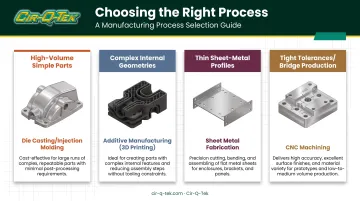
- Extremely high-volume simple parts — once tooling is amortized, die casting or injection molding often beat per-part CNC costs
- Highly complex internal geometries — channels or ducts a cutter can't reach suit additive manufacturing or a hybrid print-then-machine approach
- Thin sheet-metal profiles — laser cutting, stamping, or waterjet usually cost less than milling flat patterns from plate
Machine Design notes injection molding's edge at very high volumes, where unit price drops relative to tooling investment. There is no universal breakeven—it depends on tooling, cycle time, and scrap.
Conclusion
CNC machining is a precise, computer-controlled subtractive process used across modern production manufacturing, especially in regulated, high-tolerance industries like medical devices and automotive. Understanding how it works, from CAD/CAM programming through final inspection, gives design and sourcing teams the context to make informed decisions about cost, quality, and lead time.
Teams that get the most value apply CNC deliberately. They match material, machine type, and tolerance requirements to each part rather than defaulting to it for every job.
Pair that judgment with a manufacturing partner that holds the right certifications and inspection discipline—such as Cir-Q-Tek's ISO 13485 and IATF 16949-certified CNC lines—and you protect both part quality and program cost.
Frequently Asked Questions
What does CNC production mean?
CNC production refers to using computer numerical control machines to manufacture parts in scheduled batches or continuous runs, rather than one-off prototypes. It emphasizes repeatability, automation, and cost efficiency at volume.
What is the CNC machine production process?
The process flows from CAD design to CAM programming, which generates machine-readable tool paths. The CNC machine then cuts the part to spec, followed by dimensional inspection and any secondary finishing before shipment.
What is the difference between CNC machining and CNC production machining?
General CNC machining covers everything from prototypes to short runs. CNC production machining specifically means optimized, high-volume runs using automated tool changers and minimal manual intervention.
How accurate is CNC machining for production parts?
Many production shops hold ±0.001" routinely. With disciplined process controls, ±0.0002" to ±0.0005" is achievable—though tighter specs increase machining time and cost.
What materials can be used in CNC production machining?
Common metals include aluminum, stainless steel, and titanium, while common plastics include ABS, nylon, and PEEK. Material choice affects tool wear, cycle time, and achievable tolerance.
How does CNC machining compare to injection molding for production?
CNC machining requires no tooling investment and suits lower-to-mid volumes with faster turnaround. Injection molding becomes more cost-effective at very high volumes once tooling costs are amortized.