
CNC precision machining exists to close that gap. It uses computer-controlled cutting tools to remove material with far tighter accuracy than conventional shop-floor methods allow. The National Institute of Standards and Technology defines precision machining by the ability to repeatedly manufacture parts to specified tolerances, not just hit the number once and hope for consistency.
This article walks through how the process works, which machine types get combined to achieve those tolerances, which materials hold up best, and what to check before choosing a manufacturing partner.
Key Takeaways
- Routine tolerances of ±0.001" to ±0.002"; high-precision work reaches ±0.0002" or tighter
- Milling, turning, EDM, grinding, and 5-axis often combine on one part for final geometry and finish
- Standout benefits vs. conventional machining: repeatability, less scrap, complex geometries
- Vet partners on certifications and inspection rigor—not just the tolerance on the spec sheet
What is CNC Precision Machining?
CNC precision machining is a subtractive process. A computer numerical control system drives cutting tools through a workpiece, following G-code generated from a CAD/CAM model. Tolerance targets and inspection rigor set it apart from standard CNC work, not the machine itself.
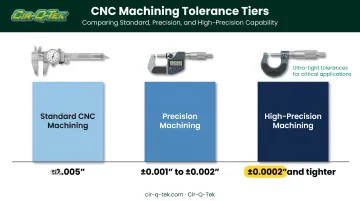
Shops commonly work within these rough tolerance bands, though they're industry convention rather than a formal published standard:
- Standard CNC machining: around ±0.005"
- Precision machining: ±0.001" to ±0.002"
- High-precision machining: ±0.0002" and tighter
CAD software builds the 3D model with exact dimensions and tolerance callouts. CAM software then translates that model into toolpaths and cutting instructions the machine can actually execute. Skip a careful CAD/CAM handoff and you risk a part that looks right on screen but drifts out of spec on the shop floor.
Cir-Q-Tek's CNC machining service holds tolerances as close as ±0.0005", tighter than typical precision bands and fit for medical and automotive critical features. Its facilities carry both ISO 13485 and IATF 16949 certification, the two credentials medical device and automotive buyers tend to ask for first. That level of accuracy matters most when a production run needs thousands of identical, interchangeable parts, not just one good sample.
Precision Machining vs. Standard CNC Machining
Every precision machining operation runs on CNC control, but not every CNC job qualifies as precision work. A shop holding ±0.010" on brackets and another holding ±0.0005" on a surgical instrument component are both doing "CNC machining." Only the second clears the precision bar, because tolerance and inspection rigor define the category.
The CNC Precision Machining Process
Getting from a digital design to a finished, inspected part follows a fairly consistent sequence, regardless of which techniques get used along the way.
Design and CAD/CAM Programming
Engineers build a detailed 3D model with dimensions, tolerances, and material callouts. CAM software then converts that geometry into G-code toolpaths that define where to cut, how fast to move, and in what order.
Before any metal is cut, teams typically run programs through simulation to catch:
- Tool collisions
- Over-travel errors
- Programming mistakes that would scrap material and waste machine time
Machine Setup and Machining
Operators fixture the workpiece securely and select the right cutting tools for the geometry and material. From there, they set the cutting parameters, which shift with the material (for example, aluminum vs. titanium):
- Spindle speed
- Feed rate
- Depth of cut
A bad setup will scrap the part even if the CAM program is perfect. Fixturing alone accounts for a surprising share of dimensional errors that show up later in inspection.
Finishing and Inspection
Raw machined surfaces often still show tool marks. Deburring, grinding, and polishing remove those marks and bring the part to its final specified surface finish.
Finished parts then go through dimensional inspection—often on a coordinate measuring machine (CMM)—to confirm every feature falls within tolerance before shipment. That last check closes the loop from CAD model to a part you can release with confidence.
Types of CNC Precision Machining Techniques
Precision machining covers a family of processes, and most complex parts pass through several of them before they're finished.
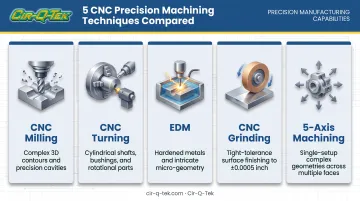
CNC Milling
A rotating, multi-axis cutting tool removes material from a workpiece that's either stationary or repositioned between cuts. Milling handles flat surfaces, pockets, and complex 3D contours well, which makes it the default choice for housings, brackets, and structural components.
CNC Turning
The workpiece rotates while a stationary tool shapes it. Turning is the natural fit for cylindrical parts such as shafts, precision connectors, and rotational components used across medical, automotive, and electronics applications.
Electrical Discharge Machining (EDM)
EDM is a non-contact process. Controlled electrical sparks erode conductive material, including hardened tool steels and superalloys, without applying cutting force. That makes it useful for intricate internal cavities and hard materials that would chew up conventional tooling.
CNC Grinding
Grinding typically serves as a finishing step, using abrasive removal to hit tight surface finishes after milling or turning has established the basic shape.
5-Axis Machining
According to Haas Automation, simultaneous 5-axis motion reduces the number of operations, cycle time, and setups needed on complex parts, while improving accuracy and consistency. Fewer setups means fewer chances for error to creep in between operations.
Materials Suited for Precision CNC Machining
Material choice drives tooling strategy as much as geometry does. Common options include:
- Aluminum: easy to machine, good chip control, widely used for lightweight structural parts
- Stainless steel: work-hardens quickly, requires sharp tooling and careful heat management
- Titanium: poor thermal conductivity concentrates heat at the cutting edge, demanding specialized tooling
- Inconel and nickel superalloys: hard, heat-resistant, and prone to work hardening
- Engineered plastics (PEEK, Delrin, nylon): dimensionally stable options for lightweight or non-conductive applications
Cir-Q-Tek machines this same range — metals, high-strength alloys, engineered plastics, and ceramics — letting engineers pick the best-fit material without changing suppliers.
Key Benefits of CNC Precision Machining
- Reproduces identical parts across large batches, eliminating the operator-to-operator variation common in manual work
- Cuts scrap with optimized toolpaths that use raw material more efficiently
- Makes complex geometries economical—multi-axis work handles turbine blades, implants, and other parts traditional machining can't match cost-effectively
- Runs metals and plastics on the same platform, so material choice follows the application, not equipment limits
- Shortens development cycles with quick-turn prototyping and flexible scaling from one-off to full production
One Modern Machine Shop case saw a boring operation's scrap rate drop from nearly 4% to below 0.5% after switching to digital tooling.
Those gains show up directly in defect rates, per-part cost, and how fast a new product moves from concept to shelf.
Choosing the Right CNC Precision Machining Partner
Tolerance claims on a spec sheet only tell part of the story. A ±0.0005" capability means little without the certifications and inspection process to back it up consistently, batch after batch.
When evaluating a machining partner, look beyond the headline number:
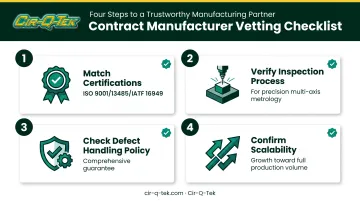
- Certifications should match your industry. ISO 9001 covers general quality management, ISO 13485 medical devices, and IATF 16949 automotive parts. A shop certified across all three, like Cir-Q-Tek, has built processes for regulated work—not general-purpose jobs alone.
- Ask about the inspection process, not just the machine. Parts should receive dimensional verification on proper metrology equipment, with a documented secondary check before shipment.
- Check the defect handling policy. Cir-Q-Tek replaces any part that does not meet fabrication specs at no added cost—confirm the same commitment with any supplier you evaluate.
- Confirm scalability. Can the shop handle a single prototype today and a production run of thousands next quarter without renegotiating terms?
A one-stop partner adds another layer of value. Cir-Q-Tek combines ISO-certified CNC machining with PCB fabrication and PCBA turnkey assembly across its U.S. and Shenzhen operations, so customers manage one supply chain instead of separate vendors for machined parts and electronics.
For material-specific questions or lead time estimates, submit CAD and 3D data through a quote request. That is the fastest path to a real answer instead of a generic capability claim.
Frequently Asked Questions
Is CNC machining precise?
Yes, CNC machining can be highly precise, with tolerances reaching ±0.001" or tighter depending on the machine's capability, the material, and how rigorous the process controls are. Not every CNC job hits that level, though.
What does a precision machinist do?
A precision machinist programs, sets up, and operates CNC equipment while reading CAD/CAM blueprints and verifying dimensional accuracy. The role blends mechanical know-how with computer programming and careful attention to measurement.
What is a precision CNC machine?
It's computer-controlled equipment (a mill, lathe, EDM unit, or grinder) engineered and calibrated to hold tighter tolerances than standard machining equipment, with part conformance confirmed through inspection.
What is the difference between CNC machining and precision machining?
CNC machining refers to the computer-controlled method itself. Precision machining refers to the tolerance level achieved. Not all CNC machining qualifies as precision-grade work.
What tolerances can CNC precision machining achieve?
Standard CNC work typically holds around ±0.005". Precision work tightens that to ±0.001"–±0.002", and high-precision jobs can reach ±0.0002" or tighter depending on the shop and part geometry.
Which industries rely most on CNC precision machining?
Automotive, medical devices, electronics, and industrial equipment rely on it most, because tight tolerances directly affect safety and performance. These are the same segments Cir-Q-Tek's ISO-certified machining operations serve.