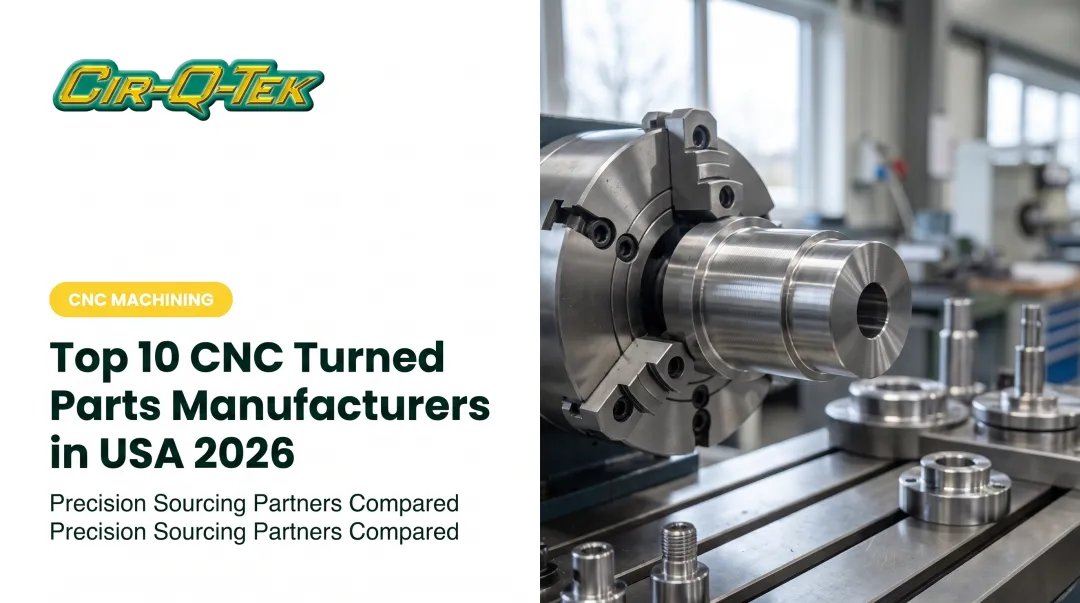

In the US, this isn't a small niche. Parts are getting smaller, tolerances are getting tighter, and the manufacturers who can actually hold ±0.0005" on a repeatable basis are becoming harder to find. This guide breaks down what precision machined components actually are, what to look for in a supplier, and a ranked look at ten manufacturers worth knowing.
TL;DR
- Expect tight tolerances—often ±0.0005"–0.001"—from CNC milling, turning, grinding, and EDM
- Accuracy is non-negotiable in medical, automotive, aerospace, and industrial parts where failure risks safety
- Prioritize certifications, tolerance capability, and material expertise over unit price alone
- Rank suppliers by process capability, quality systems, and proven delivery—not marketing claims
Overview of Precision Machined Components in Manufacturing
Precision machined components are parts produced through subtractive manufacturing. Material is cut, ground, or eroded away from a solid block or bar of stock until the final geometry matches the print.
Common processes include:
- CNC milling
- CNC turning
- Grinding
- EDM (electrical discharge machining)
The category is bigger than most people assume. US precision-machining revenue is projected at $23.64 billion in 2025, climbing to $37.11 billion by 2033, according to Grand View Research. That trajectory works out to roughly 5.8% annual growth.

That growth is driven by demand from medical device makers, automotive suppliers, and industrial OEMs who need parts that meet exacting specs without the six-month lead times of overseas-only sourcing. Below is a ranked look at manufacturers serving that need.
Top 10 Precision Machined Components Manufacturers
Rankings below weigh certifications, published tolerance capability, industry experience, breadth of service, and delivery track record. Price alone doesn't make the cut.
1. Cir-Q-Tek
Founded in 1999, Cir-Q-Tek is a one-stop manufacturing sourcing company with a domestic office in Bristol, PA and an overseas office in Shenzhen, China. OEMs get US-based project management, quality inspection, and logistics at offshore production pricing, plus rigid/flex PCB (up to 40 layers) and PCBA turnkey assembly for electromechanical builds under one partner.
Differentiators:
- Facilities certified to ISO 9001:2015 (valid through July 2027), ISO 13485, and IATF 16949 for medical and automotive compliance
- CNC tolerances as close as ±0.0005", with multi-axis/multi-tasking machines, live tooling, and multi-spindle single-setup work
- Machines metals (aluminum, stainless steel, zinc, magnesium, iron alloys), engineered plastics, and ceramics
- Bilingual US-China teams that cut the communication lag common in offshore sourcing
- Secondary quality inspection at the Pennsylvania facility with high-end metrology before shipment
- Negotiated factory cost-sharing that cuts customer-facing tariff charges by more than 50% in most cases
| Certifications | Tolerance Capability | Service Scope |
|---|---|---|
| ISO 9001:2015, ISO 13485, IATF 16949, UL/cUL | ±0.0005" | CNC machining, PCB fabrication, PCBA assembly |

2. Protolabs
Protolabs, founded in 1999 and headquartered in Maple Plain, MN, built its reputation on rapid turnaround for both prototypes and low-volume production. It's a go-to for engineers who need parts fast without sacrificing documentation.
Differentiators: ISO 9001, ISO 13485, and AS9100D certified; published tolerances down to ±0.001"; strong online quoting infrastructure that gives instant DFM feedback.
| Certifications | Tolerance Capability | Service Scope |
|---|---|---|
| ISO 9001, ISO 13485, AS9100D | ±0.001" | CNC milling, CNC turning, rapid prototyping |
3. Owens Industries
Operating out of Oak Creek, WI since 1944, Owens Industries has decades of experience in aerospace and defense-grade machining. Its wire EDM work is particularly notable.
Differentiators: ISO 9001:2015 and AS9100 certified; wire EDM positional accuracy to ±0.0005"; 3-, 4-, and 5-axis milling capability for complex aerospace geometries.
| Certifications | Tolerance Capability | Service Scope |
|---|---|---|
| ISO 9001:2015, AS9100 | ±0.0005" (wire EDM) | Multi-axis milling, wire EDM |
4. Pioneer Service
Based in Hodgkins, IL and founded in 1990, Pioneer Service specializes in Swiss-style turning for small, complex, high-precision parts, a category common to medical devices and micro-connectors.
Differentiators: AS9100:2016, ISO 9001:2015, and ISO 13485 certified; Swiss turning tolerances to ±0.0005"; centerless grinding down to ±0.0001" for cylindrical finishing.
| Certifications | Tolerance Capability | Service Scope |
|---|---|---|
| AS9100, ISO 9001:2015, ISO 13485 | ±0.0005" (Swiss); ±0.0001" (grinding) | CNC Swiss turning, centerless grinding |
5. Criterion Precision
Operating in Brook Park, OH since 1953, Criterion Precision serves aerospace, medical, and industrial customers with a machine mix built for both rotational and prismatic geometry.
Differentiators: ISO 9001, ISO 13485, and AS9100 certified; published tolerance of ±0.0002", among the tightest publicly stated in this list; Swiss turning plus 5-axis milling under one roof.
| Certifications | Tolerance Capability | Service Scope |
|---|---|---|
| ISO 9001, ISO 13485, AS9100 | ±0.0002" | Swiss turning, CNC turning, 5-axis milling |

6. Astro Machine Works
Founded in 1984 and based in Ephrata, PA, Astro Machine Works focuses on custom CNC milling and turning for OEMs that need engineering support alongside production.
Differentiators: ISO 9001:2015 and AS9100D certified; 5-axis machining for complex contoured parts; design collaboration built into its service model rather than treated as an add-on.
| Certifications | Tolerance Capability | Service Scope |
|---|---|---|
| ISO 9001:2015, AS9100D | Not publicly specified | CNC milling, CNC turning, 5-axis machining |
7. Cox Manufacturing
San Antonio, TX-based Cox Manufacturing has run since 1956, focusing on high-volume Swiss and screw machining for customers who need thousands of identical close-tolerance parts.
Differentiators: ISO 9001:2015 certified; nearly seven decades of continuous operation; production capacity built specifically for high-volume runs rather than one-off prototypes.
| Certifications | Tolerance Capability | Service Scope |
|---|---|---|
| ISO 9001:2015 | Close tolerance (not numerically published) | Swiss/screw machining, CNC milling and turning |
8. In Tolerance
Cedar Rapids, IA-based In Tolerance has been in business since 1947, primarily serving aerospace and defense customers who require Nadcap-level traceability.
Differentiators: AS9100D, ISO 9001:2015, and Nadcap certified; 78 years of continuous aerospace/defense machining experience; documentation and traceability built for regulated supply chains.
| Certifications | Tolerance Capability | Service Scope |
|---|---|---|
| AS9100D, ISO 9001:2015, Nadcap | Not publicly specified | Precision CNC machining for aerospace/defense |
9. H&R Screw Machine Products
Located in Reed City, MI, H&R specializes in precision screw machine and CNC Swiss machining, primarily serving customers who need high-volume turned components.
Differentiators: ISO 9001:2015 certified; deep specialization in screw-machine parts, a niche that rewards decades of process refinement over broad service breadth.
| Certifications | Tolerance Capability | Service Scope |
|---|---|---|
| ISO 9001:2015 | Not publicly specified | Screw machining, CNC Swiss machining |
10. Marver Med
Marver Med, based in Stoughton, MA, focuses specifically on medical device contract machining, using CNC Swiss-screw processes suited to small, high-precision implantable and surgical components.
Differentiators: ISO 13485:2016 certified specifically for medical device manufacturing; narrow focus on medical/aerospace machining rather than general industrial work.
| Certifications | Tolerance Capability | Service Scope |
|---|---|---|
| ISO 13485:2016 | Not publicly specified | CNC Swiss-screw machining, medical contract machining |
Types and Examples of Precision Machined Components
Each machining process suits a different part geometry:
- CNC milling: A rotating cutter removes material; best for prismatic and contoured parts like housings and brackets, including turbine blade production in jet engines.
- CNC turning: Stock rotates against a stationary tool; ideal for rotational parts like shafts and connectors. Common in surgical implants and heart valve components.
- Grinding: An abrasive wheel refines surface finish and cylindrical accuracy; widely used for automotive rotating parts like camshafts and crankshafts.
- EDM: Spark erosion cuts hard conductive materials; used for fine cooling holes in turbine blades where milling can't reach.

Materials commonly used:
- Aluminum (6061): Lightweight, low-cost, and highly machinable for general industrial parts
- Stainless steel: Chosen for corrosion resistance in medical and process equipment
- Titanium: High strength-to-weight ratio for aerospace and medical implants
- Brass (C36000): Engineered for high-throughput screw-machine turning
How We Chose the Best Precision Machined Components Manufacturers
The biggest mistake buyers make is choosing on price alone, without confirming certifications or tolerance capability against the actual drawing requirements. A certificate confirms the quality system behind the work—it does not by itself prove a shop can hold your drawing’s tolerances.
Factors weighed in this list:
- Industry certifications: ISO 9001 (baseline), ISO 13485 (medical), IATF 16949 (automotive), and AS9100 (aerospace) to cut regulatory risk by sector.
- Tolerance capability: published, feature-specific tolerance data rather than vague "tight tolerance" claims.
- Material versatility: ability to machine metals, plastics, and ceramics without outsourcing.
- One-stop service breadth: machining paired with related services (PCB, assembly) to cut supply chain complexity.
- Delivery track record: documented lead times and defect-replacement policies that protect time-to-market.
Conclusion
The right precision machining partner depends on your specific operational needs, whether that's medical-grade compliance, automotive volume flexibility, or aerospace traceability. Don't default to brand recognition alone.
Before committing, check these three points:
- Match certifications to your industry requirements
- Confirm tolerance capability against your actual drawings
- Test communication responsiveness early in the process
If you need a precision CNC machining partner that also handles PCB fabrication and assembly under one roof, reach out to Cir-Q-Tek for a quote that combines domestic project management with offshore pricing.
Frequently Asked Questions
What are precision machined components?
Precision machined components are parts manufactured to tight tolerances, often ±0.0005" to ±0.001", using CNC equipment to meet exact drawing specifications.
What are some examples of precision machined components?
Examples include engine parts, surgical instruments, connectors, aerospace fittings, and turbine blades.
What are the different types of precision machining?
The primary methods are CNC milling, CNC turning, grinding, and EDM. Each suits different part geometries and material hardness levels.
How much do custom machined parts cost?
Costs depend on material, tolerance requirements, part complexity, and order volume. Request a quote with CAD data or drawings for accurate pricing.
What certifications should a precision machining manufacturer have?
Look for ISO 9001 as a baseline, plus ISO 13485 for medical work and IATF 16949 for automotive projects. AS9100 matters for aerospace.
How do I choose the right precision machining partner?
Weigh certifications, published tolerance capability, material expertise, and whether they offer one-stop service for related components like PCBs or assemblies.