Here's the problem: "6-axis" gets thrown around loosely in sales conversations. Some machines truly move all six axes together while cutting. Others only use that sixth axis to flip or reposition a part between cuts. Confusing the two can lead to blown budgets and parts that don't match what you thought you were buying.
This guide breaks down what 6-axis CNC machining actually means, how it differs from 5-axis, where it earns its keep, and how to figure out whether your project genuinely needs it.
Key Takeaways
- True 6-axis machines interpolate all six axes while cutting; "5+1" setups only use the sixth for positioning.
- Extra rotational freedom keeps a constant tool contact angle on parts that curve and twist.
- Programming true 6-axis parts demands custom postprocessors and extensive collision simulation.
- A high-performance 5-axis machine is the better fit for most shops and most parts.
- Classic 6-axis use cases include aerospace blisks, medical implants, and advanced automotive prototypes.
What Is 6-Axis CNC Machining?
CNC machining is computer-controlled subtractive manufacturing: a program tells cutting tools exactly how to remove material from a workpiece. Each axis represents a direction the tool or the part can move in a controlled way.
Every CNC machine starts with three linear axes:
- X axis: side-to-side movement
- Y axis: front-to-back movement
- Z axis: up-and-down movement
A basic 3-axis mill uses only these. That's fine for flat faces, pockets, and holes drilled straight down, but it struggles the moment a part needs angled or curved features cut from multiple sides.
A 6-axis machine adds three rotational axes (A, B, and C) on top of X, Y, and Z. This lets the tool (or workpiece, or both) approach a part from nearly any angle without a manual reset.
Understanding the Six Axes: X, Y, Z, A, B, C
Per ISO 841, the international standard governing machine tool axis nomenclature, each rotary axis is tied to a linear one: A rotates around X, B rotates around Y, and C rotates around Z.
In practice, most 6-axis machines achieve this through:
- A tilting or swiveling table that provides two rotary axes (typically A and C, or A and B)
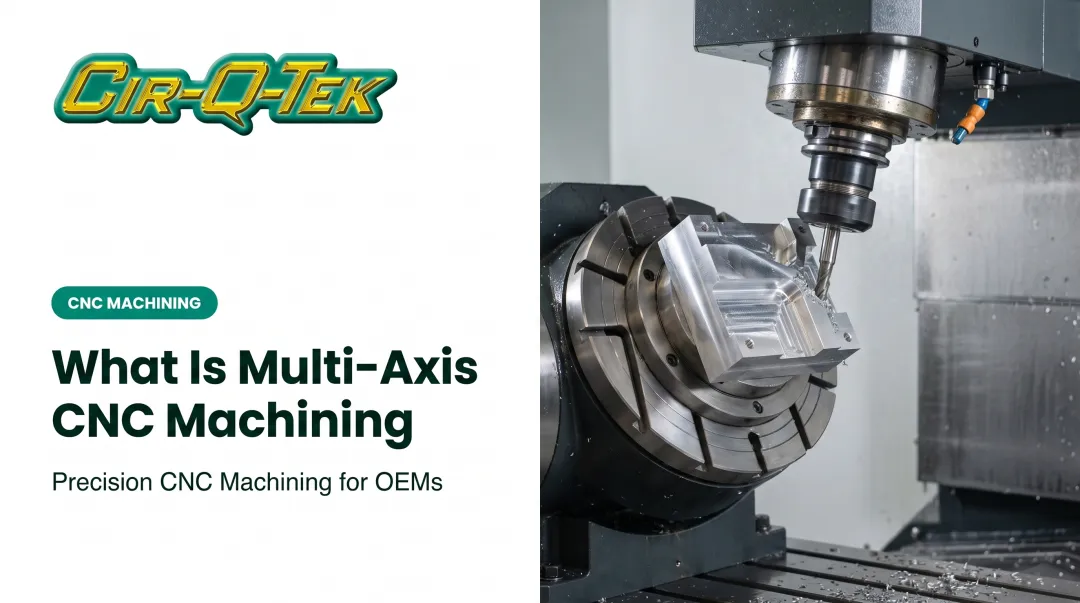
- An articulated spindle head (a "wrist") that adds the third rotation so the tool can roll independent of table orientation
That third rotation is what separates 6-axis from 5-axis. It gives the tool the ability to spin around its own cutting axis while the other five axes are already oriented, something a standard 5-axis head-table combination can't do.
True 6-Axis vs. "5+1" Configurations
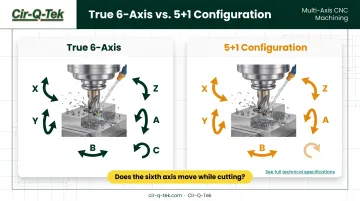
This is where buyers get burned. A true 6-axis machine moves all six axes together, interpolated, while the tool is cutting. A "5+1" configuration uses five axes for interpolated cutting and reserves the sixth strictly for auxiliary jobs: flipping a part, indexing a pallet, or repositioning between operations.
Both get marketed as "6-axis." Only one delivers the capability buyers usually expect.
There's no formalized industry standard defining "5+1." The term is largely vendor-specific, and even respected builders blur the line.
Starrag's ECOSPEED platform runs simultaneous 5-axis machining as its base process, with an interchangeable head and integral C-axis. The company itself describes this as effectively making the unit a 6-axis machine, though it is not a fully simultaneous six-axis cutting system in every mode.
Ask your supplier directly: does the sixth axis interpolate during the actual cutting pass, or does it only move for setup and repositioning? That single question determines whether you're paying for real capability or a marketing label.
6-Axis vs. 5-Axis CNC: What's the Real Difference?
The short answer: 5-axis machines control two rotational axes; 6-axis machines control three. That extra rotation gives 6-axis systems independent control over tool "roll" (the ability to spin the cutting tool around its own axis), which 5-axis geometry simply can't provide.
That sounds minor on paper. In practice, it changes tool-path control, surface finish, and how many setups a complex part needs.
Degrees of Freedom and Tool Path Control
Positioning a tool at a specific point and orienting it in space requires a minimum of five degrees of freedom (three translations and two rotations), according to peer-reviewed research on six-axis machining optimization. A sixth axis adds a redundant rotation, which sounds unnecessary until you're machining a surface that both curves and twists at the same time.
On those compound geometries (turbine blades, blisks, organic medical implant surfaces), the added axis lets the tool maintain a constant, optimal contact angle throughout the cut. The practical payoffs:
- More consistent surface finish across the cut
- Less tool deflection and vibration
- Shorter, more rigid tooling instead of long-reach tools needed to clear obstructions on a 5-axis setup
Programming and Software Complexity
This is the part vendors don't advertise loudly enough. True 6-axis programming isn't a simple extension of 5-axis CAM work.
- Postprocessors must be custom-built for the specific machine's kinematic chain
- Toolpaths require extensive collision simulation before they ever touch a real part
- The added rotational freedom introduces nonlinear tool-tip movement that has to be actively managed, not just programmed and trusted
Siemens field testing on the jump to five-axis programming alone found a 10% increase in programming effort paired with up to a 30% productivity improvement, and that's the easier jump. Six-axis programming demands specialized expertise that most shops simply don't keep on staff.
Cost, Setup, and ROI Considerations
True 6-axis machines cost significantly more to buy, program, and maintain than 5-axis equipment. That premium only makes sense when a part is physically impossible, or brutally inefficient, to produce with fewer axes.
A useful real-world reference point: Highland Manufacturing swapped jig bores and tilt tables for a six-axis boring machine on large compound-angle bore work. The results, as reported by Modern Machine Shop:
- Setup time dropped from 5 hours to 1 hour
- Runtime on the job fell from two full days to 45 minutes
- Concentricity improved thanks to single-setup access to compound-angle features
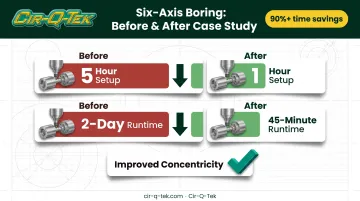
This was an indexed six-axis case, not simultaneous six-axis freeform cutting. Even so, it shows what eliminating repositioning can do for a part that genuinely needed the extra axis.
Key Benefits of 6-Axis CNC Machining
When a part actually calls for it, 6-axis machining delivers real, measurable advantages over lower-axis alternatives.
- Single-setup completion: Complex geometries that need multiple fixtures on a 3- or 4-axis machine often finish in one setup, cutting labor and repositioning errors
- Better surface finish and tool life: An optimal tool-to-surface angle throughout the cut reduces wear and yields a more consistent finish on curved or twisted surfaces
- Shorter cycle times on suitable parts: Eliminating setups and flips can cut machining time sharply when the geometry truly needs the extra motion
How large can those gains get? Starrag's Orizon Aerostructures cell reported at least 30% lower machining time versus prior methods. That figure came from a 5-axis automated cell, not a pure sixth-axis effect, but it shows the scale of savings when setups leave the workflow.
These benefits only materialize on parts that genuinely need the extra axis. Bolting six axes onto a simple bracket won't speed anything up.
Industries and Applications That Rely on 6-Axis CNC
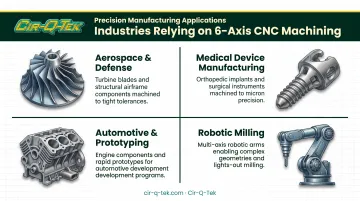
Certain part geometries simply don't have a practical alternative to multi-axis machining. A handful of industries account for most true 6-axis demand.
Aerospace and defense. Blisks, impellers, and turbine blades feature thin, curved airfoils that blend directly into a hub. Machining these accurately requires the tool to track a constantly changing surface angle. That is exactly the problem 6-axis motion solves.
Medical device manufacturing. Patient-specific implants and prosthetics often need complex, organic geometries machined from titanium or cobalt-chrome. Cobalt-chrome is notoriously difficult to machine. SME's coverage of medical manufacturing notes both alloys as standard implant materials that need precise multi-axis control.
Automotive and advanced prototyping. Engine components, complex mold cavities, and high-end concept parts benefit from the tilting and rolling capability that lets tools access deep cavities without long, whippy tooling.
A flexible alternative worth knowing about: 6-axis robotic arms fitted with milling spindles are increasingly used for softer materials like composites, foam, and aluminum. They offer a larger working envelope and lower cost than a rigid CNC machine tool.
Industrial robots carry inherently lower stiffness, though. That means more deflection under cutting force and accuracy too low for hard metals or tight tolerances.
Do You Actually Need 6-Axis, or Is 5-Axis Enough?
Before defaulting to the highest axis count, ask a simpler question: is your current setup physically unable to produce the part, or just requiring more setups than you'd like?
Those are two very different problems.
- If a part truly can't be machined on 5-axis equipment, because the geometry demands independent tool roll on a compound curve, 6-axis may be justified.
- If the issue is extra setups, extra fixturing, or longer cycle times, a well-programmed 5-axis machine usually closes that gap without the added cost and complexity.
For the overwhelming majority of shops and parts, a high-performance 5-axis machine strikes the better balance of capability, speed, and cost. Less flashy, yes—but usually the right call.
The decision should hinge on part complexity and production volume, not on acquiring maximum axis count for its own sake. A one-off prototype with wild curvature might justify 6-axis sourcing. A production run of moderately complex brackets almost never will.
Sourcing Precision CNC Parts: How Cir-Q-Tek Delivers Multi-Axis Machining Expertise
Once you know what your part actually requires, the next challenge is finding a manufacturing partner who can deliver it accurately, on schedule, and at a fair price.
Cir-Q-Tek approaches precision CNC machining as one piece of a broader one-stop sourcing model. Its capabilities include:
- Tolerances as close as ±0.0005 inches, backed by CAD design and CAM programming expertise
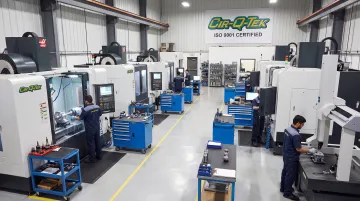
- Multi-axis, multi-tasking machinery with live tooling and multiple spindles for finished parts from a single setup
- Metals, engineered plastics, and ceramics, including aluminum, zinc, magnesium, iron, and stainless steel
Three certifications back that process control: ISO 9001:2015, ISO 13485 for medical device manufacturing, and IATF 16949 for automotive requirements. That combination matters if your project sits in a regulated industry where documentation and traceability aren't optional.
Cir-Q-Tek's dual-office structure (headquarters in Bristol, Pennsylvania, plus an operating office in Shenzhen, China) gives customers domestic-level project communication and quality oversight while sourcing at offshore manufacturing pricing. Every part also passes through a secondary inspection at the Pennsylvania facility before shipment.
The company doesn't impose minimums or maximums. Whether you need a handful of prototype parts or a sustained production run, quantity won't get the job turned away. That flexibility comes with a defect replacement policy: parts that don't meet the fabrication specifications get replaced at no additional cost.
If you're evaluating whether your part's geometry calls for advanced multi-axis capability, submitting a quote request with your CAD files is the fastest way to get a straight answer.
Frequently Asked Questions
What is 6-axis machining?
6-axis machining is CNC machining that combines three linear axes (X, Y, Z) with three rotational axes (A, B, C). This lets the tool approach a workpiece from nearly any angle within a single setup.
What are the key differences between 5-axis and 6-axis CNC machining?
5-axis machines control two rotational axes; 6-axis machines add a third, giving independent control over tool roll. That extra freedom improves surface finish on complex curves but comes with much higher programming complexity and cost.
Is a 6-axis CNC machine the same as a 6-axis robotic arm?
No. A 6-axis CNC machine is a rigid machine tool built for precision cutting. A 6-axis robotic arm is a flexible automation device fitted with a spindle, typically better suited to softer materials due to lower rigidity.
What industries commonly use 6-axis CNC machining?
Aerospace (turbine blades, blisks, impellers), medical device manufacturing (patient-specific implants), and advanced automotive prototyping are the leading users of true 6-axis capability.
Do I need a 6-axis machine, or is 5-axis sufficient for my project?
Most parts can be produced efficiently on 5-axis equipment. True 6-axis machining is typically only necessary for geometries, like compound-curved airfoils, that a 5-axis machine physically cannot cut.
How much does 6-axis CNC machining typically cost compared to 5-axis?
True 6-axis machines and their required programming carry higher capital, tooling, and labor costs than 5-axis equipment. Whether that premium pays off depends on your part geometry, volume, and whether 5-axis can already hold the required finish and tolerances.