
Choosing the right one used to be simple. Not anymore. Component pitches keep shrinking, RoHS rules keep tightening, and medical, automotive, and industrial customers keep demanding higher reliability. A finish that worked fine ten years ago might bridge pins on today's fine-pitch BGA layouts.
This article breaks down the major surface finish types, compares their trade-offs, and walks through how to pick the right one for your design.
TL;DR
- Surface finish protects exposed copper from oxidation and keeps pads solderable through assembly.
- Common options: HASL/Lead-Free HASL, ENIG, OSP, Immersion Silver, Immersion Tin, ENEPIG, and Hard Gold.
- Each finish makes different trade-offs across cost, flatness, shelf life, and fine-pitch compatibility.
- The right choice hinges on component density, RoHS requirements, budget, and reliability needs.
What Is a PCB Surface Finish?
A surface finish is a thin coating applied over exposed copper pads and traces on a bare PCB before it heads to assembly. Without it, that copper is defenseless.
It does two jobs:
- Prevents oxidation during storage, transit, and handling before assembly
- Provides a solderable surface so components bond reliably during reflow or wave soldering
Surface finish isn't a design decision made in isolation. It has to work with your assembly process, component types, and storage conditions, meaning it's really a manufacturing choice as much as an engineering one.
Why Is Surface Finish Important in PCB Manufacturing?
Unprotected copper oxidizes fast. Once that happens, you get poor solder joints, weak mechanical connections, and boards that fail well before their expected service life.
The stakes go beyond just "will it solder":
- Electrical performance: some finishes (like ENIG) can affect signal loss in RF designs
- Shelf life: how long a board can sit in inventory before it needs to be assembled
- RoHS compliance: a hard requirement for many industries, not optional anymore
- Fine-pitch/BGA compatibility: flatness matters more as pitches shrink below 0.5mm
Finish selection is also one of the more common sources of assembly defects in high-reliability sectors. Medical and automotive boards, in particular, have little tolerance for inconsistent finishes causing field failures years after shipment.
That is why process control under certifications like ISO 13485 (medical device manufacturing) and IATF 16949 (automotive manufacturing) is non-negotiable for those sectors.
Cir-Q-Tek applies these certified quality processes across its PCB fabrication lines, inspecting materials at each production stage and checking finished boards for IPC conformance before they ship.
Types of PCB Surface Finishes
Surface finishes are not one-size-fits-all. Each one balances cost, flatness, shelf life, and solderability in a different way, and the right pick depends on component pitch, RoHS requirements, environmental exposure, and budget.
HASL / Lead-Free HASL
The board gets dipped in molten solder (traditional tin-lead or a lead-free tin alloy), then leveled with hot-air knives that blow off the excess. It's the oldest, most widely used finish in the industry thanks to low cost and reliable solderability.
How it differs: HASL applies a thick metallic solder layer directly, unlike the thin chemical coatings used in immersion or electroless finishes.
Best suited for: Standard through-hole and SMT boards without fine-pitch components. Cost-sensitive projects where topography isn't a concern.
Key strengths:
- Low cost and wide availability
- Reworkable
- Excellent shelf life
Limitations:
- Uneven surface — a real problem below roughly 0.5mm pitch, where it can bridge fine-pitch pads
- Poor for BGA and other tight-tolerance components
- Can plug plated-through-holes
- Thermal shock risk during assembly
- SnPb HASL is not RoHS-compliant; lead-free versions fix compliance but keep the flatness limits

Cir-Q-Tek offers both HASL and lead-free HASL through its fabrication network.
ENIG (Electroless Nickel Immersion Gold)
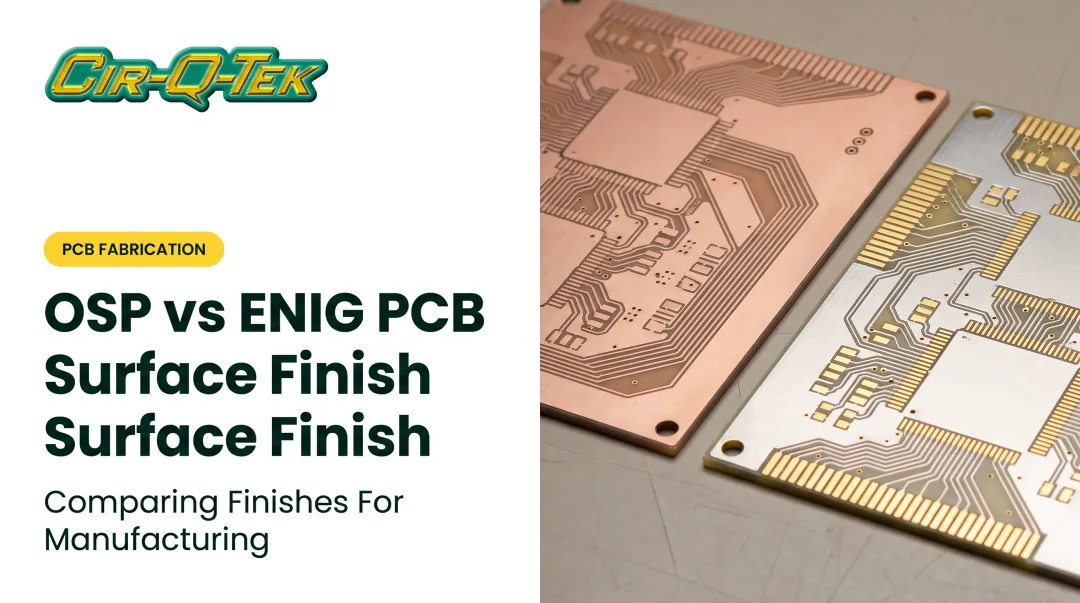
ENIG is a two-layer process: a nickel barrier (roughly 120-240 µin) plates first, then a thin gold layer sits on top of it. The nickel bonds to copper; the gold protects the nickel from oxidizing and keeps the surface solderable.
How it differs: It's a flat, RoHS-compliant metallic finish, unlike the thick solder deposit of HASL. This flatness is exactly why it handles fine-pitch and BGA work so well.
Best suited for: Fine-pitch, BGA, and high-reliability boards — think medical, automotive, and telecom applications.
Key strengths:
- Extremely flat surface, ideal for tight-pitch components
- Long shelf life
- Handles plated-through-holes well
- RoHS-compliant
Limitations:
- Higher cost than HASL or OSP
- Not reworkable once soldered
- Risk of "black pad" — a nickel corrosion defect during gold deposition that weakens solder-joint strength
- Can introduce signal loss concerns in RF designs

Manufacturers using reduction-assisted immersion gold chemistry and tight dwell-time control can significantly cut black pad risk, which is why process discipline matters as much as the finish choice itself. ENIG is available through Cir-Q-Tek's fabrication sources, including fine-pitch BGA work down to 0.2mm spacing.
OSP (Organic Solderability Preservative)
OSP applies a thin, water-based organic layer over copper through a conveyorized process. It's not metal at all, just an organic coating that keeps oxygen away from the copper until soldering.
How it differs: Simpler and less expensive than metallic finishes because there's no plating chemistry involved.
Best suited for: Cost-sensitive projects with a single reflow cycle, where the board gets soldered relatively soon after fabrication.
Key strengths:
- Low cost
- Flat surface, good for fine-pitch work
- Simple, RoHS-compliant process
- Environmentally favorable — lower process temps, fewer rinses, no precious metals
Limitations:
- Short shelf life — often ~6 months in controlled storage (≤30°C / ≤70% RH); always chemistry-specific
- Handling-sensitive; contamination degrades the layer
- No easy way to measure coating thickness in the field
- Not ideal for multiple reflow cycles or plated-through-hole designs

Cir-Q-Tek's offshore partner facilities offer OSP specifically as ENTEK 106 A-HT.
Other Notable Surface Finishes
A few finishes fill specific niches:
- Immersion Silver — Flat, cost-effective, RoHS-compliant. Tarnishes easily and needs careful handling; manufacturer-estimated shelf life often sits around six months.
- Immersion Tin — Flat and fine-pitch friendly, but shelf life is short and tin whiskers are a documented risk per NASA's Goddard tin whisker research (incubation from days to years).
- ENEPIG — A three-layer nickel-palladium-gold finish. Excellent solderability and wire-bonding capability, but the added layers mean tighter process control and higher cost.
- Hard Gold — Built for durability in high-wear spots like edge connectors and keypads. Not meant for solder joints; it's a mechanical-contact finish, not a soldering finish.
Cir-Q-Tek's fabrication capabilities include HASL, lead-free HASL, ENIG, OSP, immersion silver, and immersion tin, with RoHS-compliant options available across the board.
How to Choose the Right Surface Finish for Your PCB
The right finish depends on your application's actual technical and commercial requirements, not on whatever's most common or most advanced on paper.
Run through these factors before locking in a finish:
- Component density and pitch: Fine-pitch and BGA layouts need flat finishes like ENIG or OSP; standard SMT and through-hole boards can often get by with HASL.
- RoHS compliance and target industry regulations: Medical and automotive customers usually have zero tolerance here.
- Expected shelf life and storage conditions: OSP and immersion tin degrade faster than ENIG if boards sit in inventory.
- Budget constraints and production volume: HASL and OSP cost less; ENIG and ENEPIG cost more but deliver higher reliability.
- Number of reflow cycles and rework needs: Multiple reflow passes favor ENIG or ENEPIG over OSP.
- Environmental exposure: Humidity, sulfur exposure, and handling conditions all affect finish performance over time.

None of this needs to be guesswork. Working with an ISO-certified manufacturer helps validate these choices against your design files and compliance requirements before production starts, rather than discovering a mismatch after boards are already built.
Cir-Q-Tek's fabrication team reviews Gerber packages and BOMs during quoting, and its ISO 9001, ISO 13485, and IATF 16949 certifications give medical and automotive customers a documented quality framework to lean on.
Conclusion
Surface finish is the layer between bare copper and long-term field reliability. Choose poorly, and you risk solder defects, shortened shelf life, or compliance issues later.
No single finish wins on every axis—each option trades off cost, flatness, shelf life, and compliance:
- HASL — Low cost and durable, but a poor fit for fine-pitch work
- ENIG — Flat and reliable, at a higher price point
- OSP — Simple and environmentally friendly, but time-sensitive
Match the finish to pitch, assembly process, storage window, and regulatory needs before fab starts. That decision up front cuts rework and keeps boards reliable in the field. If you need help weighing options for a prototype or production run, a PCB manufacturing partner can align finish choice with your volume, timeline, and industry requirements.
Frequently Asked Questions
What is surface finish on PCB?
Surface finish is the protective coating applied over exposed copper on a bare PCB. It prevents oxidation during storage and provides a solderable surface for component assembly.
What are the different types of PCB surface finishes?
The main types are HASL/Lead-Free HASL, ENIG, OSP, Immersion Silver, Immersion Tin, ENEPIG, and Hard Gold. Each balances cost, flatness, and shelf life differently.
What is the best surface finish for PCBs?
There's no single "best" finish. The right choice depends on component pitch, budget, expected shelf life, and reliability requirements for your specific application.
What is HASL finish on PCBs?
HASL (Hot Air Solder Leveling) dips the board in molten solder, then levels it with hot-air knives. It's low-cost and widely used, but its uneven surface makes it unsuitable for fine-pitch components.
What is OSP finish on a PCB?
OSP (Organic Solderability Preservative) applies a thin organic layer over copper to prevent oxidation. It's low-cost, flat, and environmentally favorable, but has a shorter shelf life than metallic finishes.
What is the purpose of a PCB surface finish?
Surface finish protects exposed copper from oxidation in storage and keeps pads solderable for assembly. It is not the same as conformal coating, which is applied after assembly for environmental protection.