HSM gets oversimplified constantly. People assume it just means "spin the spindle faster." In reality, it depends on machine rigidity, tooling selection, and CAM programming all working together as one system.
This guide covers what HSM actually is, why manufacturers use it, how the process works step-by-step, where it fits best, and when it's the wrong call entirely.
Key Takeaways
- HSM combines high spindle speed, high feed rate, and reduced depth of cut to lower cutting forces and heat
- Success requires a matched system: rigid machines and balanced tooling, plus CAM toolpaths such as trochoidal milling
- HSM shines on thin-walled parts, hardened tool steels, and complex 3D geometries, not bulk roughing
- Chip load and radial engagement are the two variables that make or break HSM results
What Is High-Speed Machining (HSM)?
HSM is a milling approach that pairs elevated spindle speeds and feed rates with a lighter radial and axial depth of cut. The goal is a consistent chip load throughout the cut, rather than the load spikes typical of conventional roughing.
The payoff: faster cycle times, better surface finish, and longer tool life. This happens because HSM spreads mechanical stress and heat across many light passes instead of concentrating it in a few heavy ones.
How HSM Differs From Conventional Milling
Conventional machining favors heavier cuts at lower speeds, with more force and longer tool-to-material contact time. HSM flips that approach:
- Conventional: Fewer passes, deeper cuts, more force per engagement
- HSM: Many light passes, faster feed, smoother and more consistent engagement
That shift reduces the shock loading that causes chatter and premature wear.
Origins in the 1930s
The theory behind HSM dates back to the 1930s. German engineer Carl Salomon proposed that cutting temperature rises with speed to a critical point, then drops once speeds go beyond it.
Aerospace manufacturers put the concept into practice in the late 1980s, using chatter-free high-speed milling to produce lighter, monolithic aircraft structures. Decades of production use have proven the strategy works.
The Metrics That Define It
HSM isn't defined by one number. According to Sandvik Coromant's machining formulas reference, the strategy depends on four interdependent values:
- Cutting speed (vc) — surface speed at the cutting edge, in meters per minute
- Spindle speed (n) — tool revolutions per minute
- Feed rate (vf) — how fast the table moves, in mm per minute
- Material removal rate (Q) — volume removed per minute
Push one of these without adjusting the others, and the whole system falls out of balance.
Why HSM Matters for CNC Machining Operations
Shorter lead times. Tighter tolerances. Increasingly complex geometries. These pressures define production in aerospace, medical, and automotive work, and conventional milling struggles to keep pace.
Heavier cuts mean longer cycle times, more secondary finishing passes, and faster tool wear. HSM addresses all three by keeping engagement light and consistent instead of forcing the cutter through large volumes of material at once.
A Real-World Example: Replacing EDM
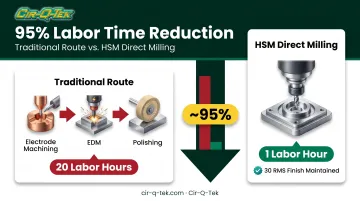
One of the clearest wins for HSM has been in hardened die and mold work. A documented case involving a 12-by-24-inch forging die shows the shift clearly.
The traditional route (electrode machining, EDM, then polishing) took 20 labor hours. Direct high-speed milling cut that to 1 hour, eliminated the EDM step entirely, and still delivered a 30 RMS finish, according to Modern Machine Shop's coverage of high-speed die and mold machining. That gap is large enough to change the production path, not just trim a few hours.
Adoption Is About Throughput, Not Compliance
HSM isn't a regulatory requirement anywhere. Shops adopt it because it cuts cost and time. The tighter dimensional control it delivers also supports the tolerance specs that regulated sectors like medical and automotive already demand.
Cir-Q-Tek's CNC machining services support tolerances as close as ±0.0005", using multi-axis, multi-tasking machinery with live tooling and multiple spindles—the kind of equipment platform HSM principles rely on.
For shops that need offshore-cost, domestic-quality precision parts without sinking capital into new high-speed equipment, that is a practical alternative to building the capability in-house.
How HSM Works (Conceptual Flow)
Think of HSM as a closed loop. Machine rigidity, spindle capability, tooling, and CAM-generated toolpaths all have to work together to control chip formation and heat. Break one link, and the whole system underperforms.
Inputs feeding the process:
- Stock material and its cutting characteristics
- Tool geometry and coating
- Spindle RPM range
- A CAM-generated toolpath designed for constant engagement
During the cut, the tool engages material at a reduced radial and axial depth. This generates thinner chips that evacuate quickly, which limits heat buildup right at the cutting edge, the main driver of tool wear and dimensional drift.
CNC look-ahead controls, chip load calculations, and toolpath strategies like trochoidal milling and adaptive clearing regulate that engagement, especially through corners where load spikes are most likely. The result: less tool deflection, less heat, tighter dimensional accuracy, and often a faster overall cycle time, even though each individual pass is lighter.
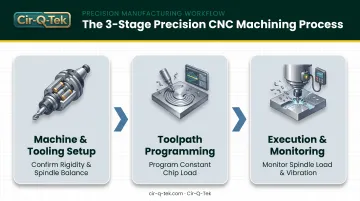
That loop plays out on the shop floor in three stages.
Step 1: Machine and Tooling Setup
Before programming starts, the shop confirms machine rigidity and spindle balance. Tooling selection follows: short, balanced holders and coatings matched to the target material and RPM range. Skip this step and everything downstream is compromised.
Step 2: Toolpath Programming
CAM software generates the actual path using strategies like trochoidal milling or adaptive clearing. The objective is constant chip load — no abrupt changes in engagement, particularly at corners where conventional toolpaths tend to overload the cutter.
Step 3: Execution and Monitoring
The machine runs the program at elevated speed and feed. Chip evacuation (air blast, mist, or coolant) keeps material moving away from the cutting zone. Where available, real-time spindle load or vibration monitoring flags instability before it becomes a scrapped part.
Where HSM Is Applied and Key Factors That Affect It
HSM is most common in mold and die making, aerospace structural components, medical implants, and high-volume aluminum and non-ferrous parts production. It's a programmed, recurring strategy used in roughing and finishing stages, not something applied ad hoc on a one-off repair job.
Factors that shape HSM results:
- Material type — aluminum and non-ferrous alloys take high speeds well; hardened steels and titanium need different feeds, speeds, and cooling
- Machine dependencies — spindle rigidity, thermal stability, and tool balance set the ceiling on how far speeds and feeds can be safely pushed
- Tooling — flute count, coating, and holder type (shrink-fit, HSK) affect runout and chip evacuation at high RPM
- Scale and throughput — benefits compound most clearly in repeat or high-mix production, not single small jobs
- Quality constraints — medical and aerospace work needs verified chip load and thermal control to limit dimensional drift
Aluminum remains the clearest fit for aggressive HSM parameters. Cir-Q-Tek's CNC machining programs regularly run aluminum alongside stainless steel and high-strength alloys, the same material set most often paired with HSM in medical and automotive production.
Common Misconceptions and When HSM May Not Be Appropriate
"HSM just means running the spindle faster." Not quite. Spindle speed is one piece; without matching rigidity, tooling, and programming, higher RPM alone won't deliver the removal rate, finish, or tool life shops expect.
"Lighter cuts mean slower production." Often the opposite is true. Consistent engagement frequently produces net-faster cycle times than heavier, interrupted cuts that keep stalling on corners and hard spots.
"HSM and high-efficiency milling (HEM) are the same thing." They're related, not identical:
| Aspect | HSM | HEM |
|---|---|---|
| Primary focus | High spindle speed, light DOC | High axial depth and removal rate |
| Radial engagement | Light and consistent | Controlled (often a fraction of tool diameter) |
| Best suited for | Finishing, complex geometry | Bulk roughing efficiency |
Even with those distinctions clear, HSM still is not the default for every job.
When HSM isn't the right call:
- Large steel-block roughing — low-RPM indexable tooling usually clears bulk material faster
- Machines short on rigidity or spindle capability — forced HSM parameters cause chatter, early tool wear, or spindle damage
- Simple, loose-tolerance parts in small quantities — extra programming and setup cost rarely beat standard milling
Frequently Asked Questions
What is considered high speed machining?
HSM typically means spindle speeds above 15,000 RPM combined with high feed rates and reduced depth of cut. The exact threshold shifts based on material and machine capability rather than one fixed number.
What is the fastest CNC machine?
Spindle speed records vary by manufacturer and application, with some specialized micro-machining spindles exceeding 40,000-60,000 RPM. "Fastest" only makes sense relative to the material and part being machined.
How is HSM different from conventional CNC milling?
Conventional milling uses fewer, heavier cuts at lower speeds. HSM uses many light, fast passes to reduce heat and force, often improving both surface finish and cycle time on complex parts.
What materials work best with high-speed machining?
Aluminum, magnesium alloys, and other non-ferrous metals respond especially well to HSM. Harder alloys like titanium or hardened steel still work with optimized tooling and cooling.
Does HSM always reduce cycle time?
Not always. HSM typically reduces cycle time on complex or precision parts, but for simple bulk roughing of large stock, traditional heavier-cut methods can still win out.
Can any CNC machine be upgraded for HSM?
Not every machine qualifies. HSM requires sufficient spindle rigidity, thermal stability, and control system capability. Shops should evaluate their equipment specs carefully before committing to the strategy.