Introduction
Jet engines, semiconductor chambers, and surgical implants share a common problem: metals melt, warp, or corrode long before the job is done. Advanced ceramics don't.
Silicon carbide grades like CoorsTek's CeraSiC-B hold up to 1,500°C with 170 W/m-K thermal conductivity, letting engineers push designs into environments no metal alloy can survive.
That performance comes with a catch. Ceramics rank among the hardest engineering materials available, but they're also brittle.
Push a cutting tool too hard, and instead of forming a clean chip like steel or aluminum, the material simply fractures. One bad pass can turn an expensive blank into scrap.
This guide covers how CNC machining actually shapes ceramics, which materials fit which application, the methods shops use to avoid cracking, and where these parts end up across medical, aerospace, and electronics manufacturing.
Key Takeaways
- Two routes: green (pre-sintered) machining for cost efficiency, sintered machining for final tight tolerances.
- Once ceramics are fully fired, diamond or CBN tooling becomes mandatory; conventional carbide won't hold up.
- Pick materials by the job driver: thermal conductivity, electrical insulation, wear resistance, or machinability.
- Medical, aerospace, semiconductor, automotive, and electronics rely on ceramics where failure isn't an option.
What Is Ceramic CNC Machining?
Ceramic CNC machining uses computer-controlled cutting, grinding, and drilling to shape advanced ceramics, including alumina, zirconia, and silicon nitride, into precise geometries. It has largely replaced traditional kiln-based shaping for engineered ceramic components, since molds and slip-casting can't hold the tolerances modern electronics, medical, and aerospace parts demand.
The catch is how ceramics behave under a cutting tool. Metals deform plastically. They bend, stretch, and curl into chips. Ceramics don't work that way.
Their atomic bonding means stress concentrates at the tool edge until the material fractures instead of flowing. That behavior demands rigid machine setups, controlled spindle speeds, and light cutting forces. Standard chip-forming techniques from metal shops simply don't translate.
Green Machining vs. Sintered (Hard) Machining
Ceramic parts can be machined at two very different stages, and the choice affects cost, lead time, and achievable tolerance.
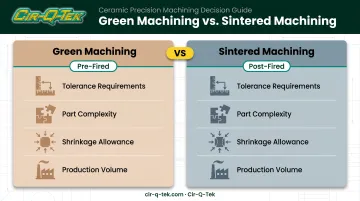
Green machining cuts the ceramic before firing, while the compacted powder is soft and chalk-like. Shops use conventional steel or carbide tools at this stage, making roughing operations faster and considerably cheaper than working fully fired material.
Sintered (hard) machining happens after firing, once the ceramic is harder than most tool steels. This requires diamond tooling, slow spindle speeds, and shallow depths of cut to avoid chipping.
There's a wrinkle with green machining: ceramics shrink roughly 20% during sintering, and that shrinkage isn't always uniform. Every green-machined dimension needs a calculated firing allowance, or the finished part comes out warped or undersized.
Choosing a route depends on a few factors:
- Tolerance requirements favor sintered machining when you need tight, final-fit dimensions
- Part complexity favors green machining, since intricate features are far cheaper to cut before firing
- Shrinkage allowance works predictably for simple geometries but gets risky on complex ones
- Production volume shifts high-volume runs toward green machining plus firing, while low-volume precision work often goes straight to sintered
The CNC Machining Workflow: From CAD to Finished Part
Every ceramic CNC job starts the same way metal jobs do. CAM software translates the CAD model into toolpaths and generates the G-code that drives the machine. The difference shows up in execution.
Tooling and spindle requirements change dramatically once you're cutting sintered ceramic. High-speed, vibration-free spindles are non-negotiable, and diamond or PCD tooling replaces standard carbide.
Cir-Q-Tek holds tolerances as tight as ±0.0005" on multi-axis ceramic work—tight enough for medical and aerospace fits where a few ten-thousandths decide whether parts mate cleanly.
Coolant and dust management shift with the machining stage too:
- Green-stage cutting typically uses light coolant or none at all, since the material is soft and dust is minimal
- Sintered-stage cutting relies on flood coolant, mist cooling, or dry vacuum extraction to control heat and capture fine abrasive particulate
Toolpath strategy matters just as much as tooling choice. Aggressive roughing passes that work fine on aluminum will chip or microcrack a ceramic blank. Shops instead use shallow stepdowns, gentle entry and exit moves, and continuous tool engagement to keep cutting forces low and consistent throughout the pass.
Types of Ceramic Materials Used in CNC Machining
Not all ceramics behave the same way under a cutting tool. Machinability, thermal performance, and mechanical strength vary drastically between material families, so the right choice depends entirely on what the part needs to survive.
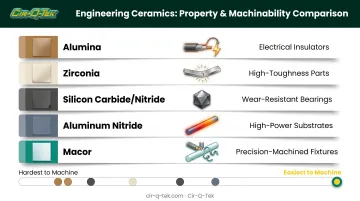
| Material | Key Property | Common Use |
|---|---|---|
| Alumina (Al₂O₃) | High hardness, wear resistance, electrical insulation | Medical tooling, electronics, structural insulators |
| Zirconia (ZrO₂) | Toughness, thermal shock resistance | Dental, medical, high-wear structural parts |
| Silicon carbide / nitride | Extreme hardness, high thermal conductivity | Cutting tools, bearings, automotive/aerospace wear parts |
| Aluminum nitride (AlN) | High thermal conductivity plus electrical insulation | Power electronics, semiconductor heat management |
| Macor | Easiest to machine, moderate strength | Prototypes, insulating fixtures, low-risk applications |
Alumina is the workhorse of technical ceramics. It's hard, wear-resistant, and electrically insulating, which is why alumina wafer boats and structural insulators show up throughout semiconductor and medical equipment.
Zirconia trades some hardness for toughness. It resists cracking under thermal shock better than most technical ceramics, making it a common choice for dental restorations and high-wear structural parts subject to repeated mechanical stress.
Silicon carbide and silicon nitride sit at the extreme end of hardness and thermal conductivity. Both resist thermal shock well, which explains their presence in cutting tools, bearings, and wear components exposed to automotive and aerospace heat cycles.
Aluminum nitride pairs high thermal conductivity with electrical insulation. That unusual combination makes it a preferred material for power electronics and semiconductor heat management, where components must move heat away from a circuit without conducting current.
Macor, Corning's machinable glass ceramic, is the outlier on this list. Unlike the others, it cuts like a stiff engineering plastic and doesn't require diamond tooling. That makes it the default choice for prototypes, insulating fixtures, and any application where cracking an expensive, diamond-machined part isn't worth the risk.
Common CNC Machining Methods for Ceramics
Most ceramic parts pass through more than one machining process before they're finished. Each method solves a different geometric or surface-finish problem.
CNC Milling shapes complex 3D geometries and sharp-cornered features using diamond-coated or CBN cutters. Spindle speeds run high while feed rates stay low, keeping cutting forces small enough that the ceramic doesn't fracture mid-pass.
For cylindrical parts—tubes, shafts, and rods—CNC Turning with PCD-tipped tools and shallow depths of cut is the usual choice. Sintered ceramic on a lathe takes more patience than metal: several light passes replace the single aggressive cut a machinist might take on steel.
Grinding (surface and diamond grinding) puts rotating diamond or CBN wheels to work when you need micron-level dimensional accuracy. Shops often add it as a hybrid finishing pass after CNC roughing, once the part is already close to final size.
Drilling and core drilling use diamond-tipped or ultrasonic-assisted tools to form precise holes without chipping brittle edges. Ultrasonic assist cuts cycle time versus conventional drilling—worth the setup on production runs with dozens of holes per part.
Electrical Discharge Machining (EDM) only works on electrically conductive ceramic grades, such as certain silicon carbide formulations. Because it erodes material electrically rather than mechanically, EDM can cut complex micro-features without inducing the mechanical stress a cutting tool would.
Lapping and polishing close out the process for parts that need sub-micron surface finishes. Optics, seals, and semiconductor components often require this final step, since even a diamond-ground surface can still be too rough for optical clarity or a hermetic seal.
Most production parts combine two or three of these methods in sequence:
- Mill or turn the bulk shape
- Grind to final dimensional accuracy
- Lap or polish only where the application demands it
Applications of Ceramic CNC Machining Across Industries
Ceramic components show up wherever a part has to survive conditions that would destroy metal or plastic.
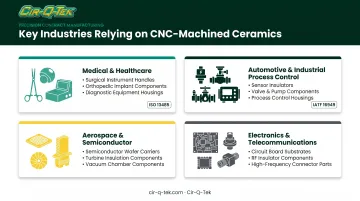
Medical & Healthcare Devices
Surgical instruments, implant components, and diagnostic tooling all lean on ceramics for biocompatibility and wear resistance.
Sourcing compliant components means working with manufacturers certified to standards like ISO 13485, the medical device quality management standard that Cir-Q-Tek holds across its manufacturing network. Without it, a supplier can't demonstrate the quality controls medical device regulators expect.
Automotive & Industrial Process Control
Ceramic sensors, wear components, and insulators handle the heat and vibration cycles automotive systems throw at them daily. Automotive-grade sourcing typically requires IATF 16949 certification, which governs quality management for automotive production parts.
Aerospace & Semiconductor
Alumina wafer boats used throughout semiconductor fabrication combine heat resistance, wear resistance, and chemical resistance in one part. Those same traits make ceramics the default for thermal barrier inserts, wafer-handling fixtures, and insulating brackets that face extreme heat and corrosive chemicals.
Electronics & Telecommunications
Dense circuitry often needs electrical isolation and heat removal at the same time. Ceramic substrates, insulators, and heat-dissipation components deliver both through dielectric strength paired with thermal conductivity. Aluminum nitride substrates, in particular, let designers move heat away from dense circuitry without risking a short, something no polymer substrate can match.
Advantages, Challenges & Design Best Practices
Advantages of Ceramic CNC Machining
CNC machining gives ceramic parts a level of precision and repeatability that kiln forming alone can't reach. Complex geometries, including internal channels, sharp functional features, and tight-fit interfaces, become possible once you're cutting rather than molding.
It also scales well. A single prototype and a production run of several thousand parts can use the same CAM program and tooling setup, without the mold or die investment that injection molding or casting requires upfront.
Common Challenges
Three problems dominate ceramic machining:
- Rapid tool wear from cutting a material harder than the tool itself
- Thermal shock risk, since low thermal conductivity in some grades traps heat at the cutting edge
- Cracking and chipping from brittle fracture, especially at edges and thin sections
NIST research on ceramic machining found that abrasive processing can account for as much as 90% of total part cost on some high-precision components. In one turbine-blade case study, grinding alone ran roughly 30% higher than machining an equivalent metal part.
These challenges typically mean longer lead times and higher costs than metal or plastic CNC work. Process control from an experienced supplier is essential to keeping both in check.
Design Guidelines for Machinable Ceramic Parts
A few design choices make the difference between a part that machines cleanly and one that cracks on the first pass:
- Avoid sharp internal corners. Use generous radii instead of 90-degree transitions, which concentrate stress.
- Design round features instead of oval. Round geometries distribute cutting forces more evenly.
- Maintain uniform wall thickness. Abrupt thickness changes create stress risers during machining and thermal cycling alike.
- Avoid abrupt cross-sectional changes. Taper transitions gradually wherever the design allows.
- Minimize deep internal-diameter features. Outside-diameter machining is consistently easier and cheaper than boring internal geometry.
Frequently Asked Questions
Can ceramics be machined?
Yes. Specialized diamond or CBN tooling combined with controlled CNC parameters lets shops cut advanced ceramics without shattering them. Machining can happen at the green (pre-fired) stage or the sintered (post-fired) stage, depending on the tolerance the part needs.
What tolerances can ceramic CNC machining achieve?
Tolerances as tight as ±0.0005" (±0.013 mm) are achievable, depending on the material, the machining stage, and whether a grinding or lapping finish follows the initial cut. Sintered-stage machining generally holds tighter tolerances than green machining.
Which ceramic material is easiest to CNC machine?
Macor, Corning's machinable glass ceramic, is the easiest by a wide margin. It cuts with conventional carbide tooling much like a stiff engineering plastic, while alumina and zirconia both require diamond tooling to machine at all.
What's the difference between green and sintered ceramic machining?
Green machining cuts the ceramic before firing, when it's soft and inexpensive to shape. Sintered machining happens after firing, when the material is far harder and requires diamond tooling to hit final, tight tolerances.
Why is diamond tooling required for ceramic machining?
Fully sintered ceramics are often harder than the tool steels used on metal parts. Diamond or CBN abrasives are the only practical way to remove material without the tool wearing out almost immediately.
What industries rely on CNC-machined ceramic parts?
Medical devices, aerospace, semiconductor manufacturing, automotive systems, and electronics all depend on precision ceramic components. These parts perform where heat, wear, corrosion, or electrical insulation would cause metal or plastic to fail.