Introduction
Steel is the backbone of CNC manufacturing, but treating it as one material is a mistake. The steel family runs from soft, forgiving 1018 carbon steel to abrasive tool steels that chew through carbide inserts.
Engineers who assume all steel grades behave the same often get burned. Unexpected chatter. Premature tool wear. Tolerance drift mid-run. Cost overruns that show up only after the first production batch ships.
The difference between a smooth production run and a scrapped batch usually comes down to grade selection made months earlier — often before the part ever hits a machine.
This guide covers how steel grades differ in machinability, the design decisions that determine success or failure, and the practical machining challenges you will hit on the floor. It also covers what to look for in a manufacturing partner before you commit a steel part to production.
Key Takeaways
- Machinability varies sharply by grade: free-machining carbon and stainless cut easily; alloy and tool steels need tighter process control
- Corrosion resistance trades off directly with machinability, clearest in 304 versus 316 stainless
- Standard tolerances of ±0.005" hold across most steel grades; tighter specs need grade-specific planning
- Wall thickness, corner radii, and heat-treat stock decide if a part machines cleanly or becomes a production risk
What Is CNC Machining Steel?
CNC stands for Computer Numerical Control. It refers to computer-guided subtractive processes (milling, turning, drilling, tapping, and grinding) that remove material from a steel blank to create a precise geometry. A CAM program generates tool-motion commands, and the CNC controller executes them with tight positional accuracy.
Yes, steel can be CNC machined. It is one of the most commonly machined materials in the industry. But steel isn't as forgiving as aluminum or brass. It demands:
- Carbide or coated inserts rather than standard high-speed steel tooling
- Rigid machine platforms that resist deflection under higher cutting forces
- Optimized speeds and feeds tuned to the specific grade and hardness
- Effective heat management, because steel's lower thermal conductivity keeps heat at the cutting edge instead of shedding it through the chip
Why Steel Still Dominates Precision Manufacturing
Steel remains the default choice for structural and mechanical components because it offers a broad performance envelope of strength, fatigue resistance, and wear resistance at a lower cost than titanium or nickel superalloys. For most load-bearing brackets, shafts, and housings, steel delivers the mechanical properties engineers need without the machining cost penalty that comes with exotic alloys.
That said, "steel" covers dozens of distinct alloys with wildly different cutting behavior. Getting grade selection right is the first real decision point in any steel CNC project.
Steel Grades and Their Machinability
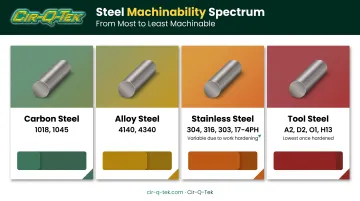
Machined steel breaks down into four practical families, each behaving differently under a cutting tool.
| Family | Representative Grades | Relative Strength | Corrosion Resistance | Machinability Trend |
|---|---|---|---|---|
| Carbon Steel | 1018, 1045 | Low to moderate | Poor without coating | Highest — most forgiving |
| Alloy Steel | 4140, 4340 | High | Poor to moderate | Moderate — condition-dependent |
| Stainless Steel | 304, 316, 303, 17-4PH | Moderate to high | Good to excellent | Variable — work-hardening risk |
| Tool Steel | A2, D2, O1, H13 | Very high (post-heat-treat) | Poor to moderate | Lowest once hardened |
Carbon Steels
1018 is low-carbon and the most forgiving grade on this list. It machines predictably, holds decent tolerances, and works well for general structural brackets, pins, and fixtures where strength requirements are modest.
1045 steps up to medium carbon for higher strength, but it cuts noticeably harder than 1018. Expect increased tool wear and slightly reduced feed rates. Both grades remain among the most cost-effective starting points for steel parts.
Alloy Steels
4140 and 4340 are workhorse alloys used for shafts, gears, and components under cyclic load. They balance strength with reasonable machinability, but only in the annealed condition.
Here's the catch: pre-hardened 4140 or 4340 (delivered at 28-32 HRC, for example) cuts very differently than annealed stock. Cutting forces climb, tool life drops, and cycle times stretch out.
If your drawing calls for pre-hardened material, your supplier needs to plan tooling and speeds around that condition specifically, not treat it like standard 4140.
Stainless Steels
The question engineers ask most often: is 304 or 316 more machinable?
304 is generally easier to machine and more cost-effective for standard corrosion resistance. 316 adds molybdenum for superior chloride and chemical resistance (critical for marine, medical, and chemical-processing applications), but it work-hardens more aggressively during cutting.
That work-hardening tendency means 316 demands:
- Sharper tooling with less rubbing contact
- Stable, consistent engagement (no light finishing passes that skate across the surface)
- Rigid setups to avoid chatter-induced hardening
Beyond the 304/316 comparison, two more grades matter:
- 303: Free-machining benchmark for turned stainless; added sulfur cuts faster than 304 or 316 on high-volume parts with moderate corrosion needs
- 17-4PH: Precipitation-hardening grade for strength plus moderate corrosion resistance; H900 (max strength) machines very differently than H1150 (toughness)
Tool Steels
A2, D2, O1, and H13 are wear-resistant tool steels typically machined in the annealed state, then heat-treated afterward for hardness. Machining hardened tool steel directly is slow, tool-intensive, and often impractical.
The standard workflow: rough and semi-finish the part annealed, heat-treat to spec, then finish critical features by grinding or EDM. This sequence manages the distortion that heat treatment inevitably introduces, without wasting cutting time fighting a hardened surface.
Machining Challenges and Best Practices
Work Hardening in Austenitic Stainless
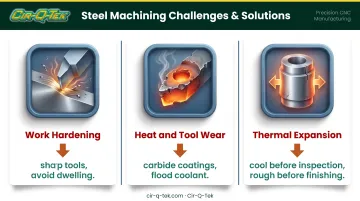
Austenitic grades like 304 and 316 work-harden when tools rub instead of cut cleanly. A dull edge or a light spring pass increases cutting forces, accelerates tool wear, and leaves a degraded surface finish.
Kennametal's guidance on preventing work hardening is direct: avoid dwelling in the cut, keep tools sharp, and maintain rigid, consistent engagement throughout the pass.
Tool Wear and Heat Management
Steel's lower thermal conductivity compared to aluminum means heat concentrates at the cutting edge rather than spreading through the chip. Harder and more heavily alloyed steels need:
- Carbide tooling with appropriate coatings (TiAlN for higher-heat applications)
- Conservative feeds and speeds matched to the specific grade
- Flood coolant or extreme-pressure (EP) additives to pull heat away from the tool-workpiece interface
Sandvik Coromant's guidance on turning different materials recommends round inserts or reduced entering angles specifically to manage notch wear in stainless applications — a small tooling adjustment that extends tool life.
Thermal Expansion and Dimensional Stability
Cutting generates localized heat that can distort thin-walled or tight-tolerance features mid-machining, only for the part to shrink back once it cools. This matters most on parts with unsupported thin sections or where tolerances leave little margin.
Parts that measure in-spec warm off the machine can drift out of tolerance once they reach room temperature. Steady flood coolant, roughing before finishing, and verifying critical dimensions after the part reaches ambient temperature keep that drift in check.
Cutting Parameters by Steel Family
Actual speeds and feeds should always come from your tooling supplier's material-specific data — but the general tightening trend across steel families looks like this:
| Steel Family | Relative Cutting Speed | Tooling Approach | Coolant Strategy |
|---|---|---|---|
| Carbon (1018, 1045) | Highest | Uncoated or TiN-coated carbide | Flood coolant, standard soluble oil |
| Alloy (4140, 4340 annealed) | Moderate-high | TiAlN-coated carbide | Flood coolant with EP additives |
| Stainless (304, 316) | Moderate | Sharp, positive-rake coated inserts | Flood coolant, no dwelling |
| Tool Steel (annealed A2, D2, O1, H13) | Lowest | Rigid coated carbide, conservative engagement | Flood coolant, reduced finishing feeds |
Achievable Tolerances
±0.005" (±0.127mm) is standard across most steel grades and a realistic baseline for general CNC work. Tolerances approaching ±0.0005" are achievable with specialized process control: stable equipment, grade-specific tooling, and rigorous in-process inspection.
Treat that precision as a capability to call out when the design needs it—not a default on every drawing.
Design Considerations for CNC Steel Parts
Design decisions made before a part ever reaches the shop floor determine whether machining goes smoothly or turns into a cost problem.
Wall thickness and rigidity. Thin sections deflect under cutting forces, and stainless grades amplify the problem due to higher cutting forces and work-hardening tendencies. Design thin walls with fixturing and finishing strategy in mind from the start, not as an afterthought during quoting.
Internal corner radii. Use the largest radius the design allows. Small internal radii force smaller tooling, which increases deflection risk, extends cycle time, and drives up cost. This is one of the cheapest design fixes available: a slightly larger radius often costs nothing functionally but saves real machining time.
Heat treatment planning. Don't hold tight final dimensions before heat treatment. Instead:
- Design in grind or finish stock on critical features
- Establish stable datums that survive the heat-treat process
- Plan final-dimension machining or grinding after hardening, when distortion has already occurred
Surface finish specification. Specify Ra values or treatments like black oxide, passivation, or electropolishing only where they affect fatigue life, sealing performance, or corrosion resistance. Over-specifying finish requirements adds cost without a functional payoff, a common and avoidable expense on production drawings.
Choosing a Manufacturing Partner for Steel CNC Machining
Supplier selection should be grade-specific. A shop that excels at 1018 brackets may lack the tooling, inspection equipment, or heat-treat process control needed for 316 stainless or hardened tool steel work.
When evaluating a potential partner, look for:
- Process capability — multi-axis milling and turning, grinding, and EDM access for hardened materials
- Inspection equipment — CMM capability and hardness testing appropriate to your tolerance requirements
- Relevant quality certifications — ISO 9001 as a baseline, IATF 16949 for automotive parts, ISO 13485 for medical device components
Partners that clear that checklist still differ on how they deliver cost, communication, and multi-process support. Cir-Q-Tek is an ISO 9001, ISO 13485, and IATF 16949-certified manufacturing partner offering precision CNC machining with tolerances as tight as ±0.0005". Multi-axis, multi-tasking equipment with live tooling handles complex steel geometries in a single setup, and CAD/CAM programming helps hold that accuracy into production.
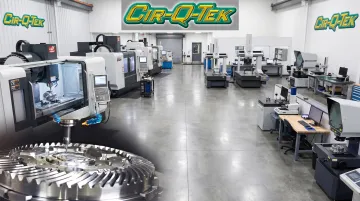
Its dual U.S.–Shenzhen model pairs a Pennsylvania headquarters for secondary quality inspection and domestic communication with Shenzhen operations that deliver offshore manufacturing pricing. Engineers who also need PCB assemblies or related contract manufacturing can consolidate sourcing under one partner. Projects with specific tolerance or material requirements can be scoped through Cir-Q-Tek's quote request page.
Frequently Asked Questions
Can you CNC machine steel?
Yes. It requires carbide or coated tooling, rigid machine platforms, and cutting parameters optimized for the specific grade because of steel's hardness and heat generation.
What does CNC mean in steel manufacturing?
CNC stands for Computer Numerical Control. It covers computer-guided milling, turning, drilling, and grinding used to shape steel to precise specifications from a CAD/CAM program.
Is 304 or 316 more machinable?
304 is more machinable and cost-effective for standard applications. 316 offers superior corrosion resistance but work-hardens more aggressively, requiring sharper tooling and more conservative cutting parameters.
What is the easiest steel to machine?
Low-carbon 1018 and free-machining 303 stainless are among the easiest grades, offering predictable chip control and faster cycle times than their alloy or work-hardening counterparts.
Does heat treatment affect machinability?
Yes. Hardened steel increases tool wear and cutting time significantly. Most tool steel and pre-hardened alloy parts are roughed in the annealed condition, heat-treated, then finished by grinding or EDM.
What tolerances can be achieved when CNC machining steel?
±0.005" is standard across most grades. Tolerances down to ±0.0005" are achievable but require specialized process control, stable equipment, and rigorous inspection.