What do precision machinists do?
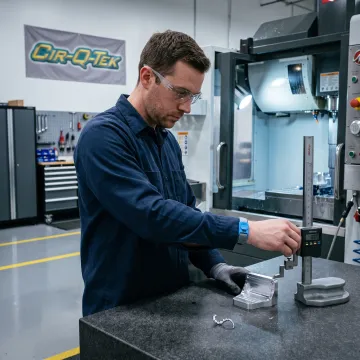
Precision machinists manufacture components that must meet exact dimensional, geometric, and surface-finish requirements. They interpret engineering drawings and CAD data, select appropriate materials and machining methods, program and operate CNC equipment, and inspect finished parts with metrology tools. Their work is essential when a component’s fit, function, reliability, or regulatory requirements leave little room for variation.
What is considered precision machining?
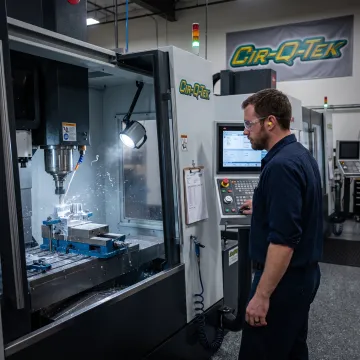
Precision machining is the controlled removal of material to produce parts with highly accurate dimensions, tolerances, and features. It commonly uses CNC milling, turning, and multi-axis equipment guided by CAD/CAM programming. At Cir-Q-Tek, precision machining can maintain tolerances as close as ±0.0005 inches, supported by strict supervision and high-end inspection equipment.
What materials can be CNC machined?
CNC machining can be used with almost any material appropriate for the component’s design and application. Cir-Q-Tek supports standard metals, high-strength and high-temperature metals and alloys, engineered plastics, ceramics, composites, and other non-metals. The team also has finish-machining expertise for aluminum, zinc, magnesium, iron, and stainless-steel castings.
How accurate are Cir-Q-Tek’s CNC machining services?
Cir-Q-Tek provides tight-tolerance CNC machining with capabilities as close as ±0.0005 inches. Achievable tolerance depends on the material, part geometry, feature size, machining process, and inspection requirements. Providing complete CAD models, drawings, critical dimensions, and functional requirements during quoting helps the team evaluate manufacturability and plan the appropriate process controls.
Can Cir-Q-Tek machine complex or multi-feature parts?
Yes. Cir-Q-Tek uses high-performance milling and turning equipment, multi-axis and multi-tasking machinery, live tooling, and multiple spindles to support complex geometries and intricate features. Completing more features in a single setup can reduce part handling and help preserve relationships between critical dimensions, improving consistency for demanding components.
Do you support prototypes and production machining orders?
Cir-Q-Tek supports manufacturing needs from prototype quantities through repeat production runs. This flexibility allows customers to validate a design before scaling while working with one coordinated manufacturing partner. For production programs, parts stocking and just-in-time shipment options can help align component availability with a customer’s scheduling and inventory requirements.
What information is needed for a CNC machining quote?
For non-PCB and non-PCBA items, Cir-Q-Tek requests CAD and 3D data and/or fabrication drawings to prepare a quote. Include the material, quantity, required tolerances, finish requirements, critical features, inspection needs, and target delivery date whenever available. Clear technical information enables a more accurate manufacturability review and production recommendation.
What quality standards support your machining programs?
Cir-Q-Tek’s machining is performed in facilities certified to ISO 9001, ISO 13485, and IATF 16949. These certifications support established quality-management practices and are particularly relevant to demanding medical and automotive manufacturing programs. High-end metrology equipment is used under strict supervision to verify that finished components meet specified requirements.