Get the substrate, layer count, or copper thickness wrong, and the results show up fast: overheating, cracked copper traces at bend points, or LEDs that dim and fail months ahead of schedule. Many buyers struggle with these choices simply because flex PCB specs aren't explained in plain terms anywhere.
This guide breaks down flex PCB types, materials, copper weight, advantages and limitations, common applications, and what to look for in a manufacturing partner — so you can spec your next LED strip project with confidence.
Key Takeaways
- Flex PCBs use polyimide or PET instead of rigid FR-4, so LED strips can bend, coil, and fit curved surfaces.
- Copper weight sets the trade-off: thicker copper carries more current but flexes less easily.
- Single, double, and multilayer builds match needs from basic accent lighting to addressable RGB systems.
- The global flexible PCB market is projected to hit $50.90 billion by 2030, driven by lighting and electronics demand.
- Choosing a manufacturer with proven flex/LED experience and quick-turn prototyping reduces costly redesigns later.
What Is a Flex PCB for LED Strips?
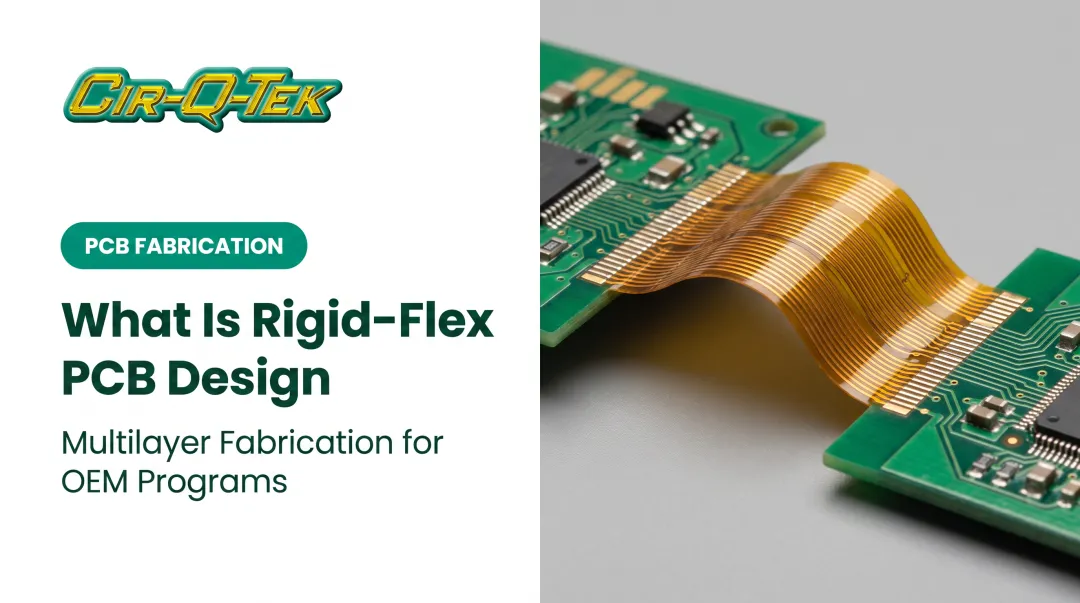
A flexible PCB is a bendable circuit board built on a polyimide or polyester substrate, with copper traces printed or etched onto it instead of the rigid fiberglass core used in standard FR-4 boards. That flexibility is the entire point: it lets the board bow, twist, and coil without snapping.
In an LED strip, the flex PCB does two jobs at once. It's the mechanical platform that holds the SMD LEDs and current-limiting resistors in place, and it's the electrical pathway carrying power and signal between them. The substrate material also helps pull heat away from each LED during operation—critical in these compact layouts.
This combination of flexibility and dual-function design is why LED strips can be sold in continuous 5-meter reels and installed around curves, corners, and irregular shapes without cutting and rejoining segments mid-run.
Flex PCB vs. Rigid PCB for LED Applications
Rigid boards still have a place in LED lighting, particularly for flat, high-power fixtures. But the two technologies serve different jobs.
| Factor | Flex PCB | Rigid PCB (FR-4) |
|---|---|---|
| Substrate | Polyimide or polyester (PET) | Fiberglass-epoxy laminate |
| Typical thickness | 0.05–0.80 mm finished | Often 0.062 in (roughly 1.6 mm) for standard two-layer boards |
| Bend capability | Designed to flex and conform | Fixed, no intended flexing |
| Best use case | Curved coves, automotive interiors, wearables | Flat panels and fixtures where the board stays stationary |
Pick flex when the installation needs to bend, twist, or fit into a tight, irregular space. Pick rigid when the fixture is flat and stationary. For high-power LEDs that need serious heat management, metal-core boards are usually the better rigid option.
Types of Flex PCBs Used in LED Strips
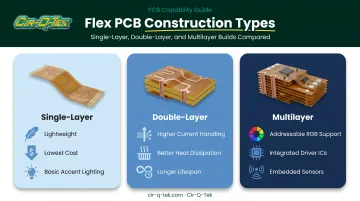
Not every LED strip needs the same circuit complexity. Flex PCBs for lighting generally fall into three categories, and picking the right one comes down to power draw and feature set.
Single-Layer Flex PCB
This is the simplest and most common construction for basic LED strips. The stack-up includes:
- A flexible substrate (polyimide or PET)
- A single conductive copper layer
- Solder mask and silkscreen for component placement
- An adhesive layer, often with a protective liner for mounting
Single-layer boards are the lightest and least expensive option. They're well-suited to low-to-moderate power strips, such as ambient accent lighting where current demand stays modest and cost matters more than raw output.
Double-Layer Flex PCB
Double-layer construction adds a second conductive layer, separated by flexible dielectric and connected through plated through-holes (vias). The typical stack-up includes:
- Top and bottom copper layers
- Coverlays on each side
- Adhesive and a protective liner
That extra copper layer isn't just for routing convenience. It allows:
- Higher current handling across the strip
- Better heat dissipation, since thermal load spreads across two planes
- Brighter, more consistent LED output
- Longer strip lifespan compared to single-layer designs
For strips running higher-density LEDs or longer continuous runs, double-layer boards are usually worth the added cost.
Multilayer Flex PCB
Multilayer flex boards (three or more conductive layers) support smart lighting that goes well beyond simple on/off strips. They provide the routing density needed for:
- Addressable RGB LED strips
- Integrated driver ICs
- Embedded sensor modules
More layers mean more capability, but also higher cost and a tighter bend radius. That tighter radius protects the additional copper layers from cracking during installation.
Materials and Copper Thickness: Getting the Engineering Right
Two decisions shape almost every flex PCB's real-world performance: the substrate material and the copper weight. Get either one wrong, and you'll see it in overheating, voltage drop, or premature LED failure.
Substrate Choice: Polyimide vs. Polyester (PET)
| Factor | Polyimide (PI) | Polyester (PET) |
|---|---|---|
| Bend flexibility | Handles dynamic, repeated bending well | Generally limited to static installations |
| Temperature resistance | High: PI film retains stability well above typical LED operating temperatures | Lower: finished PET boards commonly rated around -25°C to +75°C |
| Bend-cycle life | Strong in bare-film testing, though assembled-strip life depends on the full construction | Not well documented for dynamic use |
| Relative cost | Typically higher | Typically lower, though pricing varies by stack-up |
Polyimide is the go-to choice for automotive interiors, wearables, and anything that gets bent repeatedly or sits near heat sources. PET works well for budget-conscious, low-heat, install-once-and-leave-it applications like basic cove lighting.
Copper Weight and Its Impact on Performance
Copper thickness is measured in ounces per square foot, and it's one of the most overlooked specs on an LED strip order. 1 oz copper equals roughly 0.036 mm, while 2 oz copper comes in around 0.071 mm, according to All Flex's copper thickness guidance. Higher-power LED strips often call for 2 oz, 3 oz, or even 4 oz copper to handle the additional current safely.
The trade-off runs both directions:
- Thicker copper improves current capacity and heat dissipation, but reduces flexibility and can complicate manufacturing.
- Thinner copper stays more flexible, but increases resistance, which leads to heat buildup, voltage drop, and earlier LED failure on longer runs.
Adhesive layers and coverlay films complete the stack-up: they protect exposed copper and bond the layers so the strip survives installation without delaminating.
Specify substrate and copper together. Pair polyimide with heavier copper for high-power or dynamic flex; use PET with 1 oz copper for static, low-heat runs. That match is what keeps voltage drop and thermal stress in check over the life of the strip.
Advantages and Limitations of Flex PCBs for LED Strips
Flex PCBs solve real problems, but they're not the right answer for every LED application. Weighing both sides upfront saves a redesign later.
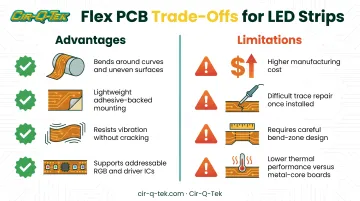
Advantages:
- Bends around curves, corners, and uneven surfaces where rigid boards simply won't fit
- Lightweight, with adhesive-backed tape making mounting fast and clean
- Resists vibration and repeated flexing without cracking, when specced correctly
- Supports complex smart-lighting circuits, including addressable RGB and driver ICs
Limitations:
- Costs more to manufacture than comparable rigid boards
- Damaged traces are difficult to repair once installed
- Design requires careful attention to bend zones and stress relief
- Thermal performance lags behind metal-core PCBs, which is why flex boards generally aren't specified for the highest-wattage LED applications
That last point matters most when specifying high-output fixtures. If your project pushes serious wattage, a metal-core board may outperform flex on heat management. Flex earns its place on flexibility and form factor, not raw thermal ceiling.
Common Applications of Flex LED Strip PCBs
Flex PCBs show up anywhere lighting needs to follow a shape rather than sit flat. Common use cases include:
- Architectural and cove lighting: under cabinets, along ceiling coves, and inside display cases
- Automotive interior and dashboard lighting: ambient cabin lighting and addressable RGB accents in tight, curved spaces
- Retail signage and displays: shelf accents, product highlighting, and illuminated signage
- Medical and industrial equipment: status indicators and backlighting in compact or irregular enclosures
- Wearable and compact electronics: lighting built into flexible, space-constrained assemblies
Compact size, high brightness, and low power draw also make flex LED strips a practical fit for commercial interiors and OEM products that need ambiance or indication lighting without a major electrical redesign.
How to Choose the Right Flex PCB Manufacturing Partner
Specifying the right substrate and copper weight only pays off if your manufacturer can actually build to that spec, consistently, at scale. A few criteria separate a reliable flex PCB partner from a risky one:
- Proven flex/LED manufacturing experience — not every board house handles the tighter tolerances flex circuits demand.
- Recognized quality certifications — ISO 9001 at minimum, with UL/cUL approval where safety compliance matters.
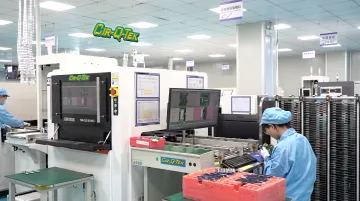
- In-line inspection capability — AOI and X-ray inspection during assembly catch defects before they reach a customer's dock.
- Quick-turn prototyping — the ability to move from design file to physical sample in days, not weeks, keeps development timelines realistic.
Cir-Q-Tek meets those criteria as a one-stop sourcing partner for flex PCB projects. The company is ISO 9001:2015 certified (valid through July 2027) and holds UL and cUL approval, giving buyers a documented quality baseline before production starts. Prototype turnaround runs as fast as 3 days to build and 2 days to ship, which matters when a lighting product needs to move from concept to sample fast.
On the production side, Cir-Q-Tek's SMT lines run inline AOI and X-ray inspection, catching placement and solder defects on components as fine as 01005 parts and 0.2mm BGA spacing before boards move further down the line.
Multilayer flex capability extends up to 40 layers, built with laser direct imaging for tighter registration across complex stack-ups. That matters for addressable RGB strips with integrated driver ICs.
Beyond fabrication, a few operational details reduce risk for teams scaling LED strip production:
- Just-in-time delivery and parts stocking, so volume orders arrive on a schedule rather than sitting in a warehouse
- Secondary quality inspection at the company's Pennsylvania facility before anything ships, on top of factory-level checks in Asia
- A defect replacement policy covering parts that don't meet the fabrication specs submitted at order time, at no added cost
Dual-location operations (headquarters in Bristol, PA, plus an office in Shenzhen, China) make domestic-level service and offshore pricing possible in the first place. For LED strip projects, submit a quote request with your Gerber files or ODB data and BOM. That lets the team confirm copper weight, layer count, and substrate against your application before production begins.
Frequently Asked Questions
What makes LED flex PCBs different from regular PCBs?
Flex PCBs use bendable polyimide or PET substrates instead of rigid FR-4, allowing the board to twist and conform to curved or tight spaces. Rigid boards stay flat and fixed, which limits where they can be installed.
Can LED flex PCBs handle high temperatures?
Polyimide-based flex PCBs handle higher sustained temperatures than PET-based boards, making them a better fit for LED strips that run warm during extended operation. PET boards are typically limited to lower-heat, static installations.
What copper thickness is best for LED strip PCBs?
Standard LED strips often use 1oz copper for basic current needs. Higher-power strips typically require 2oz, 3oz, or 4oz copper for better current handling and heat dissipation.
What's the difference between single-layer and double-layer flex PCB for LED strips?
Single-layer boards are cheaper, lighter, and suited to low-to-moderate power strips. Double-layer boards handle more current and dissipate heat more effectively, which extends LED lifespan on brighter or denser strips.
How do I choose between PET and polyimide substrate for my LED project?
PET suits low-cost, low-heat, static installations where the strip is mounted once and left in place. Polyimide fits high-temperature, dynamic-bending, or long-lifespan applications like automotive interiors.
How long does it typically take to get flex PCB LED strip prototypes made?
Industry quick-turn prototypes typically take 3–6 days, depending on layer count and whether assembly is included. Cir-Q-Tek targets 3 days to build and 2 days to ship for pre-production samples.