The technical side gets most of the attention — spindle speeds, CAD/CAM programming, tolerance charts. But the real value shows up somewhere else entirely: fewer rejected parts on the assembly line, faster product launches, and a lower total cost of ownership once you account for scrap and rework.
This article isn't another definition of precision machining. It's a breakdown of why it matters in practice, and how to evaluate whether a manufacturing partner is actually delivering that value or just quoting tight numbers on a spec sheet.
Key Takeaways
- Tolerance control directly reduces assembly-line rejects and warranty costs, not just "part quality"
- CNC automation cuts per-part cycle time and labor overhead compared to manual processes
- ISO/IATF certifications turn accurate parts into documented, audit-ready compliance
- Skipping process discipline compounds into scrap, delays, and requalification headaches
- Partner evaluation should focus on proven capability, not marketing language
What Is Precision Metal Machining
Precision metal machining is the controlled removal of material from a metal workpiece, using CNC mills, lathes, and grinders, to produce parts that meet exact specifications and tolerances.
Precision here means repeatability: producing parts to the same specified tolerance, run after run, not only on a first sample. NIST frames the idea in those terms—consistent process capability, not one-off accuracy.
It shows up wherever fit, function, and safety depend on dimensional accuracy:
- Medical device components requiring biocompatibility and exacting fit
- Automotive assemblies where mating parts from multiple suppliers must align
- Industrial control systems with tight mechanical interfaces
- Telecom hardware enclosures and connector housings
Precision machining exists to make parts that perform reliably in the field. The point is reliable performance, not machining sophistication for its own sake. A machinist chasing ±0.0005" tolerances on a feature that doesn't need it isn't adding value. They're adding cost.
Key Advantages of Precision Metal Machining
The advantages below map directly to metrics manufacturing and procurement teams already track: defect rates, cycle time, scrap cost, and audit outcomes. If a machining partner can't connect their process to these numbers, they're delivering the appearance of precision manufacturing, not the full value of it.
Dimensional Accuracy and Repeatability
Precision machining holds tolerances often within thousandths of an inch. Every part in a production run matches specification, including the units that follow the approved first article.
CNC programming combined with inline measurement removes the variability that manual machining introduces. A skilled machinist working by hand can produce an excellent single part. What's harder is producing 10,000 identical ones. That's where programmed, repeatable cuts matter.
Why this is an advantage:
Consistent tolerances reduce assembly-line fit issues and field failures, which lowers warranty and rework costs before they reach a customer complaint.
NIST's research on machining precision confirms that tighter-tolerance features are inherently more difficult and costly to produce. Inconsistent process control risks defects and erodes the cost advantage you set out to capture.
For buyers, this translates into confidence: you can commit to tighter product specs and multi-supplier assemblies without gambling on whether every batch will actually fit.
KPIs impacted:
- Defect and scrap rate
- First-pass yield
- Warranty claims
- Assembly rework hours
When it matters most: Multi-component assemblies, high-volume production runs, and any application where a fraction-of-a-millimeter deviation affects function or safety.
Cost and Time Efficiency at Scale
Precision machining reduces material waste and staffing overhead compared to manual processes. Programmed cuts minimize excess material removal, and CNC automation enables fast turnaround on both prototype quantities and high-volume runs — without the re-tooling delays that stall manual shops.
Why this is an advantage:
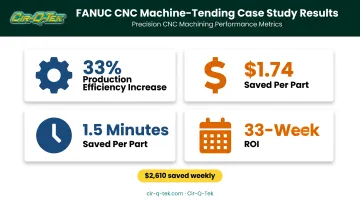
Faster, leaner production reduces per-unit cost and shortens the path from design to shipped product. A documented FANUC CNC machine-tending case study reported a 33% production efficiency increase. The line saved $1.74 and 1.5 minutes per part, or roughly $2,610 weekly, with a 33-week return on investment. That is real evidence automated precision processes can lift throughput, not a blanket promise for every shop.
For decision-makers, predictable lead times and unit costs make launch planning and inventory management far less of a guessing game.
KPIs impacted:
- Cost per part
- Lead time
- Material utilization rate
- On-time delivery
When it matters most: Scaling from prototype to production, managing tight launch windows, or sourcing parts that need to compete against offshore pricing without sacrificing quality.
Regulatory Compliance and Risk Mitigation
Industries like medical devices and automotive require accurate parts and documented, traceable manufacturing processes. ISO 9001 sets the baseline for controlled operations and measurement. ISO 13485 adds risk management and validated processes for medical devices. IATF 16949 adds lot traceability and control-plan requirements for automotive.
Why this is an advantage:
Certified processes reduce the risk of failed audits, recalls, or non-compliant shipments. Those costs dwarf the machining spend itself.
NHTSA issued Ford a $165 million consent order in 2024 for untimely recalls and incomplete recall information, and required Ford to build a VIN-based component traceability system. That is the exposure poor documentation creates, even when the parts themselves were sound.
Cir-Q-Tek's machining operations run under ISO 9001, ISO 13485, and IATF 16949 certified processes, paired with UL/cUL approval. For regulated buyers, that is documented assurance on top of the finished part, not only a tolerance claim on a quote sheet.
KPIs impacted:
- Audit pass rate
- Non-conformance reports
- Recall risk
- Supplier qualification time
When it matters most: Medical devices, automotive components, and any application where documentation and traceability are contractually or legally required.
What Happens When Precision Machining Standards Are Missing or Ignored
Skip tolerance control and process discipline, and the consequences rarely show up immediately. They show up downstream, where they're more expensive to fix.
- Inconsistent part quality that only surfaces after assembly or once the product is in the field
- Higher scrap and rework rates, inflating the true per-unit cost well beyond the quoted price
- Reactive firefighting: expedited reorders, missed launch dates, strained customer relationships
- Rising long-term costs as defects and delays compound across successive production runs
- Difficulty scaling to new products or higher volumes without requalifying the process each time
None of this is theoretical. NIST's own research on manufacturing process variability notes that inadequate control leads directly to scrap, rework, and repair. Those are the exact costs that erase whatever savings a cheaper quote appeared to offer.
How to Get the Most Value from a Precision Machining Partner
Precision machining delivers its full value only when tolerance capability, inspection rigor, and certifications are applied consistently — not just quoted on a spec sheet and hoped for on the shop floor.
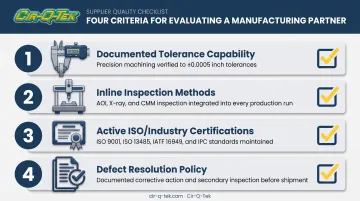
When evaluating a potential partner, look past the tolerance number itself. Ask about:
- Documented tolerance capability — evidence they hold the quoted tolerance across production runs, not only on a sample
- Inline inspection methods — CMM measurement, optical comparators, or other metrology suited to the part
- Active ISO/industry certifications relevant to your sector — medical, automotive, or general quality systems
- Defect resolution policy — what happens when a part doesn't conform to spec
Supply chain design matters too. A one-stop manufacturing partner like Cir-Q-Tek — offering ISO-certified CNC machining alongside PCB fabrication and PCBA assembly under one roof — can simplify supplier management while holding consistent quality standards across a product's bill of materials. Instead of qualifying several vendors against different quality systems, you manage one.
If you're evaluating machining for a regulated application, request a quote with your part drawings and tolerance requirements rather than comparing generic capability claims.
Conclusion
The real value of precision metal machining is the control, consistency, and compliance it brings to production. Tight tolerances mean nothing without repeatability, and repeatability means little without documentation to prove it.
These advantages compound. Better tolerances and fewer defects reduce cost and risk with every production run, not just the first one. Choosing a machining partner is an ongoing operational decision that affects every batch that follows, not a one-time procurement checkbox.
Frequently Asked Questions
What is precision machining?
Precision machining uses CNC-controlled tools — mills, lathes, and grinders — to remove material from a workpiece and hit exact dimensions with tight, repeatable tolerances. What sets it apart is consistency across production runs, not one accurate part.
What is precision metal?
"Precision metal" refers to metal components manufactured to tightly controlled dimensional specifications, typically through CNC machining. It's used where fit and function are critical, such as medical or automotive assemblies.
What do precision machinists make?
Precision machinists produce machined parts and components across medical, automotive, and industrial sectors. CAD/CAM programming and metrology skills are what keep those parts on spec from the first piece to the last.
What industries rely most on precision metal machining?
Automotive, medical devices, and industrial process control (for example, fluid power fittings) depend most on precision-machined components. Telecom, gaming, and commercial electronics also use precision parts where fit and reliability matter.
What tolerances can precision CNC machining achieve?
Standard CNC tolerances typically run around ±0.005", with production-grade services reaching ±0.002". Feature-specific work such as reamed holes can reach ±0.0005", depending on material and geometry.
How is precision machining different from standard machining?
Precision machining emphasizes tighter tolerances, higher repeatability, and documented quality control through inspection records and traceability. Standard machining typically follows default drawing tolerances without the same level of measurement rigor.