How machinable is 304 stainless steel?
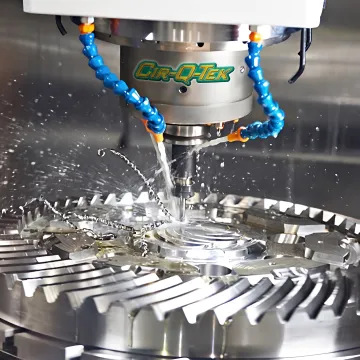
304 stainless steel is widely CNC machined, but it work-hardens quickly and has lower thermal conductivity than many carbon steels. Successful machining depends on rigid setups, sharp tools, suitable cutting speeds, controlled feed rates, and effective coolant use. For components with tight tolerances or intricate features, proper CAM programming and in-process inspection help maintain dimensional stability and surface quality.
What stainless steel CNC machining services does Cir-Q-Tek provide?
Cir-Q-Tek provides precision CNC milling, CNC turning, multi-axis machining, and finish machining for stainless steel castings. Its equipment includes multi-tasking machinery, live tooling, and multiple spindles that can complete finished features from a single setup. The team also offers CAD design and CAM programming support for custom geometries, prototypes, and production parts.
How tight are your CNC machining tolerances?
Cir-Q-Tek can maintain machining tolerances as close as ±0.0005 inches, subject to part geometry, material condition, feature accessibility, and production requirements. Tolerance planning should account for the dimensions that are functionally critical rather than applying extreme precision everywhere. High-end metrology equipment is used under strict supervision to verify dimensional conformance.
Can you machine prototypes as well as production quantities?
Yes. Cir-Q-Tek supports parts in virtually any quantity, from prototype and pre-production requirements to recurring production programs. Engineering, CAD, and CAM support can help prepare a design for efficient manufacturing before volume production begins. The company can also stock completed parts and coordinate just-in-time shipments when an ongoing supply arrangement is needed.
What files are needed for a stainless steel CNC machining quote?
For non-PCB and non-PCBA machining work, Cir-Q-Tek requests CAD and 3D data and/or fabrication drawings. Complete documentation should identify the material grade, dimensions, tolerances, threads, finishes, critical inspection points, expected quantity, and any special packaging needs. Clear requirements enable the team to evaluate manufacturability, select an appropriate process, and prepare an accurate quote.
Can you help improve a part design before machining?
Yes. Cir-Q-Tek offers engineering assistance for part design and machining challenges, supported by CAD design and CAM programming expertise. Early review can identify features that require specialized tooling, difficult internal corners, unnecessary tight tolerances, or setup-intensive operations. Addressing these details before production can improve manufacturability, repeatability, lead-time planning, and overall program cost.
What quality certifications support your machining services?
Cir-Q-Tek’s manufacturing facilities are certified to ISO 9001:2015, ISO 13485 for medical device manufacturing, and IATF 16949 for automotive manufacturing requirements. The company also holds ISO 14001 certification, along with UL and cUL approvals. These credentials support disciplined quality-management processes for customers working in regulated and quality-sensitive industries.
How do you ensure custom stainless steel parts meet specifications?
Quality begins with complete design documentation and continues through programming, controlled machining, and final inspection. Cir-Q-Tek uses high-end metrology equipment under strict supervision to verify critical dimensions and features. Its certified facilities support structured quality processes, while design and CAM expertise help establish repeatable manufacturing methods for complex stainless steel parts.