But here's where things get murky. Engineers and buyers searching for "12-axis CNC machine" frequently find conflicting answers. Some sources treat it as a real, well-defined category. Others suggest it's mostly a marketing term.
This article breaks down what axes actually mean in CNC machining, explains how 12-axis configurations really work, and helps you decide whether your project genuinely needs that level of capability — or whether 5-axis (or a good sourcing partner) will do the job just fine.
Key Takeaways
- A "12-axis" CNC usually means two independent 6-axis heads (X, Y, Z, A, B, C) cutting a part at once, not one 12-direction path.
- Higher axis counts reduce setups and re-fixturing, improving accuracy and shortening production time on complex parts.
- Axis count is a configuration detail, not a performance guarantee; tolerance and repeatability matter more than the number.
- Most manufacturers don't need to buy multi-axis equipment—an experienced CNC partner delivers the capability without the capital outlay.
Understanding CNC Machine Axes: From 3-Axis to 9-Axis
An "axis" in CNC machining is simply a direction the cutting tool or workpiece can move under computer control. Three of them (X, Y, Z) are linear: left-right, front-back, and up-down. Three more (A, B, C) are rotational, adding angular movement around the X, Y, and Z axes respectively.
More controlled axes generally means:
- Fewer manual setups and re-fixturing steps
- Tighter achievable tolerances
- Complex geometries cut in one pass instead of several
Here's how the common tiers stack up:
| Axis Count | Motion Type | Typical Use Case |
|---|---|---|
| 3-axis | X, Y, Z linear only | Basic milling, drilling, flat/prismatic parts |
| 4-axis | 3 linear + 1 rotary | Cutouts, arcs, and features around a part's circumference |
| 5-axis | 3 linear + 2 rotary | Complex contoured surfaces; industry standard for high-precision work |
| 7-axis | Custom combinations, up to 3 spindles | Aerospace-grade and medical parts machined from bar stock |
| 9-axis | Multiple spindle/turret systems | Combined turning and milling in Swiss-type production |
Why 5-Axis Remains the Benchmark
Five-axis machines strike a balance most shops can actually justify. They handle five-sided access on a single setup, which covers the vast majority of aerospace, medical, and automotive components without the programming complexity or capital cost of a 7-, 9-, or 12-axis system. For most shops, that makes 5-axis the practical ceiling for high-end work. It is also the clearest springboard for understanding what changes once you move above it.
What Is a 12-Axis CNC Machine?
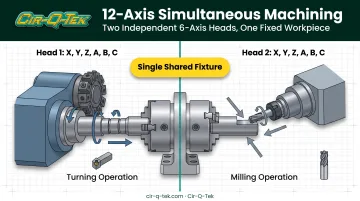
A 12-axis CNC machine typically refers to a system with two independent 6-axis heads or turrets working on the same part at once. Each head moves through its own X, Y, Z, A, B, C set. Combined, that's 12 controlled motions running in a coordinated sequence.
The practical benefit is straightforward: one head can turn a feature while the other mills a separate face, or one finishes a surface while the other starts the next operation. The part never leaves its fixture.
What this configuration eliminates:
- Reorientation of the workpiece between operations
- Secondary fixturing that introduces alignment error
- Idle time waiting for a second machine in the process chain
Geometries and Materials These Machines Handle
Dual-head, multi-axis systems are built for parts with compound angles, internal and external features on the same component, and fine surface details that would otherwise demand multiple machines. They also cut a wide material range (metals, engineered plastics, and composites), so the same platform covers production runs and rapid prototyping.
Precision holds up under that complexity. DMG MORI's benchmarking for advanced multi-axis milling cites volumetric accuracy better than 30 microns and positioning accuracy around 4 microns on a five-sided part machined in a single clamping (DMG MORI, 2024). That same level of control scales into dual-head systems running similar work at the same time.
Real-world example: Shanghai Medical Instruments uses multi-axis, multitasking machining centers to produce roughly 500 types of minimally invasive and ENT surgical instruments. The process finishes up to six faces from bar stock in a single setup and delivers productivity gains of up to 20% on certain parts (Modern Machine Shop, 2021).
That is the job 12-axis and near-12-axis setups target: complex, small-batch medical components that cannot tolerate re-fixturing error.
Is There Really a 12-Axis CNC Machine? Clearing Up the Confusion
Yes, machines with 12 or more controlled motions exist. There's a catch before you spec one into a project.
Most "12-axis" machines aren't a single kinematic chain moving in 12 independent directions at once. They're two combined 6-axis heads operating in parallel. True single-chain machines with 12-plus simultaneously interpolated axes are rare and expensive, and almost always custom-built for one application.
What's the Highest Axis Count Commercially Available?
Some multi-spindle turning centers push well past 12 by adding sub-spindles, tailstocks, and tool-change axes into the count. INDEX's MS24-8, for example, lists 14 tool carriers with one or two axes each, plus up to eight main spindles and additional swiveling synchronous spindles (INDEX, accessed 2026).
Notably, INDEX doesn't publish a single "total axis" figure for the machine, because the honest answer depends on how you count.
Beyond a certain point, added "axes" often describe supporting functions, not independent cutting motions. A tool-change axis isn't cutting metal. A tailstock axis is positioning, not machining.
So what should buyers actually focus on?
- Achievable tolerance on the specific feature you need
- Repeatability across a production run, not just a single sample part
- Setup reduction: how many operations actually get consolidated
- Cycle time for your part geometry specifically, not a generic marketing claim
Axis count is a spec sheet detail. It's not a substitute for asking a supplier to show you tolerance data on a comparable part.
Benefits, Applications, and Limitations of 12-Axis Machining
The Real Advantages
When a dual-head, multi-axis setup is matched to the right part, the gains are measurable. DMG MORI's comparison of a 3-axis process against a 5-axis process on a comparable part found:
- 60% fewer setups (from more than five down to two)
- 30% shorter cycle time (48 minutes down to 33)
- 50% fewer tools required (17 down to 8)
- 25% improvement in process accuracy
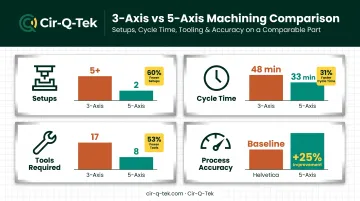
Those figures are for 5-axis work and vary by part, but the same pattern scales to higher-axis systems: fewer setups mean fewer error points and faster turnaround.
Where This Capability Actually Matters
- Aerospace — turbine blades, impellers, and blisks with compound-curved surfaces
- Medical devices — implants, surgical instruments, and dental components finished six sides from one blank
- Automotive — precision housings and high-tolerance components at volume
The Limitations Nobody Advertises
- High capital investment — multi-axis machines cost far more than 3- or 5-axis equipment (rotary tables, thermal control, advanced controllers)
- Skilled operator scarcity — programming and running these machines needs specialized training that's hard to find
- Complex CAM programming — more axes raise collision risk and extend simulation time before any metal is cut
- Not cost-justified for simple parts — if the geometry doesn't need simultaneous multi-sided access, you pay for unused capability
Sourcing 12-Axis and Multi-Axis CNC Machining Services
For most companies, buying a 12-axis machine outright doesn't pencil out. The equipment cost alone can run into seven figures, and that's before accounting for skilled programmers and operators. That's why most OEMs source complex machining work through a manufacturing partner rather than carrying the capital burden themselves.
Cir-Q-Tek is built around that problem. It operates as a manufacturing sourcing company, not an equipment owner-operator, and connects customers to precision CNC machining—including multi-axis and multi-tasking work—through a network of certified partner facilities.
What Cir-Q-Tek brings to complex machining projects:
- Tolerances as tight as ±0.0005", backed by CAD design and CAM programming support
- Machining performed in ISO 9001, ISO 13485, and IATF 16949 certified facilities, covering general quality, medical device, and automotive requirements
- Covers standard and high-temperature metals, engineered plastics, and ceramics
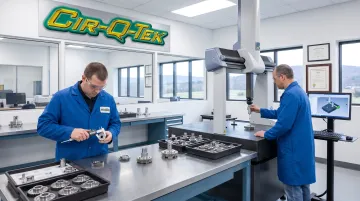
- Secondary quality inspection at its Pennsylvania facility before parts ship to you
What to Evaluate in Any Multi-Axis Partner
Before committing to a supplier for a complex, multi-axis project, check:
- Documented tolerance capability on parts similar to yours, not just a general spec sheet number
- Material expertise relevant to your application (medical-grade alloys, automotive castings, engineered plastics)
- Quality certifications that actually match your industry's regulatory requirements
- Responsiveness during quoting — how quickly they turn CAD data into a workable quote and timeline
Axis count gets the conversation started. Tolerance data, certifications, and turnaround are what actually determine whether a partner can deliver.
Frequently Asked Questions
Is there a 12-axis CNC machine?
Yes, but it typically consists of two combined 6-axis heads rather than one continuous 12-axis motion path. Fully custom machines with 12-plus simultaneous axes exist, but they are rare and built for specific applications.
What is the highest axis CNC machine?
Some multi-spindle turning centers claim well beyond 12 axes by counting sub-spindles, tailstocks, and tool-change functions. The practical "highest" figure depends entirely on how the manufacturer defines and counts an axis.
What is the difference between 5-axis and 12-axis CNC machining?
A 5-axis machine moves a single head through three linear and two rotary directions. A 12-axis system pairs two 6-axis heads, letting you turn and mill simultaneously instead of sequentially.
How much does 12-axis CNC machining cost?
Costs run significantly higher than 5-axis work due to equipment investment, skilled labor, and programming complexity. Pricing is project-specific, so request a quote based on your actual part geometry.
What industries typically use 12-axis CNC machines?
Aerospace, medical device, and automotive manufacturers are the primary users, driven by the need for complex, high-precision parts completed in a single setup.
Can a 12-axis machine mill and turn a part at the same time?
Yes. The dual-head design allows one head to turn while the other mills, cutting total production time compared to running separate turning and milling machines.