Introduction
Walk into a machine shop serving medical, automotive, aerospace, or industrial process control customers today. You'll rarely see a machine that only moves a tool in three straight lines.
Multi-axis CNC machining has become the backbone of precision manufacturing, replacing the old model of flipping and re-clamping parts by hand. The market mirrors that change: the 5-axis CNC machining-center segment alone is projected to grow by $875.4 million at a 6.3% CAGR between 2024 and 2029, according to Technavio's 2025 industry analysis.
Here's the problem: many engineers and buyers treat "multi-axis CNC machining" as one interchangeable capability. It isn't. Axis count changes what geometries are possible, what a part costs, and how long it takes to land on your dock. Get that wrong, and sourcing decisions suffer.
This guide breaks down what multi-axis CNC machining is, how it works stage by stage, and where it delivers the most value.
Key Takeaways
- Multi-axis CNC machines move tools or workpieces along four or more coordinated axes, cutting complex parts in a single setup
- Configurations range from 3-axis (flat, simple parts) to 5-axis and beyond (turbine blades, implants, engine housings)
- Every setup follows the same four stages: programming, cutting, real-time control, and final inspection
- Medical, aerospace, and automotive parts benefit most from the tight tolerances multi-axis machining enables
- The right axis count depends on part geometry and volume — not "more axes equals better"
What Is Multi-Axis CNC Machining?
Multi-axis CNC machining is a subtractive manufacturing process. Computer-controlled tools, workpieces, or both move along four or more coordinated axes (beyond the standard X, Y, and Z linear planes) to remove material and shape a part.
Traditional 3-axis machining only moves in straight lines. To reach a different face, operators have to unclamp the part, flip it, and re-fixture it, sometimes several times per job. Each of those manual repositioning steps introduces:
- Alignment error that stacks with every setup change
- Extra labor hours and machine downtime
- A higher chance of scrapped or reworked parts
Multi-axis machining solves this by adding rotational movement, so the tool or table can reach multiple faces without breaking the original setup.
Multi-Axis vs. Multi-Spindle and Swiss-Style Machining
These terms get mixed up constantly, but they describe different architectures:
- Multi-spindle machining uses several cutting tools running simultaneously at different stations, not additional axes of motion
- Swiss-style turning relies on a sliding-headstock lathe design built for long, slender parts
Either can be combined with multi-axis technology, but neither one is multi-axis machining.
Why It Still Beats Additive Manufacturing for Regulated Parts
Even with 3D printing's growth, multi-axis CNC remains the standard for tight-tolerance, regulated components. NIST research found that additive manufacturing produces rougher surface finishes and lower achievable dimensional tolerances than CNC machining. That gap matters when a part has to seal, mate, or carry a load precisely.
Machine types range from 4-axis to 5-axis, 6-axis, and beyond, but the high-level workflow stays the same: fixture the part, program the toolpath, cut, verify. Each added axis increases reach and complexity, which the sections below break down.
Types of Multi-Axis CNC Machines Compared
Axis count determines how many sides of a part can be machined in one setup. That single variable drives complexity, cost, and cycle time more than almost anything else in the shop.
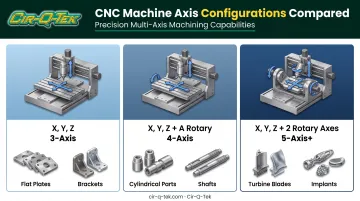
| Configuration | Movement | Best Suited For |
|---|---|---|
| 3-axis | X, Y, Z only | Flat, simple, or 2.5D parts |
| 4-axis | X, Y, Z + one rotary (A-axis) | Cylindrical parts, multi-face holes |
| 5-axis+ | X, Y, Z + two rotary axes | Curved, free-form surfaces |
3-Axis Machining
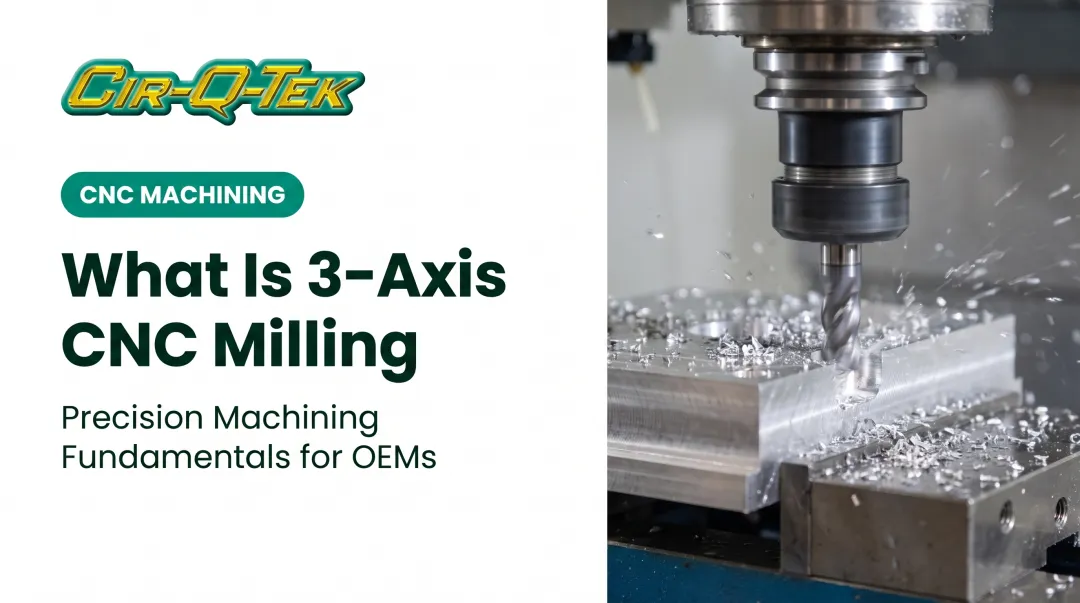
The tool moves along X, Y, and Z only. It's a solid fit for flat, simple, or 2.5D geometries like brackets, plates, and panels.
The limitation shows up fast on anything more complex: machining multiple faces means manually refixturing the part, which adds labor cost and raises the risk of misalignment between setups.
4-Axis Machining
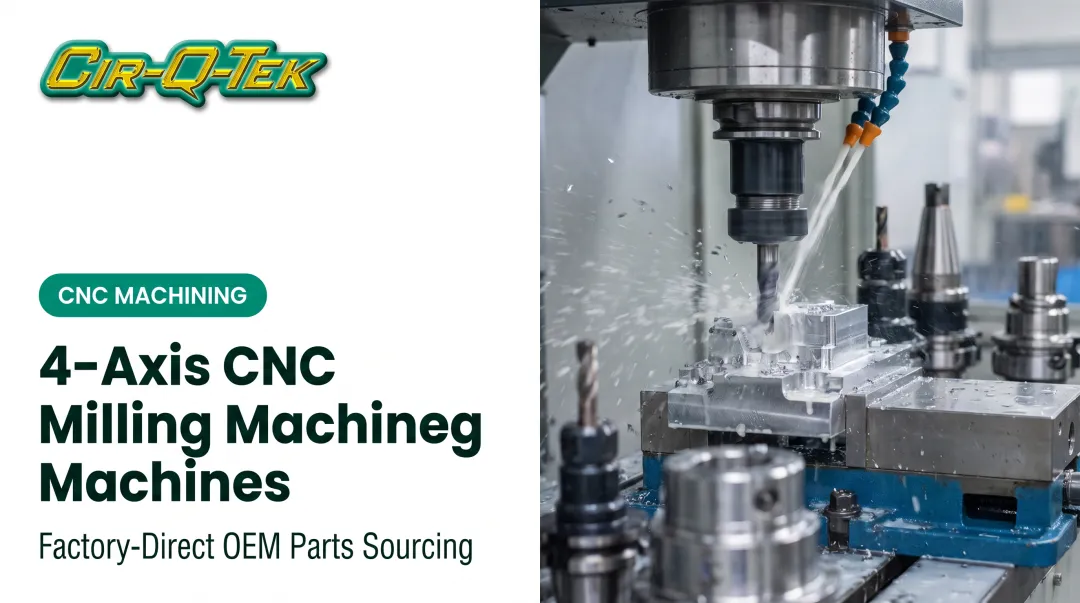
Add an A-axis (rotation around the X axis) and the machine can access multiple faces of a part without manual repositioning. This matters for:
- Cylindrical parts requiring holes drilled on multiple surfaces
- Cam-like components with features around a rotational axis
- Parts needing consistent indexing between features
5-Axis and Beyond
Five-axis machines add two rotary axes to the three linear ones, so the tool can approach complex curved surfaces from nearly any angle in one setup. Turbine blades and medical implants are common examples.
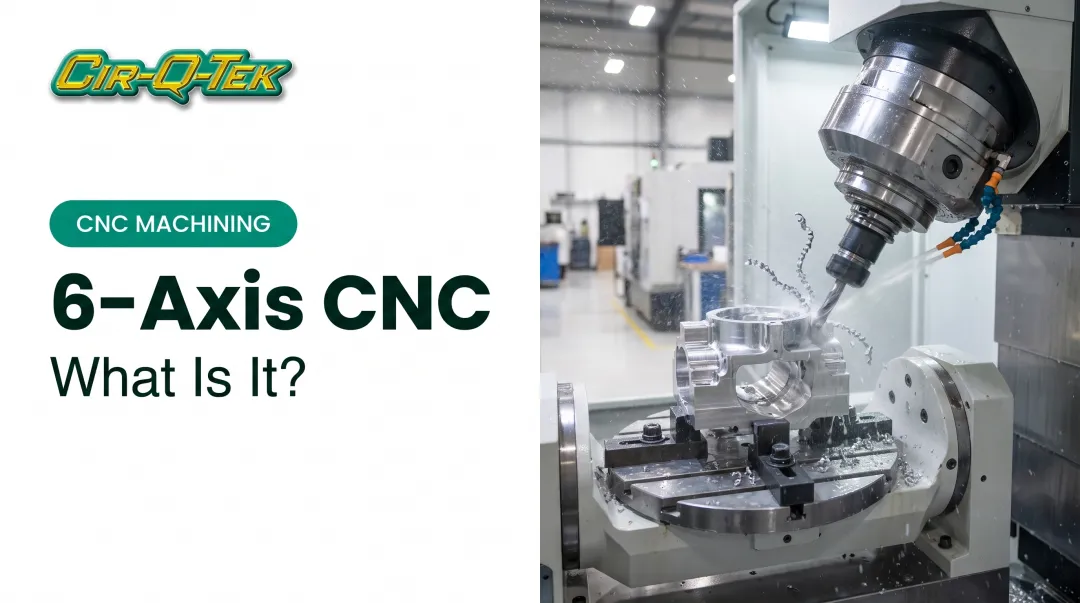
Beyond that, 6-axis and turn-mill (multitasking) machines exist for highly intricate or high-volume work that combines turning and milling operations. These setups demand advanced CAM programming and experienced operators to run well.
Cir-Q-Tek supports multi-axis machining with tolerances as close as ±0.0005", backed by CAD design and CAM programming expertise that helps manufacturers match axis configuration to a part's real complexity.
How Does Multi-Axis CNC Machining Work?
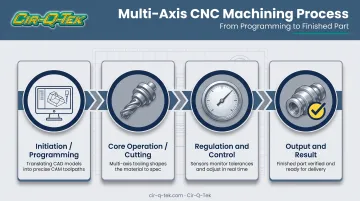
Regardless of axis count, the process follows a defined sequence: setup and programming, cutting, in-process control, and final output.
Initiation
The process starts with a CAD design translated into CAM-generated toolpaths, which a postprocessor converts into machine-specific G-code. The CNC controller then executes that code.
Fixturing — mounting the workpiece — happens once on a multi-axis machine, compared to multiple times on a 3-axis setup. That single difference removes one of the biggest bottlenecks in traditional machining: repeated manual repositioning.
Core Operation
The cutting tool, the workpiece, or both rotate and translate simultaneously to remove material along complex paths, guided by the coordinated axes.
During execution, the spindle engages the material while rotary axes tilt or rotate the part to reach faces a 3-axis machine simply can't hit without stopping. This stage directly drives:
- Cutting speed and cycle time
- Surface finish quality
- Dimensional accuracy achievable in a single setup
Regulation and Control
The CNC controller continuously monitors tool position, spindle load, and feed rate to hold accuracy as cutting conditions change mid-operation.
Corrective mechanisms — real-time calibration, toolpath adjustments, collision avoidance — prevent tool crashes or deviation on complex geometries. Without this control, the simultaneous movements on a multi-axis machine raise the risk of tool breakage or scrapped parts.
Output and Result
The final output is a finished part machined to spec in fewer setups, often with a better surface finish thanks to optimal tool angles that reduce vibration.
Fewer fixturing changes mean fewer accumulated tolerance errors, which cuts downstream inspection and rework. That consistency shows up in measurable outcomes: lower scrap rates and faster time-to-market for complex assemblies.
Where Multi-Axis CNC Machining Is Used
Multi-axis machining fits across the production workflow, from prototyping complex geometries early on to final production of regulated, high-tolerance parts at volume.
It performs best in environments with:
- Tight tolerance requirements where fixturing error isn't acceptable
- Curved or multi-face geometries that a 3-axis machine can't cut in one pass
- Moderate-to-high production volumes where cycle time savings compound
Industries that rely on it most:
- Medical devices: implants and surgical tools with complex curved surfaces and biocompatible materials
- Automotive: engine housings, brackets, and cylinder heads (SME case study on full simultaneous 5-axis)
- Aerospace: turbine blades, blisks, and structural components needing tight geometric control
- Industrial process control: housings and precision components where dimensional consistency affects system performance
Cir-Q-Tek's CNC machining operations run inside ISO 9001, ISO 13485, and IATF 16949 certified facilities. ISO 13485 and IATF 16949 specifically govern medical device and automotive part production.
Conclusion
Multi-axis CNC machining trades setup complexity for part complexity. By reducing manual refixturing, it delivers higher accuracy and fewer errors, exactly what regulated, high-tolerance parts demand.
That understanding should shape how you source. Choose a manufacturing partner with proven multi-axis capabilities, ISO-certified quality systems, and real CAD/CAM expertise so parts come out right the first time.
Cir-Q-Tek's precision CNC machining services combine multi-axis, multi-tasking machinery with live tooling and multiple spindles, holding tolerances as tight as ±0.0005". Offshore-supported pricing comes with domestic quality oversight at our Pennsylvania facility.
If you're weighing axis configurations for an upcoming part, request a quote and get engineering input before you commit to a design.
Frequently Asked Questions
What types of multi-axis CNC machining are available?
Options range from 3-axis and 4-axis machines to 5-axis, 6-axis, and specialized turn-mill setups. The right configuration depends on your part's geometry and tolerance needs—not a one-size-fits-all rule.
What is the difference between 3-axis and 5-axis CNC machining?
3-axis machines move only along X, Y, and Z, requiring manual refixturing to reach multiple faces. 5-axis machines add rotational movement, letting them machine complex geometries in a single setup.
How does multi-axis CNC machining improve part accuracy?
Fewer setups mean fewer chances for misalignment between operations. That translates into tighter tolerances and more consistent parts across a production run.
Which industries benefit most from multi-axis CNC machining?
Medical devices, automotive, and aerospace benefit most, since they need complex, high-tolerance parts produced reliably. Industrial process control components also rely heavily on this capability.
Is multi-axis CNC machining more expensive than 3-axis machining?
Equipment and programming costs run higher, but overall part cost is often lower for complex geometries. Fewer setups mean less labor, less handling, and less scrap across the run.
What tolerances can multi-axis CNC machining achieve?
Tolerances as tight as ±0.0005" are achievable on multi-axis equipment—Cir-Q-Tek holds this capability—though the exact figure depends on material, part geometry, and complexity.