Introduction
Every metal part starts as a decision: melt it into shape, or cut it into shape. Get that call wrong, and you'll find out the hard way: blown budgets, missed launch dates, or a mold that doesn't fit the redesign you needed three months in.
Casting and machining are the two workhorses of metal manufacturing. Each has a different cost curve, lead time, and precision ceiling.
Protolabs and other manufacturing platforms generally place CNC machining in the dozens-to-a-few-thousand-parts range, while die casting starts paying off once volumes climb into the thousands.
This guide breaks down both processes across cost, tolerance, material, and volume, and shows why many manufacturers stop choosing one or the other and start using both together.
Key Takeaways
- Casting molds molten metal into shape; machining cuts it away from solid stock
- High volume favors casting on per-part cost; low volume favors machining for flexibility and speed
- Machining holds far tighter tolerances than standard casting methods
- Hybrid workflows (cast near-net-shape, then machine critical features) deliver the best of both
- Your best fit depends on volume, complexity, tolerance needs, material, and design maturity
Casting vs Machining: Quick Comparison
Here's how the two processes compare side by side.
| Factor | Casting | Machining |
|---|---|---|
| Process type | Formative: molten metal poured into a mold and solidified | Subtractive: material cut away from a solid block |
| Cost structure | High upfront tooling ($20,000-$100,000+ for steel dies), low cost per part at volume | Low setup cost, but per-part cost stays higher as volume grows |
| Best volume | High-volume runs, generally 5,000+ units | Prototyping through a few thousand units |
| Tolerances | Looser standard tolerances; tighter "precision" grades cost more | Tight tolerances as standard, down to a few ten-thousandths of an inch |
| Materials | Metals with predictable melting points: aluminum, zinc, magnesium, iron | Metals, plastics, composites, ceramics; no melting-point limits |
| Surface finish | Often needs secondary finishing (grinding, shot blasting) | Clean finish typically achievable straight off the machine |
A few of these numbers deserve context. Fictiv's manufacturing cost guide notes there's no single break-even volume that applies to every part. The crossover shifts with geometry, material, and finish requirements. Die casting tooling might take weeks to months to cut and qualify, while a machined part can often be cut from a CAD file within hours.
The short version: casting front-loads your investment into tooling and pays it back at scale. Machining skips the tooling entirely but charges more per unit as quantities climb.
What is Casting?
In casting, molten metal is poured into a mold, left to cool, then removed as a finished (or near-finished) part. It's one of the oldest manufacturing methods around, and it's still the go-to choice when a part needs a complex shape at production volume.
Three things make casting economically attractive:
- Near-net-shape production cuts wasted material versus carving a part from solid stock
- Scalability drives per-unit cost down as the mold is reused thousands of times
- Internal cavities and complex geometries form in a single pour, eliminating extra assembly steps
Common Casting Methods
Not all casting is created equal. The main subtypes each trade off differently between cost, finish, and strength:
- Sand casting — flexible and low-cost, best for lower volumes or larger parts, but leaves a rougher surface
- Die casting — high-pressure injection into reusable steel dies, ideal for high-volume aluminum and zinc parts with tighter tolerances than sand casting
- Investment casting — higher strength and reduced porosity, suited to performance-critical parts that can't afford internal defects
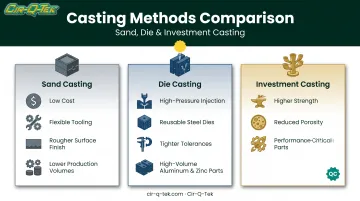
Die casting equipment spans a wide tonnage range. Some shops run machines under 200 tons for miniature connectors and brackets; others run 1,000+ ton presses for large structural automotive and industrial components, sometimes in the same facility.
Use Cases of Casting
Casting earns its place once a design is finalized and volume justifies the mold investment, or when a part needs internal passages or complex shapes that would be impractical to machine from solid.
You'll typically see it in:
- Automotive engine blocks and structural components
- Telecom equipment housings
- Industrial enclosures
- Appliance brackets and mounting hardware
The economics get compelling fast. Die casting specialist Bruschi reports that cycle-time optimization alone can cut production costs by 20-30% or more, on top of the baseline savings from spreading tooling costs across thousands of identical parts. Once you're past the break-even point, casting is genuinely hard to beat on cost per unit.
What is Machining?
Machining flips the process on its head. Instead of pouring metal into a shape, you start with a solid block — metal, plastic, or ceramic — and remove material with cutting tools until you're left with the finished part. It's a subtractive process, whether it's run manually or, more commonly today, on a CNC (computer numerical control) system.
Three practical advantages come with that approach:
- Material integrity stays intact since nothing melts, avoiding casting defects like porosity or shrinkage
- Design changes cost far less because there's no mold to modify or scrap
- Tight tolerances and clean finishes come standard, cutting down on secondary finishing work
CNC Machining Subtypes
Different operations suit different geometries:
- Milling — rotating cutting tools shape flat or contoured surfaces
- Turning — the part spins while a stationary tool cuts, ideal for cylindrical shapes; multi-axis, multi-tasking setups can often finish a part in one run
- Drilling — creates precise holes for fasteners or fluid paths
- Grinding — a final finishing pass for the tightest surface requirements
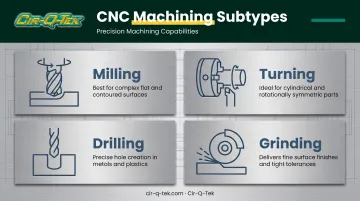
Modern precision CNC equipment can hold tolerances as tight as a few ten-thousandths of an inch — Cir-Q-Tek's shop, for example, quotes as close as ±0.0005" on critical features, though the achievable number always depends on material and geometry. That level of control makes CNC machining the default whenever alignment and fit genuinely can't slip.
Use Cases of Machining
Machining shines in three scenarios: prototyping, low-to-mid volume production, and finishing critical features on parts that started life as a casting or forging.
Typical applications include:
- Medical device components requiring documented, repeatable precision
- Aerospace parts where tolerance stacking isn't an option
- Precision automotive assemblies
- Electronics housings needing fine-tolerance fits
The speed advantage is real. Protolabs notes that machined parts can be produced within hours of finishing a CAD model, which is why teams often machine, test, and redesign a part several times before committing to a casting die and its tooling cost.
Casting vs Machining: Which One Should You Choose?
There's no universal winner here — the right call depends on how several factors line up for your specific part.
Weigh these together:
- Production volume — thousands of units favors casting; dozens to low-thousands favors machining
- Part complexity — internal cavities and complex 3D geometry favor casting; precision features favor machining
- Tolerance and finish requirements — tight tolerances point toward machining, or machining as a finishing step
- Material — casting needs predictable melting points; machining works across nearly anything solid
- Design maturity — early-stage, changing designs favor machining's zero-tooling flexibility
The Hybrid Approach
In practice, plenty of manufacturers stop treating this as an either/or decision. They cast the bulk of a part to near-net shape, then machine only the features that need tight tolerances — bearing bores, mounting faces, sealing surfaces.
The Steel Founders' Society documented exactly this shift with a redesigned steel snubber arm. Moving from a fabricated-and-machined design to a near-net-shape casting finished with targeted machining delivered 46% unit cost savings, a 40% cut in machining time and cost, and a 15% weight reduction — without sacrificing the tight tolerances the part needed.
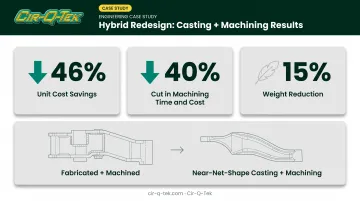
That's the pattern worth remembering: the savings don't come from eliminating machining. They come from casting closer to the final shape so there's simply less material to cut away.
When the hybrid path makes sense, the machining step still has to hit spec. Cir-Q-Tek provides precision CNC machining rated to ±0.0005" under ISO 9001, ISO 13485, and IATF 16949 certified processes — suited to finishing cast near-net shapes or producing fully machined parts when casting isn't the right fit.
If you're weighing casting against machining for an upcoming part, request a quote and get input from a team that machines these parts daily.
Conclusion
Neither casting nor machining is the "better" process in any general sense. Casting wins on cost at volume and handles complex geometry in a single step. Machining wins on precision, material flexibility, and the freedom to change your design without touching a mold.
For many production parts, the smartest path is hybrid: cast the rough shape, then machine the features that must be perfect.
Before you commit, score your part against these factors:
- Volume — tool cost amortization and per-part economics
- Complexity — internal geometry, undercuts, and near-net shape needs
- Tolerance — which surfaces truly need tight precision
- Material — castability versus full alloy and grade flexibility
- Design maturity — how likely the design is to change
Those five inputs drive cost, lead time, and whether production stays reliable as the design evolves. Choose casting, machining, or both based on that score—not on a generic rule.
Frequently Asked Questions
What is machining?
Machining is a subtractive manufacturing process that uses cutting tools (manual or CNC-controlled) to remove material from a solid block until it reaches a precise final shape.
Is casting cheaper than machining?
Casting is generally cheaper per part at high volumes once the mold cost is amortized, typically past a few thousand units. Machining is more cost-effective for smaller runs since it skips tooling entirely.
Can casting achieve tight tolerances like machining?
Standard casting tolerances are looser than machining. Parts needing tight-tolerance features usually get those features finished with a secondary CNC machining step.
What industries use both casting and machining together?
Automotive, aerospace, medical device, and industrial equipment manufacturers commonly combine casting and machining, casting bulk geometry and machining critical features.
How do I know if my part should be cast or machined?
Look at production volume, part complexity, tolerance requirements, material, and how finalized your design is. High volume and finalized design lean casting; tight tolerances or evolving designs lean machining.
What is the difference between casting and forging?
Forging shapes solid metal using compressive force, while casting pours molten metal into a mold to solidify. Both differ from machining, which removes material rather than shaping it.